


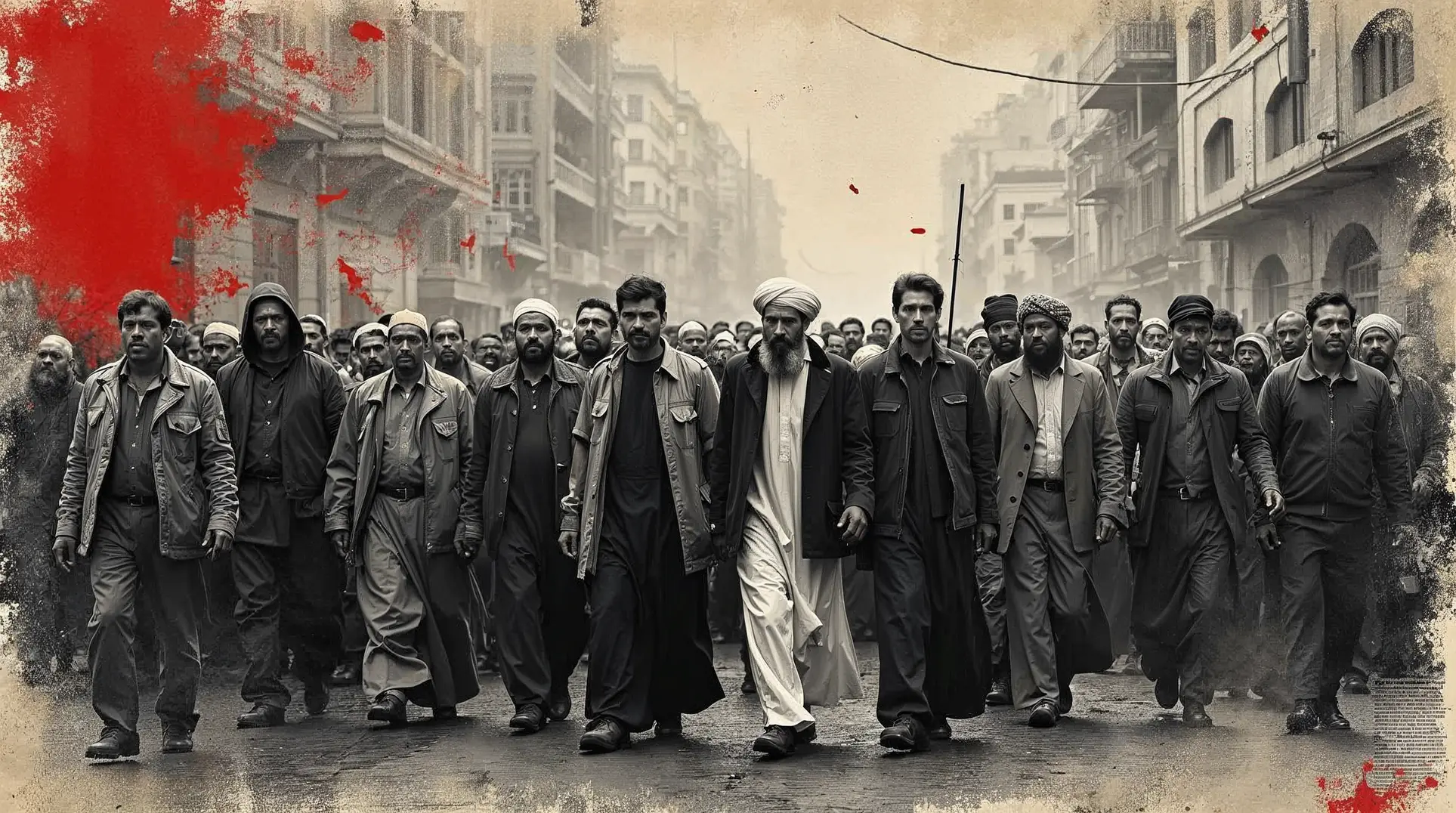
When Tehran's Grand Bazaar merchants shuttered their shops on December 28, they weren't just protesting the rial's latest collapse. They were withdrawing support from a revolution they helped create. Four decades after bazaaris bankrolled Ayatollah Khomeini's ascent, their strikes against currency devaluation have evolved into a nationwide movement demanding the regime's end. The government's simultaneous offers of dialogue and deployment of tear gas reveal a state trapped between its legitimating rhetoric and its authoritarian reality.
What distinguishes these demonstrations from previous economic protests is the speed with which they've transcended material grievances. Within days, chants shifted from complaints about bread prices to explicit calls for regime change—"Death to the dictator," "We don't want an Islamic Republic." The participation of university students alongside traditional merchants signals something more dangerous to the establishment than isolated unrest: the formation of a cross-class opposition that mirrors the revolutionary coalition of 1979, now turned against its creation.
Economic Collapse as Political Rupture
The numbers sketch a portrait of systemic failure. The rial has plummeted to approximately 1.4 million per US dollar, losing nearly half its value in 2025 alone. Inflation officially stands at 42.2 percent, but food price inflation has surged past 72 percent. For ordinary Iranians, this translates to a daily calculus of which necessities to forgo. The Central Bank chief's resignation mid-crisis underscores the government's inability to manage economic fundamentals even as it pours resources into regional proxy networks and nuclear development.
But focusing solely on these statistics misses the structural dimension. Iran's economic crisis isn't primarily a technical failure of monetary policy—it's the logical endpoint of a political economy built on revolutionary legitimacy rather than productive capacity. The Islamic Revolutionary Guard Corps controls an estimated 40 to 60 percent of the economy through front companies and quasi-governmental foundations, crowding out private enterprise while operating beyond regulatory oversight. This system enriches regime insiders while suffocating the bazaar merchants and small manufacturers who once formed the revolution's economic backbone.
The regime has consistently prioritized ideological projects over domestic welfare. Billions flow to Hezbollah, Hamas, and Syrian President Bashar al-Assad while Iranian cities suffer water shortages and infrastructure decay. Supreme Leader Ali Khamenei frames this as "resistance economy," portraying external sanctions as the sole cause of hardship. Yet international pressure has merely exposed vulnerabilities the regime created through its own choices: backing proxies across the region, pursuing nuclear weapons development, and maintaining an economy structured around patronage rather than productivity.
Members are reading: Analysis of how the regime's foundational social contract has terminally decomposed, leaving only coercion as a governing tool.
Navigating State Failure's Next Phase
The Islamic Republic now confronts a legitimacy crisis it cannot resolve through its available tools. Economic reforms would require dismantling the IRGC's commercial empire, challenging the core power structure. Political concessions would invite further demands the system cannot accommodate without ceasing to be itself. Increased repression may restore order temporarily but deepens the regime's isolation from the society it claims to represent.
The comparison to the 2022 Mahsa Amini protests is instructive. Those demonstrations achieved unprecedented scale and duration but remained concentrated among younger, urban, and more secular demographics. The current movement's incorporation of bazaar merchants—the revolution's original financial backbone—represents a more existential threat. When a regime's founding constituencies abandon it, structural transformation becomes inevitable.
International actors will shape the trajectory ahead. Trump's backing for potential Israeli strikes on Iranian missile facilities and Netanyahu's pursuit of American support for broader military action could either accelerate the regime's collapse or provide the external enemy narrative it needs to justify further repression. What remains clear is that the Islamic Republic can no longer deliver on the promises that once justified its authority. The bazaar's betrayal signals not just another protest cycle, but the architecture of a state consuming itself from within.
Subscribe to our free newsletter to unlock direct links to all sources used in this article.
We believe you deserve to verify everything we write. That's why we meticulously document every source.


