


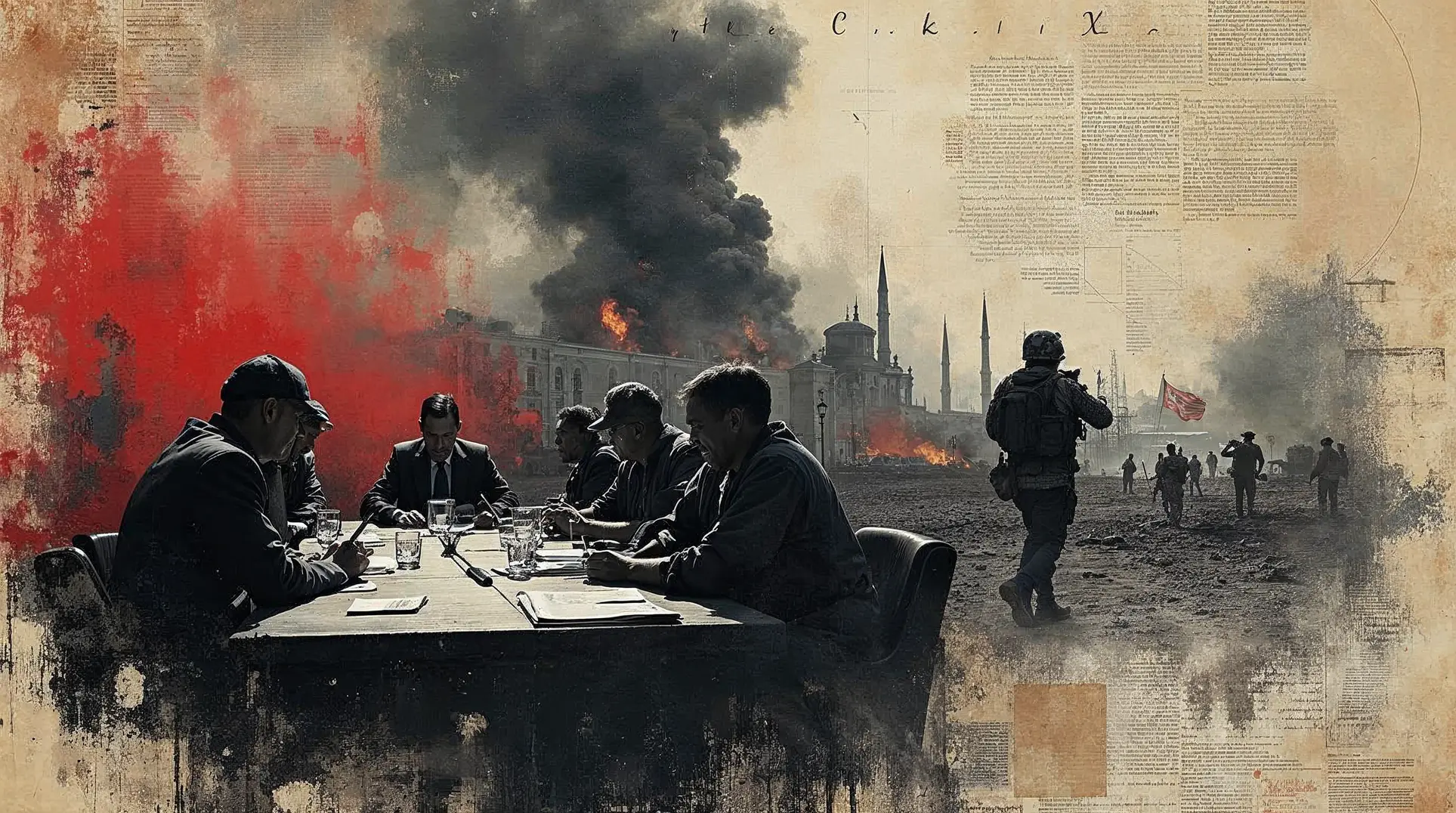
President Volodymyr Zelensky's unveiling of a revised 20-point peace plan, developed in coordination with the Trump administration, marks a pivotal moment in the Ukraine conflict—not because peace is suddenly achievable, but because it exposes the brutal calculus that now governs the negotiating table. The Kremlin's confirmation that President Vladimir Putin is reviewing the proposal signals tactical engagement, but the strategic reality remains unchanged: this is a negotiation shaped fundamentally by battlefield positions, not diplomatic aspirations. The question is not whether the parties want peace, but whether the deal on offer serves their core national interests better than continued war.
The revised plan represents Ukraine's attempt to salvage strategic autonomy from an initially disastrous 28-point draft that heavily favored Russian demands. Yet the core compromises—on territorial control in Donetsk and the fate of the Zaporizhzhia nuclear plant—remain unresolved friction points that no amount of diplomatic language can reconcile. Russia's simultaneous intensification of drone and missile strikes on Ukrainian energy infrastructure while reviewing peace proposals reveals Moscow's true strategy: negotiate from a position of maximum military pressure, using talks as an adjunct to warfare rather than an alternative.
From 28 to 20 points: Ukraine's damage control
The evolution from the original 28-point draft to the current 20-point framework tells a revealing story about the negotiating dynamic. Kyiv successfully eliminated some of the most egregious concessions that would have formalized Russian gains while offering little in return. The introduction of concepts like "potential free economic zones" for contested areas represents calculated semantic maneuvering—creating ambiguity where clarity would expose irreconcilable positions.
But this is damage control, not victory. The fundamental tension remains: Ukraine insists on sovereignty and territorial integrity as non-negotiable principles, while Russia demands recognition of its conquests as the price of any settlement. The proposal to freeze front lines and establish demilitarized zones does not resolve this contradiction; it merely postpones the reckoning. From a realist perspective, such arrangements historically succeed only when backed by credible enforcement mechanisms and mutual exhaustion—neither of which currently exists.
The Ukrainian withdrawal from Siversk provides essential context. This wasn't a tactical repositioning; it was a strategic retreat from a town that held symbolic and operational significance. Europe's frantic efforts to revise Trump's approach before key deadlines underscore the recognition that Ukraine's negotiating position weakens with each lost position. Moscow understands this dynamic perfectly, which explains why it talks while simultaneously attacking.
Members are reading: Why Putin's review of the peace plan reveals Moscow's calculation to exploit Trump's legacy priorities and extract maximum concessions.
The Trump factor and credibility costs
President Trump's role as mediator introduces a distinct dynamic that cuts against Ukraine's interests. His publicly stated desire to be a peacemaker, combined with skepticism about continued U.S. support for Kyiv, creates asymmetric pressure on the parties. Ukraine faces the prospect of losing American backing if it refuses a deal Trump considers reasonable; Russia faces no equivalent penalty for intransigence.
This imbalance has not gone unnoticed in European capitals, where the fear is that a hastily concluded agreement will sacrifice Ukraine's long-term viability for a short-term diplomatic win. The transatlantic security architecture depends on the principle that borders cannot be changed by force—a principle this negotiation directly challenges. If the United States brokers a deal that essentially ratifies Russian conquest, the implications extend far beyond Ukraine to every alliance commitment and security guarantee Washington has made.
Conclusion: the unstable geometry of forced compromise
The 20-point plan will likely evolve further as Moscow formulates its response, with each iteration testing the limits of what Ukraine can be pressured to accept and what Russia believes it can extract. The fundamental problem remains: this is not a negotiation between parties seeking mutually beneficial compromise, but a contest between incompatible strategic objectives conducted under the shadow of ongoing violence.
Any deal emerging from this process will be inherently unstable, satisfying neither side's core interests while creating new tensions around implementation and enforcement. The Kremlin's review of Trump's proposal is not a step toward genuine peace—it is the next move in a longer game where military capabilities and resolve matter more than diplomatic assurances. The strategic reality is that conflicts end when one side prevails or both exhaust themselves; neither condition yet applies.
Subscribe to our free newsletter to unlock direct links to all sources used in this article.
We believe you deserve to verify everything we write. That's why we meticulously document every source.


