


The American Merops counter-drone system is being deployed across NATO's eastern flank, marking the alliance's latest institutional response to a documented pattern of Russian airspace violations that have escalated throughout 2025. Poland, Romania, and Denmark will field the compact, AI-powered technology that can identify and neutralize unmanned aerial systems even when satellite and electronic communications are jammed—a capability designed explicitly to counter the hybrid warfare tactics Moscow has employed with increasing frequency against NATO territory.
The deployment responds to concrete security challenges. In September 2025, 21 Russian drones violated Polish airspace in a single mass incursion, forcing Warsaw to scramble expensive fighter jets against low-cost aerial platforms. Romania has experienced repeated drone breaches linked to Russian operations in Ukraine's Black Sea theater. These incidents represent more than navigational errors or collateral damage from the war next door—they constitute a pattern that NATO officials describe as deliberate testing of alliance readiness and political cohesion. The Merops system offers an asymmetric answer: portable enough to fit in a midsize pickup truck, yet sophisticated enough to operate autonomously when adversaries attempt electronic warfare countermeasures.
The question now facing NATO planners extends beyond technological capability to strategic coherence: can distributed counter-drone deployments deter further Russian probing, or will Moscow interpret defensive measures as validation that hybrid escalation below the Article 5 threshold remains effective? And perhaps more critically, how does the alliance balance the imperative to defend sovereign airspace with the risk that each new defensive capability might be read by Moscow as offensive preparation?
The institutional logic of counter-drone deployment
NATO's selection of Merops reflects organizational learning from Ukraine's drone warfare laboratory. The system's proven operational success in Ukrainian service provides empirical validation that resonates within alliance defense planning structures, where procurement decisions require demonstrable capability rather than theoretical promise. The technology's capacity to function under electronic warfare conditions addresses a specific vulnerability that Russian military doctrine has exploited: the assumption that jamming GPS and communication links would render Western precision systems ineffective.
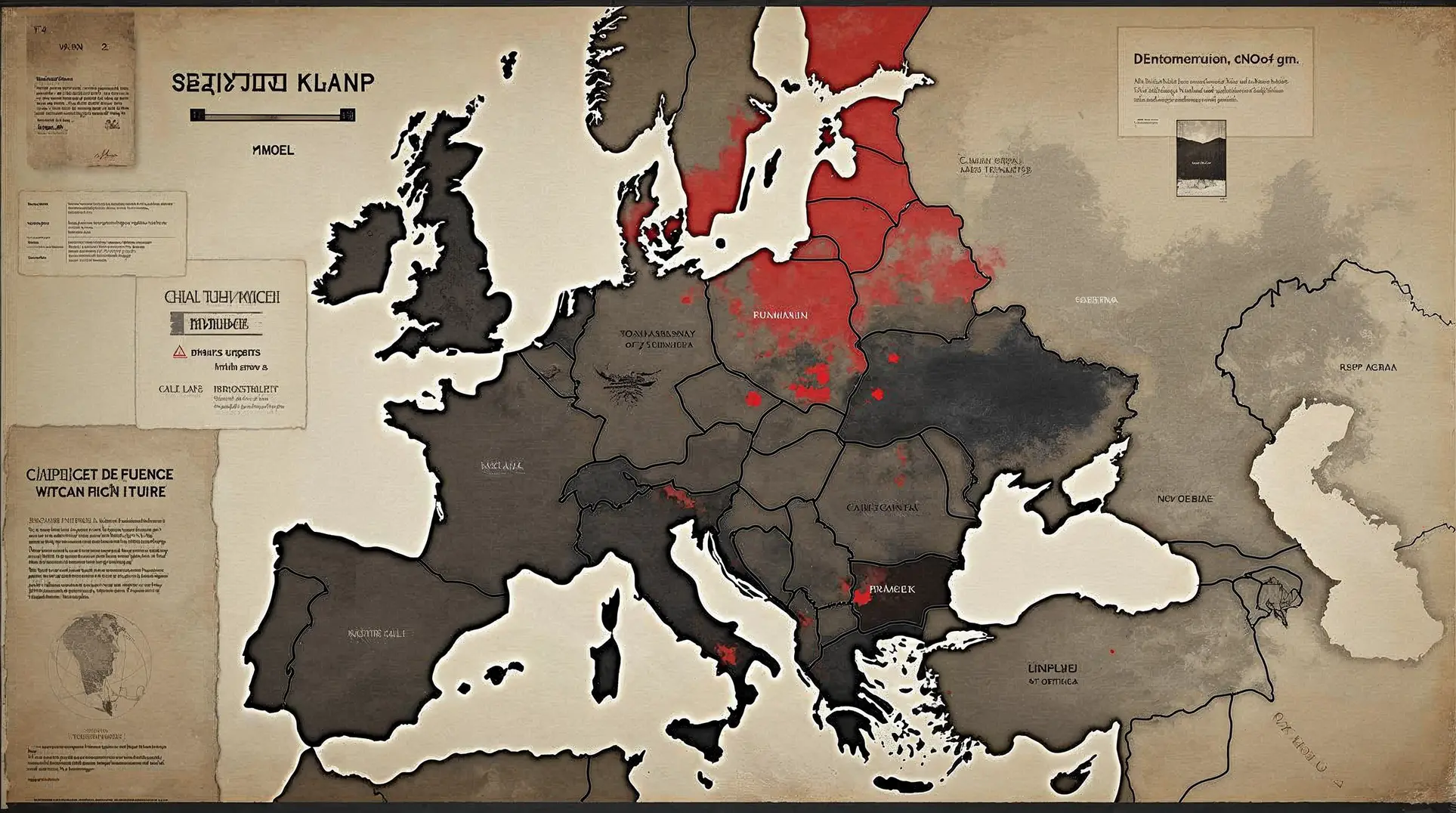
The deployment pattern—Poland, Romania, Denmark—reveals the alliance's geographic prioritization. Poland anchors the central European corridor where the Baltic fortress concept depends on rapid reinforcement capability. Romania guards the Black Sea approaches and has absorbed repeated drone incursions as spillover from Russia's naval campaign against Ukrainian grain exports. Denmark's inclusion signals Nordic integration into eastern flank defense following Finland and Sweden's NATO accession, extending the defensive perimeter from the Baltic to the North Sea.
This geographic distribution supports NATO's "Eastern Sentry" air surveillance mission, announced as part of the alliance's broader response to persistent airspace violations. Eastern Sentry represents an institutional acknowledgment that peacetime air policing—adequate for managing occasional civilian aviation incidents—proves insufficient against deliberate hybrid operations designed to probe response times, test political unity, and gather intelligence on defensive capabilities.

Members are reading: How Merops' cost-effectiveness inverts drone warfare economics and why NATO's layered defense timeline reflects institutional caution about technological dependencies.
The escalation pattern and attribution challenges
Russian drone incursions into NATO territory follow a pattern consistent with hybrid warfare doctrine: sufficient to demonstrate capability and test responses, yet calibrated to remain below thresholds that would compel alliance-wide military reaction. The September 2025 mass incursion of 21 drones into Polish airspace represents the most brazen example, but the documented incidents extend across the eastern flank with troubling consistency.
Romania's repeated airspace violations coincide geographically with Russian naval operations against Ukrainian grain shipments and attacks on port infrastructure. Moscow maintains these are navigational errors caused by Ukrainian jamming systems, creating plausible deniability while achieving intelligence objectives. Each violation maps NATO response times, identifies radar coverage gaps, and tests political cohesion between frontline states and alliance headquarters.
The Baltic states—Estonia, Latvia, Lithuania—have documented similar patterns, including a notable incident where Russian MiG-31 fighters violated Estonian airspace. These violations serve multiple purposes: they remind populations of Russian military proximity, they pressure governments to divert resources to air defense, and they create incremental normalization of sovereignty violations that may facilitate more aggressive future actions.
Attribution, however, remains contested terrain. While NATO officials characterize the incursions as Russian operations, some technical assessments acknowledge that drone origins cannot always be definitively traced to Russian forces versus Ukrainian operations or even third parties. This ambiguity serves Russian strategic interests by complicating alliance decision-making about proportional responses and creating space for information operations that blame NATO enlargement for creating tensions.
The institutional challenge NATO faces resembles the dilemma confronted in cyberspace: how to respond to attacks designed to remain below Article 5 thresholds while cumulatively degrading security. The alliance's response—technological deployment of systems like Merops rather than military escalation—represents the institutional preference for defensive measures that minimize escalation risks while demonstrating resolve.
Members are reading: How the Ukraine war's drone laboratory shapes NATO procurement in real-time and why the multi-year deployment timeline creates vulnerability windows Moscow may exploit.
The institutional realist assessment
The Merops deployment represents NATO functioning as it was designed: as a coordination mechanism that identifies shared threats, pools resources, and deploys capabilities to reinforce deterrence. The eastern flank faces a documented pattern of airspace violations that individual member states cannot efficiently counter in isolation. The alliance provides the framework for sharing cost-effective technology developed in one theater (Ukraine) and deployed to defend collective territory.
Yet institutional effectiveness depends on shared threat assessment and political will to sustain defense spending over multi-year timelines. The gap between frontline states' acute threat perception and western European allies' more distant concerns about Russian intentions creates persistent tension. Merops and similar deployments partially bridge this gap by providing tangible evidence of alliance commitment to territorial defense, but they cannot substitute for the political cohesion that collective defense ultimately requires.
The technological dimension of this competition will continue to accelerate. Drone warfare evolution in Ukraine has compressed development cycles that once required years into months. NATO's procurement and deployment processes, designed for deliberate decision-making and consensus-building, struggle to match this pace. The Merops deployment timeline—multi-year even for a relatively simple truck-mounted system—illustrates the institutional constraint.
Russia's hybrid warfare doctrine exploits precisely this asymmetry. Moscow can rapidly deploy or modify tactics—whether drone incursions, cyber operations, or disinformation campaigns—while NATO must navigate consensus-building processes that involve 32 member states with divergent threat perceptions and domestic political constraints. Counter-drone technology provides tactical answers, but the strategic challenge involves institutional adaptation to operating tempos that favor agile adversaries over consensus-based alliances.
The eastern flank will remain contested space where Russian probing operations test NATO cohesion and capabilities. Each technological deployment like Merops represents one move in an extended strategic competition where neither side seeks direct military confrontation but both continuously probe for advantages. The alliance's ability to sustain this competition depends less on any individual capability than on maintaining political unity and resource commitment across countries with very different relationships to Russian power.
For Poland, Romania, and the Baltic states, Russian proximity represents an existential security challenge requiring permanent vigilance. For France, Spain, or Portugal, eastern flank tensions compete for attention with Mediterranean migration, Sahel instability, or economic priorities. NATO's institutional machinery exists to reconcile these different perspectives into coherent policy, but the reconciliation process creates delays and compromises that tactical situations sometimes do not accommodate.
The Merops deployment will deter some Russian drone incursions by raising the operational cost of airspace violations. It will not eliminate the fundamental strategic challenge: how to defend alliance territory against hybrid operations designed to probe, test, and potentially create pretexts for escalation, all while maintaining both defensive credibility and avoiding the overreaction that Moscow could exploit for propaganda purposes. This is the institutional tightrope that NATO has walked since 2014, and the counter-drone deployments represent the latest step along that narrow path.
The question is whether technology can substitute for political will indefinitely, or whether the accumulation of violations, provocations, and hybrid operations will eventually force starker choices about deterrence and escalation. Until then, truck-mounted counter-drone systems will patrol the eastern approaches, autonomous algorithms will identify and track incoming aerial threats, and alliance defense planners will continue the perpetual adaptation to adversaries who innovate as rapidly as defenders deploy countermeasures.
Subscribe to our free newsletter to unlock direct links to all sources used in this article.
We believe you deserve to verify everything we write. That's why we meticulously document every source.


