




- Russian hybrid operations—airspace violations, GPS jamming, migration weaponization—are systematic intelligence gathering for NATO's crisis response architecture
- NATO's shift from tripwire to brigade-level denial forces represents permanent militarization of Europe's eastern frontier for decades to come
- Critical infrastructure vulnerabilities—Russian-gauge railways, inadequate bridges, exposed ports—undermine NATO's rapid reinforcement strategy in the Baltics
The airspace violation lasted twelve minutes. On September 19, three Russian MIG-31 fighter jets pierced Estonian airspace over the Gulf of Finland, ignoring warnings from NATO F-35s scrambled to intercept. Tallinn's response was swift and unambiguous: invoking Article 4 of the North Atlantic Treaty and demanding an emergency UN Security Council briefing. Moscow's retort? A bland denial, claiming their aircraft never left international waters. It was textbook Russian gaslighting—and a crystallizing moment for what has become the new reality along Europe's most volatile border.
What we're witnessing in the Baltic Sea region isn't merely a military build-up. It's the construction of a modern-day Maginot Line—a vast, technologically sophisticated defensive architecture being erected at breakneck speed in response to an adversary that has abandoned any pretense of restraint. Over the past two months alone, Russian forces have violated Estonian airspace, sent nineteen drones into Polish territory, and buzzed Romanian airspace with attack UAVs. These aren't accidents or navigational errors. They're probes—testing NATO's reflexes, mapping response times, identifying gaps in coverage.
The West's answer has been emphatic: Operation Eastern Sentry, the rapid expansion of Enhanced Forward Presence battlegroups to brigade-level formations, and a Baltic Defence Line of fortifications snaking along the Russian and Belarusian borders. But here's the question that should trouble policymakers in Brussels and Washington alike: Are we building deterrence, or are we constructing the infrastructure for the next major European war?
The Russian calculus: Hybrid escalation as statecraft
To understand the militarization now reshaping the Baltic frontier, you must first grasp Moscow's strategic logic. Russia doesn't see NATO's eastern enlargement—particularly Finland and Sweden's accession—as a defensive measure. It views it as an existential threat requiring military response. The reintroduction of the Leningrad Military District in February 2024 wasn't administrative housekeeping; it was a signal that Russia's North-Western strategic direction is now a priority theater.
Russian military thinking, gleaned from academic journals and defense commentators, is alarmist and aggressive. NATO's transformation of the Baltic Sea into what some analysts now call "NATO's Lake" has triggered what Moscow perceives as encirclement. The response has been multifaceted and relentless: GPS jamming that disrupts civilian aviation, suspected sabotage of critical infrastructure like the Baltic connector pipeline and Estlink 2 cable, and the weaponization of migration flows against Finland, Latvia, Lithuania, Norway, and Poland.
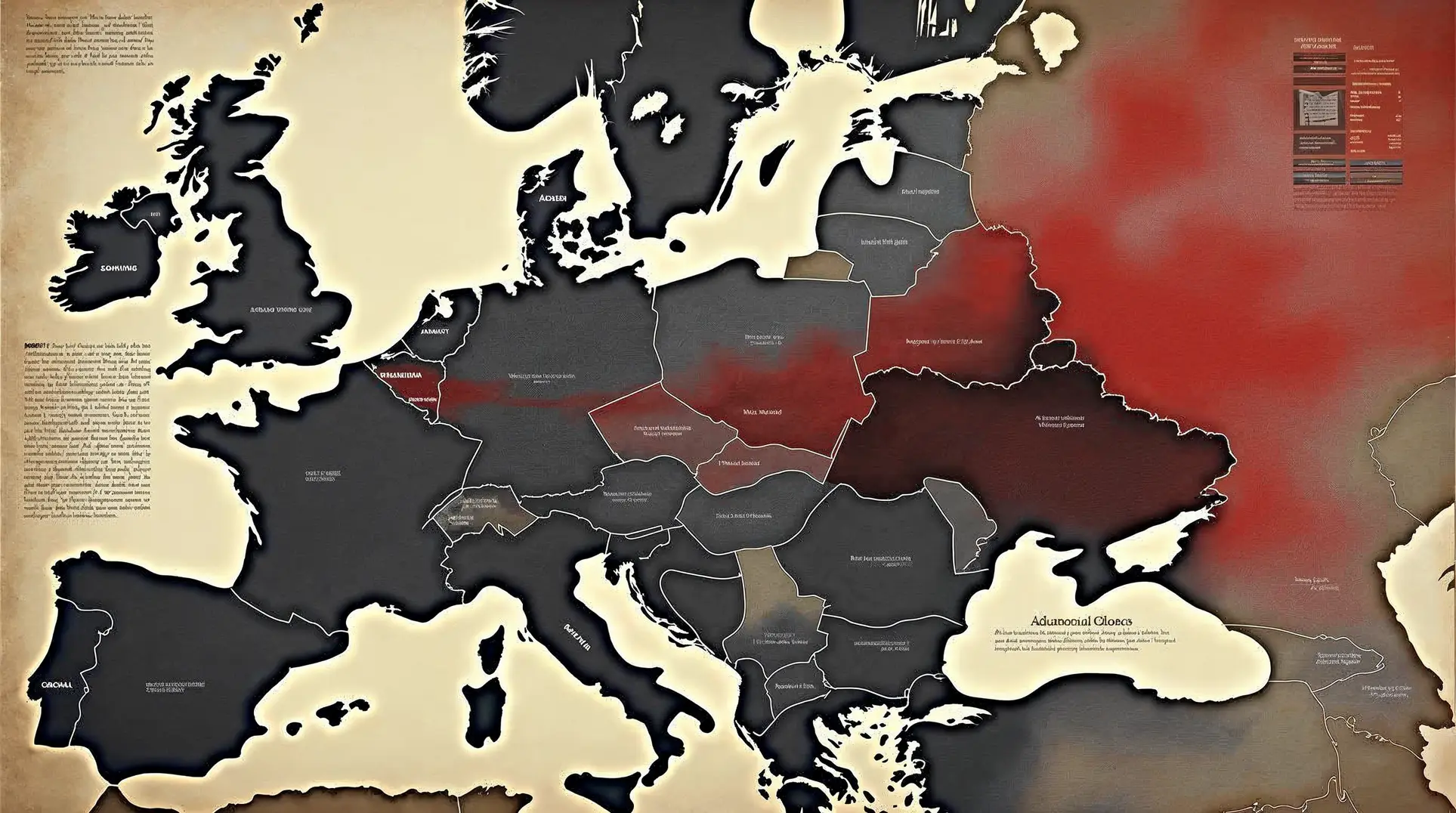
REVEALED: Moscow's chilling playbook—how each airspace violation, GPS jam, and migration surge is actually intelligence gathering for the invasion scenario NATO fears most. The war game is already underway.
NATO's response: From tripwire to fortress
The Alliance's counter-build has been impressive in scale, if lagging in speed. The Enhanced Forward Presence concept, introduced after Russia's 2014 Crimea annexation, originally deployed battalion-sized battlegroups to Estonia, Latvia, Lithuania, and Poland—roughly 1,000 troops each, sufficient as a political tripwire but militarily insignificant against a determined Russian assault. That calculation has fundamentally shifted.
Estonia now hosts a UK-led battlegroup expanding toward light brigade strength—approximately 4,000-5,000 troops—with the British committing to maintain forces on standby for rapid deployment from July 2025 onward. Pre-positioned equipment and ammunition stocks are being established, dramatically reducing the time required to achieve full operational capability. American forces, including elements of the 5-7 Cavalry Regiment, operate from REEDO base in close proximity to the Russian border, conducting constant readiness drills.
Latvia's NATO Multinational Battlegroup formally transitioned to brigade command in October. Canada, the framework nation, is increasing its presence to 2,200 personnel by 2026, with substantial Danish and Swedish contributions. Lithuania received perhaps the most significant commitment: Germany's September agreement to establish a permanent brigade—the 45th Armoured Brigade, known as "Brigade Lithuania"—expected to reach full mission capability by 2027. This represents the first permanent deployment of German combat forces on NATO's eastern frontier since reunification, a historically momentous development that Berlin approached with characteristic caution before ultimately committing.
These brigade-level formations represent a doctrinal shift from deterrence by punishment to deterrence by denial. The original EFP concept accepted that Baltic states couldn't be defended conventionally; instead, the presence of NATO forces guaranteed Alliance involvement in any conflict, making aggression prohibitively costly politically. The new posture aims to make Russian aggression prohibitively costly *militarily*—creating sufficient combat power to blunt an initial assault and buy time for reinforcements flowing through the Suwałki corridor.
But combat power means nothing without the infrastructure to sustain it. This is where Host Nation Support becomes critical—and where vulnerabilities persist.
The fatal flaw nobody's talking about: Why NATO's bridges can't handle its own tanks, railways run on Russian gauge, and ammunition depots are sitting ducks. The logistics nightmare that could lose the war before it starts.
The Swedish and Finnish advantage: Changing Baltic geometry
The accession of Finland and Sweden to NATO in 2023-2024 fundamentally altered the strategic geometry of the Baltic Sea. What was once a contested maritime space where Russian naval and air forces operated with relative freedom has become, in a remarkably short time, largely enclosed NATO territory. This shift cannot be overstated.
Finland brings 830 miles of border with Russia and a defense establishment that never abandoned Cold War readiness principles. Finnish forces maintained conscription, territorial defense structures, and a national mindset oriented toward Russian threats long after Western European nations pursued peace dividends. Sweden contributes advanced submarine warfare capabilities, sophisticated signals intelligence infrastructure, and—critically—the remilitarization of Gotland island, which sits astride key Baltic Sea lanes and provides surveillance coverage of Russian naval movements.
Together, these additions give NATO the ability to conduct sea denial operations throughout the Baltic, complicating Russian naval operations and potentially isolating Kaliningrad in a conflict scenario. They also provide strategic depth that the Baltic states desperately lack. Estonia, Latvia, and Lithuania are small states with limited territory for defense-in-depth operations; a Russian breakthrough could reach national capitals in hours. Finland and Sweden provide fallback positions, alternative logistics routes, and additional mobilization base—transforming NATO's strategic position from precarious to sustainable.
Yet this advantage carries its own risk. From Moscow's perspective, the Baltic is no longer a buffer space but an enclosed NATO lake threatening Russia's northwest approaches. This perception drives escalatory behavior. Russia's hybrid operations—the airspace violations, the infrastructure sabotage, the migration weaponization—can be understood as attempts to reassert contested status over a region Moscow sees slipping decisively into adversarial control.
The fortification imperative: Baltic Defence Line and East Shield
Perhaps the most visible manifestation of the new Baltic reality is the construction of the Baltic Defence Line—a fortified barrier system running along Estonia's, Latvia's, and Lithuania's borders with Russia and Belarus. This isn't a continuous Maginot-style wall but a network of anti-tank obstacles, surveillance systems, and pre-prepared defensive positions designed to channel, slow, and disrupt mechanized incursions.
The concept reflects lessons from Ukraine, where prepared defensive positions—trenches, tank traps, minefields—proved remarkably effective at degrading Russian mechanized assaults even when defenders were outnumbered. The Baltic states, which would face precisely such numerical disadvantages in any conflict, are applying these lessons prophylactically. The goal isn't to make their borders impermeable—no static defense can achieve that—but to buy time for NATO reinforcements to arrive and for mobile defense forces to position themselves.
Complementing physical fortifications are the societal resilience measures the Baltic states have implemented. All three have tightened integration requirements for Russian-speaking populations, imposing stricter language requirements, security vetting, and loyalty expectations. This might seem harsh by Western European standards, but Baltic policymakers view their Russian-speaking minorities—roughly 25% of Estonia and Latvia's populations—as potential vectors for Russian hybrid operations.
Moscow has consistently leveraged ethnic Russian populations in neighboring countries as instruments of influence and destabilization. The "compatriots" doctrine, embedded in Russian foreign policy, positions ethnic Russians abroad as Moscow's responsibility—a pretext that justified interventions in Georgia, Ukraine, and Moldova. Baltic leaders, acutely aware of this history, are preemptively closing vulnerabilities. It's ruthlessly pragmatic, reflective of the high-stakes environment they inhabit.
The Suwałki problem: NATO's unreinforced Achilles
All the brigade deployments, infrastructure investments, and defensive fortifications in the world cannot eliminate the Baltic states' fundamental geographic vulnerability: the Suwałki Gap. This 65-kilometer corridor between Kaliningrad and Belarus represents NATO's only land route for reinforcing the Baltics. Close it—either through conventional military seizure or through threatening fires from Kaliningrad and Belarus—and Estonia, Latvia, and Lithuania become islands, dependent on contested sea and air lines of communication.
Russian and Belarusian forces conduct regular exercises practicing precisely this scenario. The Zapad exercises rehearse rapid corridor closure through combined arms operations, while Russian A2/AD systems in Kaliningrad practice denying NATO air and naval reinforcement. Western planners have few good options. Reinforcing through the corridor in a crisis requires moving large formations through a narrow space under threat from both flanks—a nightmare scenario for any operational commander.
NATO's response has been to emphasize rapid reinforcement, aiming to surge forces through the gap before Russia can close it. But this creates a use-it-or-lose-it dynamic that's inherently destabilizing. In a crisis, NATO would face pressure to move forces quickly, potentially escalating before diplomatic options are exhausted. Russia, aware of NATO's dilemma, has incentives to create ambiguous crises—hybrid provocations just below the Article 5 threshold—that complicate Alliance decision-making.
The Suwałki Gap represents the clearest manifestation of how geography constrains strategy. No amount of political will or military capability can change the fact that NATO's eastern members are vulnerable to isolation. The Alliance can raise the costs of Russian aggression, but it cannot eliminate the temptation—particularly if Moscow believes Western resolve would falter when faced with fait accompli occupation.
The strategic verdict: Preparedness without provocation?
Europe's Baltic frontier has become a militarized frontier unlike anything seen since the Cold War's end. Brigade-level NATO formations, fortified borders, pre-positioned equipment, and constant military exercises have created facts on the ground that fundamentally alter the regional security environment. Russia, in turn, has intensified hybrid operations, modernized Kaliningrad's forces, and adopted increasingly aggressive rhetoric about pre-emptive action and nuclear options.
What emerges from this briefing is a region trapped in a security dilemma's iron logic. NATO's defensive preparations—entirely rational responses to Russian aggression in Ukraine and hybrid attacks against Alliance members—are perceived in Moscow as offensive preparations for confrontation. Russia's counter-measures, framed as defensive responses to NATO encroachment, are perceived in NATO capitals as proof of aggressive intent requiring further defensive preparations. Each side's actions validate the other's worst assumptions.
Three strategic insights crystallize from the evidence:
First, deterrence architecture is being built faster than diplomatic off-ramps. The military build-up on both sides is comprehensive and accelerating, but there's virtually no institutional mechanism for managing tensions or preventing escalation. The OSCE, which once provided such forums, has been hollowed out. NATO-Russia dialogue channels are frozen. We're constructing a hair-trigger military environment without accompanying crisis management infrastructure—a recipe for accidents becoming catastrophes.
Second, the Baltic states are being transformed into a frontier of permanence rather than transition. The brigade deployments, infrastructure investments, and defensive fortifications represent long-term commitments that will outlast any individual political leadership. This is Europe's new eastern border—militarized, contested, and likely to remain so for decades. Anyone expecting a return to post-Cold War normalcy is deluding themselves.
Third, and most troubling: the current trajectory leads toward either permanent Cold War-style frozen confrontation or eventual military collision. There's little middle ground in the current dynamics. NATO cannot abandon its eastern members—credibility once lost is nearly impossible to restore. Russia cannot accept what it perceives as strategic encirclement—this is embedded in Moscow's geopolitical DNA. Something has to give, and the Baltic frontier is where the pressure is building most acutely.
The Maginot Line was supposed to prevent war. It ended up defining where the next war would be fought. Europe's new Baltic fortress may serve the same function—a monument to defensive preparations that ultimately couldn't prevent the conflict they were designed to deter. The question that should haunt European and American policymakers isn't whether NATO can defend the Baltics militarily. It's whether we've created conditions where that defense will eventually be necessary—and whether, when that moment comes, the edifice we've built will prove sufficient or merely give us front-row seats to catastrophe.
Subscribe to our free newsletter to unlock direct links to all sources used in this article.
We believe you deserve to verify everything we write. That's why we meticulously document every source.


