


Myanmar's first phase of voting begins Sunday in a country where the government controls perhaps a quarter of its territory and a brutal civil war has displaced 3.5 million people. This is not an election in any meaningful democratic sense. It is economic theater—a calculated performance staged primarily for an audience of regional economic actors who need political cover to continue engaging with a military regime.
The question is not whether Senior General Min Aung Hlaing's military-backed Union Solidarity and Development Party will win—that outcome is predetermined through systematic institutional rigging. The question is whether this manufactured civilian veneer will successfully unlock the trade, investment, and diplomatic recognition that pure military rule cannot secure. Myanmar's performative election reveals the economics of manufactured legitimacy, creating a fiction that allows neighboring powers to engage without the political cost of openly backing a dictatorship.
The institutional architecture of predetermined outcomes
The State Administration Council has methodically dismantled any possibility of genuine contestation. The National League for Democracy, which won the 2020 election in a landslide with over 80% of seats, has been dissolved. Aung San Suu Kyi remains imprisoned on charges widely considered fabricated. The electoral system has been changed from first-past-the-post to proportional representation specifically to benefit the USDP, which historically performs poorly in direct constituency contests.
The so-called Election Protection Law criminalizes criticism of the electoral process, effectively outlawing the documentation of fraud. Myanmar's election theater targets regional wallets, not ballot boxes, with the first phase of voting occurring in only a fraction of townships—those where the military maintains sufficient control to stage the performance. Independent monitoring is absent. Thousands of political prisoners remain detained, ensuring that any potential opposition leadership is neutralized.
This is not incompetence or miscalculation. It is precision engineering designed to produce a specific outcome: a civilian government in name that remains under complete military control in practice.
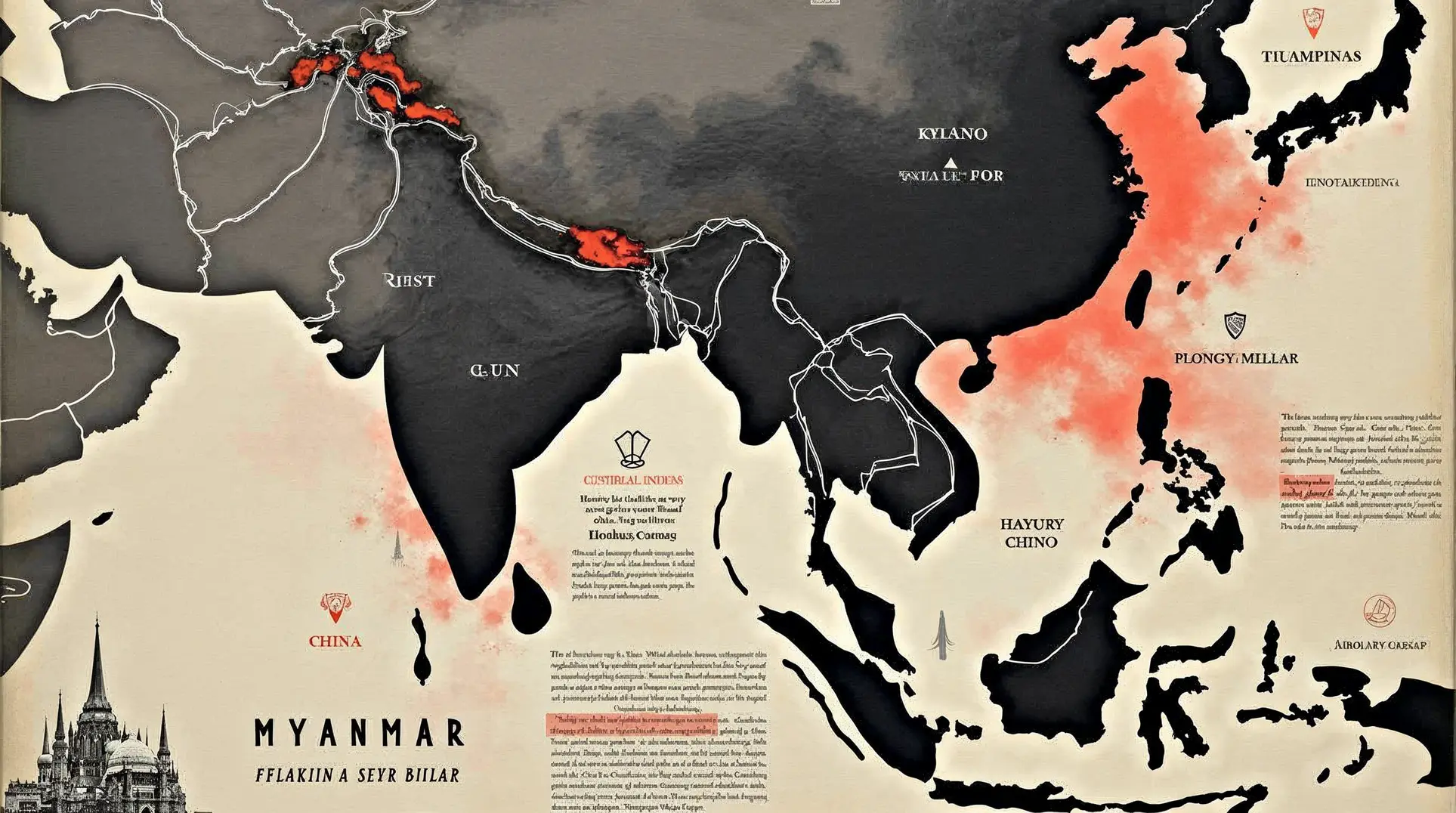
Members are reading: How the election's manufactured legitimacy unlocks billions from China, Thailand, and India who need diplomatic cover for strategic engagement.
The cost of performance versus reality
The disconnect between electoral performance and battlefield reality creates its own instability. Myanmar's military junta regains strategic ground as civil war enters brutal new phase, but territorial gains are temporary and costly. The junta's military spending has reportedly increased to over 40% of government expenditure, straining an economy already hemorrhaging foreign currency reserves.
Meanwhile, Western nations led by the United States and European Union have declared the election illegitimate and maintained sanctions. This creates a bifurcated international response: condemnation from the West, pragmatic acceptance from regional powers. That split is precisely what the junta is banking on. It needs Chinese investment and Thai border cooperation far more than it needs European diplomatic recognition.
The humanitarian toll provides the backdrop. Over 5,000 civilians killed since the 2021 coup. Systematic targeting of healthcare workers and teachers. Entire townships rendered uninhabitable. This election changes none of that—it merely provides a political frame that allows regional actors to continue business while the violence continues.
Stability through fiction, crisis through reality
The likely outcome is grimly predictable. Min Aung Hlaing will transition from military chief to civilian president, cementing a model of military dominance wrapped in constitutional formality. Regional powers will offer muted acceptance, unlocking economic engagement. Western sanctions will continue, creating a two-tier international response.
But this manufactured legitimacy will not bring stability. The ethnic armed organizations and People's Defense Forces controlling vast swaths of territory have no incentive to negotiate with a government they view as illegitimate. The election closes off political pathways rather than opening them, likely intensifying the conflict.
The future of Myanmar depends less on who votes Sunday than on whether regional economic actors choose to validate this performance. Early signals suggest they will—not because they believe in its legitimacy, but because strategic interests demand a fiction they can work with. In that calculus, the people of Myanmar remain irrelevant to their own supposed democratic exercise.
Subscribe to our free newsletter to unlock direct links to all sources used in this article.
We believe you deserve to verify everything we write. That's why we meticulously document every source.


