


The missiles fell on Ternopil as Steve Witkoff fine-tuned his talking points. On the same day the U.S. special envoy intensified back-channel talks with Moscow over a 28-point "peace framework," Russia launched one of its largest combined-arms strikes of the war—470 drones and 48 missiles targeting energy infrastructure, transport nodes, and residential neighborhoods across Ukraine. At least ten civilians died in a single apartment strike. President Zelensky, meanwhile, traveled to Turkey to present new Ukrainian proposals; Moscow didn't bother sending representatives. Instead, the Kremlin signaled optimism about a different set of negotiations—the ones conducted without Kyiv in the room.

Unlock this in-depth audio analysis. This content is reserved for Front Line Members.
This is the context in which we are asked to evaluate the Trump administration's emerging Ukraine deal: a proposal drafted with Russian input, reported by multiple outlets to include recognition of annexed territories beyond Moscow's actual control, the demilitarization of Ukraine's army to half its current size, and the explicit exclusion of NATO membership—all in exchange for security "guarantees" so vague that allies from Warsaw to Brussels are scrambling for clarity. Russian investment chief Kirill Dmitriev, who has been liaising with Witkoff, told Axios the "Russian position is really being heard." He is not wrong. What is being floated is, point by point, a Russian wish list. And it is being sold under the banner of realpolitik.
The uncomfortable truth is that this proposal fails every test that actual realism would impose. It inverts deterrence logic, creates an enforcement vacuum, rewards conquest, and teaches revisionist powers that aggression pays if you can simply outlast American attention spans. Ukraine is right to reject it. European allies are right to resist laundering it through diplomatic euphemisms. And anyone who cares about the stability of the international order—an order in which borders are not permanently redrawn by force—should call this plan what it is: not peace, but capitulation on installment.
Let me be clear: I am no sentimentalist about Ukrainian sovereignty, and I harbor no illusions about the limits of Western will. The war has been brutal; the costs are mounting; the political appetite for open-ended support is waning in key capitals. A negotiated settlement is both inevitable and necessary. But a deal is not inherently better than continued conflict if it entrenches the very dynamics that produced the war in the first place. Realism is about managing power, not pretending it away. And what Witkoff is offering is a plan that disarms the victim, empowers the aggressor, and pretends that paper guarantees can substitute for credible deterrence. That is not strategy. It is wishful thinking with a body count.
The reported terms: Moscow's maximalism, formalized
Details remain in flux—European officials complained to Politico that they were blindsided by the 28-point framework—but multiple sourcing paints a consistent picture. According to the New York Times, the plan was developed with Russian input but without substantive Ukrainian consultation; Kyiv officials say they were informed of talks but not invited to shape the document. Axios reports that the proposal includes U.S. recognition of Crimea and the Donbas (Luhansk and Donetsk oblasts) as "lawfully Russian," and restrictions on the size of Ukraine's military and its access to long-range strike systems. AFP cites a source describing a 400,000-troop cap—more than halving Ukraine's current active forces—and the surrender of long-range missile capabilities. The Independent, drawing on Telegraph reporting, mentions concepts like "leasing" portions of Ukrainian territory to Russia and granting cultural-language concessions in occupied zones.
The security architecture is even more troubling for its vagueness. According to public remarks by Witkoff, the approach involves no formal NATO membership or automatic Article 5 commitment, with the envoy stating, "There's a security protocol, no NATO, NATO's Article 5. […] There are a lot of details attached to this complicated situation." Alternative ideas being floated include a European "reassurance force"—essentially a tripwire deployment by European NATO members without formal U.S. Article 5 commitment—or a "porcupine model" that floods Ukraine with defensive weapons and builds indigenous arms production. But neither model has been spelled out in enforceable terms. European capitals are demanding clarity on what happens if such a force is attacked, and whether the U.S. would come to its aid. So far, there are no answers.
The territorial component is particularly instructive. Brookings notes that Witkoff's discussions reference Russian "ownership" of five Ukrainian regions: Crimea, Luhansk, Donetsk, Zaporizhzhia, and Kherson. The problem: Russia does not fully control Donetsk, Zaporizhzhia, or Kherson. Battlefield mapping cited by the Times suggests that at current rates of advance, Moscow would need years to seize the remainder of the Donbas if fighting continued. In other words, the proposal contemplates handing Russia—through recognition, "lease," or de facto acceptance—territory it has not conquered. That is not acknowledging reality; it is creating a new reality more favorable to the aggressor than the battlefield itself has delivered.
What does Russia give in return? That remains "unclear," according to AFP's source. The Kremlin has publicly downplayed any new breakthroughs, insisting there are "no new developments" beyond earlier Alaska-format conversations. Dmitriev's optimism notwithstanding, Moscow has not signaled readiness to withdraw from occupied territories, scale back annexation claims, or accept meaningful constraints on its own military posture. The asymmetry is glaring: Ukraine demobilizes and cedes land; Russia consolidates gains and retains freedom of action.
The Istanbul precedent and the enforcement problem
This is not the first time an ambitious framework has collapsed under the weight of Moscow's maximalism and the West's ambiguity. The 2022 Istanbul talks contemplated Ukrainian neutrality, force caps, and international guarantees in exchange for territorial integrity within 1991 borders. Those talks broke down after the Bucha revelations and Russia's refusal to offer concrete security commitments or meaningful withdrawals. What remained were narrower agreements—prisoner exchanges, humanitarian corridors—that required constant re-negotiation and produced no strategic shift.
The Minsk experience is even more instructive. Minsk I and II established ceasefires, demarcation lines, and monitoring by the OSCE. What they did not establish was enforcement. Violations became routine. The "frozen conflict" was anything but frozen; it became a platform for infiltration, coercion, and eventual full-scale invasion. The lesson: monitoring without the credible threat of cost imposition does not deter. Observers can count violations; they cannot punish them. And in an anarchic international system—one where no supranational authority can impose binding verdicts—deterrence rests on the ability and willingness of powerful actors to raise costs for aggression.
The Witkoff framework offers no mechanism to do that. A European reassurance force without U.S. backing is a tripwire without a trap. It invites testing. Would Germany or France risk war with Russia over a skirmish in eastern Ukraine if Washington has explicitly said "no NATO, Article 5"? The entire logic of extended deterrence depends on the certainty that an attack will trigger overwhelming retaliation. Ambiguity in that commitment does not preserve flexibility; it invites miscalculation.
A bilateral U.S.–Ukraine security guarantee—akin to those Washington extends to Israel or South Korea—would require Senate ratification. In the current Congress, that is a fantasy. NATO membership, the one guarantee Moscow genuinely fears because it is institutionalized and automatic, has been ruled out by the envoy driving the talks. What remains are vague reassurances and the promise of arms transfers—valuable, but not a substitute for the certainty that aggression will be met with collective defense.
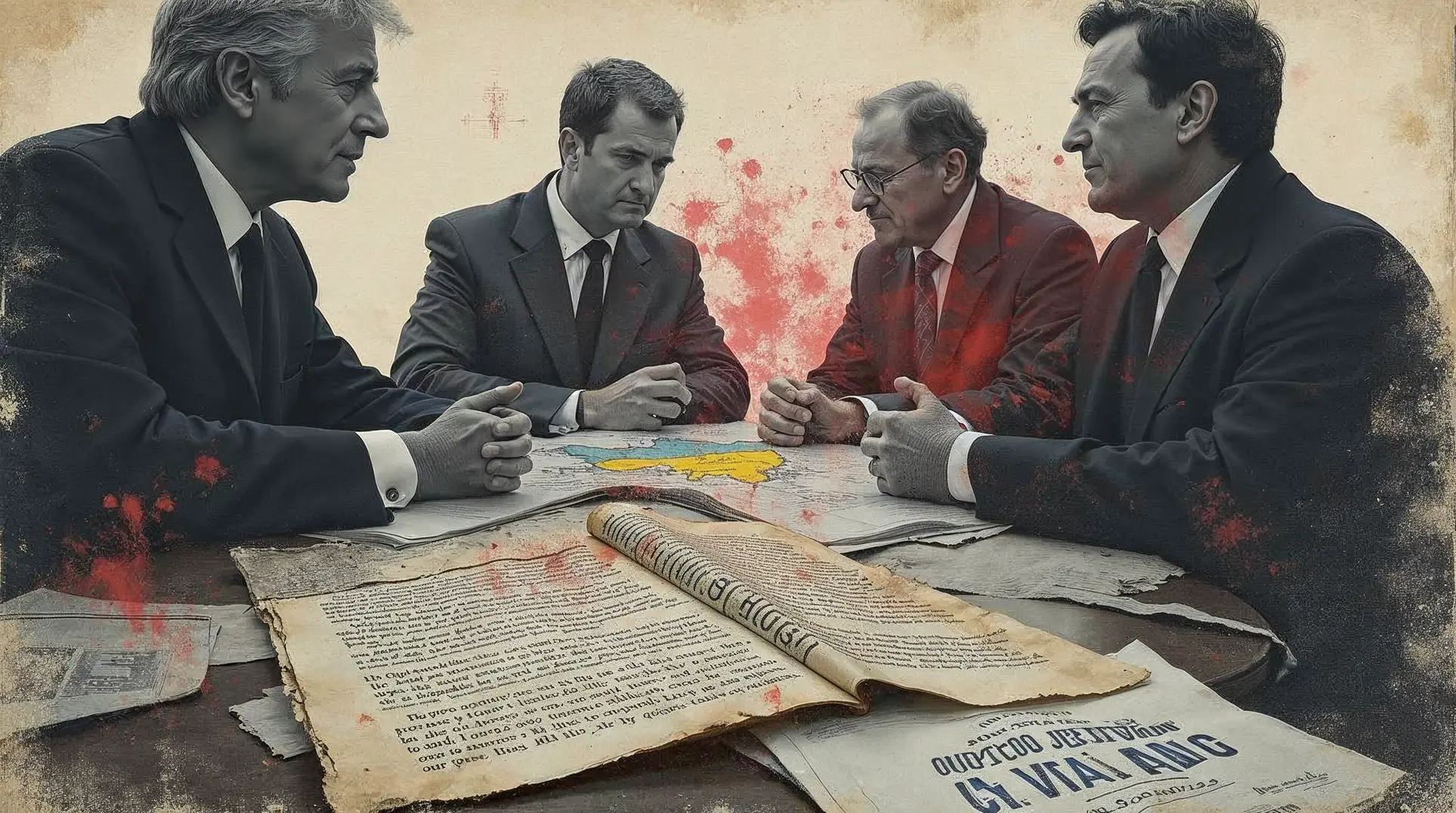
Members are reading: Why the Witkoff plan fails every realist test—from deterrence logic to enforcement mechanics to credibility cascade.
The transatlantic fracture and the "new Yalta" problem
European reactions have been swift and anxious. Officials in Warsaw, Tallinn, and Vilnius—states that border Russia or have lived under its dominion—are horrified by the prospect of a great-power bargain struck over Kyiv's head. The fear is not abstract: it is the nightmare of a "new Yalta," where Washington and Moscow divide spheres of influence and smaller states lose sovereignty in the transaction. As I examined in an earlier piece (Washington's Peace Plan for Ukraine Exposes Deepening Transatlantic Fracture), the debate over "sovereignty language" in any settlement has become a flashpoint. If the U.S. is willing to recognize annexations without Ukrainian consent, the entire post-1945 norm against territorial conquest becomes negotiable.
Germany and France face their own dilemmas. Both have invested heavily in the diplomatic process and in sanctions coordination; both have publics weary of the war's economic costs. But both also recognize that a deal which abandons Ukraine sets a precedent they may one day face themselves if the security architecture collapses. The question Berlin and Paris are asking is whether they can trust Washington to anchor European security if the U.S. is willing to trade a European state's territory for expedience.
This matters because any security guarantee mechanism—whether a reassurance force, a bilateral pact, or an arms-transfer regime—requires transatlantic coordination. If the U.S. and Europe are not aligned on red lines, enforcement becomes impossible. Russia will exploit every seam. And if European capitals conclude they cannot rely on American commitments, the fracture will extend beyond Ukraine to NATO itself, raising existential questions about Article 5 credibility in the Baltics or Poland.
The frozen assets issue compounds the dilemma. Europe holds approximately €210 billion in Russian state reserves; that leverage was supposed to extract concessions or fund reconstruction. But as I detailed previously (Europe's €210B Frozen Assets Trap: Putin Wins Budapest), Moscow has refused to negotiate over those assets and has instead waited for Western resolve to fracture. If a deal is signed that grants Russia territorial and strategic gains without requiring it to pay for reconstruction or compensate for aggression, Europe's leverage evaporates. The assets become a sunk cost, sanctions fatigue sets in, and the economic instrument of coercion is spent.
The battlefield reality and the fatalism fallacy
Supporters of the Witkoff framework often argue that Ukraine is losing and will lose the contested territories anyway, so recognizing that reality is pragmatic rather than cynical. This argument is both factually contestable and strategically dangerous.
Factually: Russia has made incremental gains in the east, but at enormous cost. Casualty estimates vary, but even conservative figures suggest hundreds of thousands of Russian dead and wounded. Equipment losses have forced Moscow to draw down Soviet-era stocks and rely on Iranian drones and North Korean shells. The Times noted that battlefield mapping indicates Russia would need years to fully capture the remaining portions of Donetsk at current rates of advance. Ukraine, meanwhile, has demonstrated adaptability—developing domestic drone production, integrating Western systems, and sustaining resistance despite severe infrastructure damage. The trajectory is grinding, but it is not inevitable.
Strategically: even if one accepts the premise that Ukraine cannot militarily reclaim all occupied territory, that does not mean the current battlefield lines should be rewarded with international recognition. There is a difference between a frozen conflict with contested status—where Ukraine retains legal claims and the possibility of future leverage—and a formal settlement that ratifies Russian annexations. The former keeps pressure on Moscow and leaves open pathways for diplomacy tied to changed conditions (regime change in Russia, economic collapse, renewed Western commitment). The latter closes those pathways and treats aggression as fait accompli.
Moreover, the fatalism ignores alternative models. The "porcupine" strategy—arming Ukraine heavily, building indigenous defense production, and creating a prohibitively costly target for future aggression—does not require NATO membership. Israel, Taiwan, and South Korea have all adopted versions of this model: deep defense partnerships, massive arms transfers, and the demonstrated will to fight. None enjoy formal alliances with the U.S. in the NATO sense, but all present credible deterrence because adversaries know the costs of attacking them are high and the likelihood of outside intervention is non-zero. Ukraine, with sustained support, could achieve a similar posture. That would not end the war tomorrow, but it would create conditions for a durable settlement based on mutual exhaustion and credible red lines, rather than one-sided concessions.

Members are reading: What a realistic alternative would require—and why the common objections to rejecting this deal are wrong.
The process problem: Witkoff's capacity and the confidence gap
Even if one accepted the strategic logic of the proposal—I do not—the process by which it has been developed raises serious implementation concerns. Politico's reporting on Witkoff's management is damning: limited readouts, reliance on ad hoc channels, early reliance on Putin's own translator in meetings, and complaints from both U.S. and Russian counterparts about communication rigor. One official disputed the characterization, but the pattern is consistent enough to warrant concern.
Why does this matter? Because complex security arrangements depend on precise language, mutual understanding of commitments, and confidence that agreements will be honored and interpreted consistently. If the lead negotiator is not engaging daily intelligence products, if communication discipline is weak, if there is confusion about what was agreed and what was merely discussed, the risk of implementation failure or dangerous misunderstanding multiplies. Enforcement of a Ukraine settlement will require monitoring compliance, adjudicating disputes, coordinating sanctions relief, and managing crises when violations occur. That demands institutional rigor, not improvisation.
The fact that Ukraine was informed of the talks but not invited to shape the document is equally troubling. Agreements imposed rather than negotiated lack legitimacy and durability. If Kyiv feels the U.S. is negotiating about Ukraine rather than with Ukraine, the domestic political fallout could be severe—undermining Zelensky, empowering hardliners or defeatists, and fracturing the coalition that has sustained resistance. Likewise, if European allies are blindsided, their willingness to contribute forces, funding, or political cover for implementation will erode.
Diplomacy is not merely about reaching an agreement; it is about building the political and institutional infrastructure to sustain it. The Witkoff process, as reported, has neglected that dimension. And that neglect is not a minor procedural flaw—it is a structural weakness that could doom even a well-designed settlement, let alone one as imbalanced as this.
Conclusion: Real realism requires real deterrence
The Witkoff framework is being marketed as hard-nosed realism—a recognition that wars end through negotiation, that Ukraine cannot win militarily, and that U.S. interests lie in shifting focus to other theaters. There is a kernel of truth in each premise. But the conclusion drawn from them—that Washington should ratify Russian annexations, disarm Ukraine, exclude NATO, and hope that vague reassurances prevent future aggression—is not realism. It is fantasy dressed in the language of strategy.
Realism is not indifference to outcomes; it is the rigorous analysis of power, interests, and the conditions under which order can be sustained in an anarchic system. By those standards, the emerging deal fails comprehensively. It rewards the aggressor, punishes the victim, degrades deterrence, creates an enforcement vacuum, fractures the transatlantic alliance, and teaches every revisionist power that patience and brutality pay. The costs of this settlement will not be confined to Ukraine. They will ripple through Europe, embolden adversaries in Asia, and degrade American credibility in every alliance system that depends on the belief that Washington honors its commitments and defends the rules-based order.
Ukraine is right to resist this plan. Its rejection is not obstinacy or maximalism; it is a clear-eyed assessment that a deal which leaves it disarmed, dismembered, and unprotected is not peace—it is a countdown to the next invasion. European allies should resist as well, not because they are naive idealists, but because their own security depends on the principle that borders cannot be rewritten by force and that U.S. guarantees mean something.
There is an alternative. It requires conditioning any settlement on reciprocal, verifiable steps by Russia; enforceable security commitments backed by credible deterrence; Ukrainian agency in negotiations; and the preservation of legal and diplomatic leverage even where de facto control is contested. It requires sustained arming of Ukraine, institutionalized defense cooperation, and the political will to maintain sanctions pressure until compliance is demonstrated. It does not promise a swift or painless resolution. But it offers the possibility of a durable one—because it manages power rather than pretending it away.
The Kremlin understands power. It has calculated that the West will tire, fracture, and ultimately acquiesce to a settlement that locks in Moscow's gains. The Witkoff proposal proves that calculation correct. If Washington proceeds with this plan, it will not have ended the war; it will have funded the intermission. And when the curtain rises on Act Two, the United States will find that it has fewer allies, less credibility, and a world in which aggression has been validated as strategy.
That is not an outcome any realist should accept. The international system remains fundamentally anarchic; no higher authority will enforce justice or punish revisionism. In that world, order depends on the willingness of powerful states to impose costs on aggression and to credibly commit to the defense of rules and allies. If the United States abandons that role in Ukraine, it will not recover it elsewhere. And the rivals watching—in Beijing, in Tehran, in Pyongyang—will draw their conclusions accordingly.
Capabilities matter more than intentions. And right now, the Witkoff plan is building the capability for the next war, not the conditions for a sustainable peace.
Sources
This analysis draws on the following materials:
- The New York Times: Reporting on the 28-point framework, Witkoff–Dmitriev negotiations, lack of Ukrainian input in drafting, and battlefield mapping estimates of Russian advance timelines.
- Politico: Allies blindsided by 28-point plan; significant restraints and territorial concessions included; process concerns regarding Witkoff's management and communication discipline.
- Axios: U.S. and allied recognition of Crimea and Donbas; restrictions on Ukrainian military size and long-range weapons; Dmitriev comments on Russian position being heard.
- AFP / The Moscow Times: Territorial cessions; 400,000-troop cap; unclear Russian reciprocal concessions; Dmitriev optimism.
- The Independent / The Telegraph: Reported "leasing" formulas for Donbas; cultural-language concessions in occupied zones.
- Brookings Institution: Analysis of Witkoff's public remarks ("no NATO, NATO, Article 5"); discussion of Russian "ownership" claims to five regions; alternative security models (reassurance force vs. porcupine strategy).
- Associated Press / Euronews: Zelensky's Turkey visit; Russian non-participation; intensified Russian strikes (470 drones, 48 missiles); humanitarian and infrastructure impacts.
- The Hindu: U.S. Army Secretary Dan Driscoll's Kyiv visit; ambiguity regarding linkage to peace talks.
- Ukrainian government sources: Casualty figures from Ternopil strike; Zelensky social media posts on strike scale.
Subscribe to our free newsletter to unlock direct links to all sources used in this article.
We believe you deserve to verify everything we write. That's why we meticulously document every source.


