


Venezuela's Caribbean coast was struck by two successive major earthquakes on June 24, 2026, a magnitude 7.2 foreshock followed 39 seconds later by a magnitude 7.5 mainshock. Acting President Delcy Rodríguez confirmed at least 188 deaths and more then 1500 injuries as of June 25, declaring a state of emergency across affected regions. The U.S. Geological Survey has issued red alerts projecting between 10,000 and 100,000 potential fatalities based on building vulnerability assessments and population density calculations.
The stark disparity between official casualty figures and scientific projections reveals not merely the immediate challenges of disaster assessment in isolated coastal zones, but exposes the accumulated costs of decades of political and economic crisis. Venezuela's successive earthquake sequence has become a catastrophe amplified by systemic failures in governance, infrastructure maintenance, and building code enforcement. The disaster arrives as the interim government navigates a complex relationship with Washington, testing institutional capacity at precisely the moment when Venezuela's fragile state apparatus faces its most demanding operational challenge.
 Alex Thompson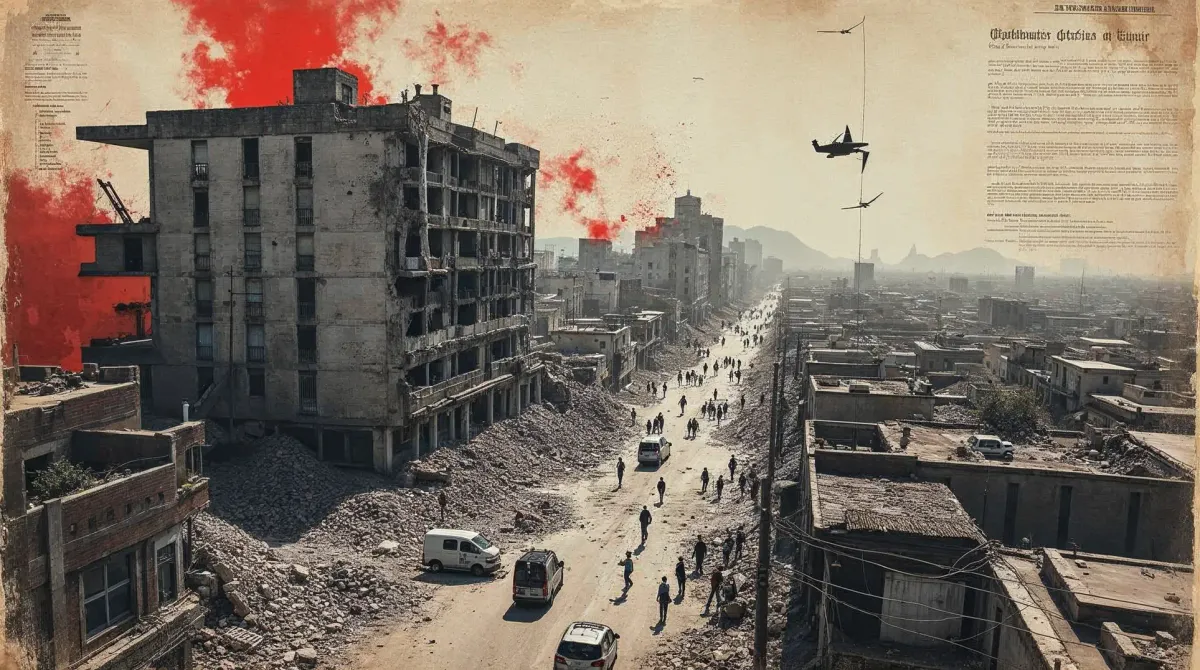
Successive earthquake sequence compounds destruction in vulnerable zones
Two major earthquakes struck near Morón in Carabobo state, with both quakes occurring at shallow depths of 13 and 10 kilometers respectively. According to USGS data, structures weakened by the initial 7.2 magnitude tremor faced immediate additional stress from the more powerful 7.5 mainshock before residents could evacuate or engineers could assess damage. The second quake represents the strongest seismic event to hit Venezuela since 1900.
La Guaira, Venezuela's primary port city housing approximately 300,000 residents, experienced the most severe destruction. Rodríguez declared the coastal state a disaster zone with over 100 collapsed buildings reported, though specific casualty figures for La Guaira remain absent from official tallies. The exclusion of La Guaira from initial death counts represents a critical information gap, particularly as the coastal city sits in the zone of highest seismic intensity and serves as Venezuela's main maritime gateway.
The tremors were felt across Caracas, particularly in the Altamira and El Paraíso neighborhoods, where structural collapses and widespread panic led to evacuations. Yaracuy, Carabobo, Miranda, and Trujillo states also reported significant damage. The seismic waves reached as far as northern Brazil, indicating the extraordinary energy released by the earthquake sequence. At least 20 aftershocks have been recorded since the initial strikes, complicating rescue operations and preventing residents from returning to potentially compromised structures.
Infrastructure collapse reflects governance failure
The earthquake's devastating impact reflects Venezuela's severely deteriorated infrastructure, a direct consequence of years of economic contraction, hyperinflation, and institutional neglect. Power outages, internet disruptions, and gas service interruptions are widespread across affected regions, hampering coordination of rescue efforts and assessment of damage in isolated communities.
The USGS attributes its catastrophic casualty projections to the predominance of unreinforced brick masonry and adobe construction in high-density population centers. These building typologies, common across Venezuela's coastal zones, offer minimal resistance to seismic forces. The absence of enforced building codes and structural oversight—eroded through decades of institutional decay—has left entire communities vulnerable to collapse during major seismic events.
Rodríguez's interim government suspended classes and non-essential activities nationwide, while declaring La Guaira a disaster zone and mobilizing military resources for search and rescue operations. The main airport in La Guaira has been shut down, further isolating the coastal region from humanitarian assistance. An initial tsunami alert for Puerto Rico and the U.S. Virgin Islands was canceled following assessment, though coastal communities remain on alert given the ongoing aftershock sequence.
Members are reading: Analysis of how infrastructure vulnerability and institutional capacity gaps could drive casualty figures toward USGS catastrophic projections.
International response tests geopolitical dynamics
The United States has pledged search and rescue teams and humanitarian assistance, marking continued engagement with Venezuela's transitional government. Senator Marco Rubio and President Trump offered support statements, while U.S. disaster response specialists prepared deployment pending Venezuelan authorization.
The international aid response arrives at a critical juncture for Rodríguez's interim government, which assumed power following the January 2026 removal of Nicolás Maduro and has been navigating a complex relationship with Washington focused on energy sector access and foreign policy alignment. The earthquake presents both opportunity and risk: effective coordination with U.S. disaster response could strengthen the interim government's legitimacy, while coordination failures could expose persistent institutional weaknesses and undermine Washington's rationale for continued support.
The geopolitical dimension extends beyond U.S.-Venezuela bilateral dynamics. China and Russia, traditional Venezuelan allies, have not yet announced disaster response commitments, creating space for Washington to demonstrate the benefits of alignment with U.S. priorities. The interim government's handling of international aid coordination will signal its capacity to operate as a functional state actor rather than merely an American-backed transitional authority.
Members are reading: How the earthquake tests whether Venezuela's interim government possesses actual state capacity beyond political theater.
Historical precedents suggest prolonged humanitarian crisis
Venezuela has experienced two major seismic disasters in recent memory, both of which produced casualties far exceeding initial government estimates. The 1967 Caracas earthquake, magnitude 6.6, officially killed 236 people, though independent assessments suggest higher tolls due to unreported deaths in informal settlements. The 1999 Vargas landslides, triggered by torrential rainfall in La Guaira state, killed an estimated 15,000 to 30,000 people when mudslides buried coastal communities. Initial government figures in 1999 reported only hundreds dead, with the true scale emerging only after weeks of recovery operations.
These historical precedents suggest several patterns likely to repeat in the current crisis. First, casualty figures will climb substantially as rescue teams reach isolated coastal settlements currently inaccessible due to infrastructure damage and communication breakdowns. Second, the concentration of destruction in La Guaira—the same region devastated in 1999—indicates potential for mass casualty events in densely populated coastal zones built on unstable slopes. Third, Venezuela's institutional capacity for rapid damage assessment and coordinated response has not improved since 1999; if anything, it has deteriorated significantly.
The successive nature of the current earthquake introduces an additional complicating factor absent in previous disasters. Buildings that survived the initial 7.2 magnitude quake with structural damage then faced immediate additional stress from the 7.5 mainshock, creating conditions for progressive collapse. This sequence likely produced higher casualty rates than a single earthquake of equivalent magnitude, as residents who survived the initial shock and sought shelter in damaged buildings were then caught in secondary collapses 39 seconds later.

Members are reading: Analysis of how earthquake-driven displacement intersects with Venezuela's existing migration crisis and reconstruction resource gaps.
Information gaps complicate assessment and response
The disparity between official casualty figures and USGS projections highlights fundamental information gaps that extend beyond typical disaster response timelines. As of June 25, Rodríguez's government had not provided specific casualty figures for La Guaira despite declaring it a disaster zone with over 100 collapsed buildings. This absence suggests either communication breakdowns preventing casualty verification or deliberate underreporting to manage domestic and international perceptions.
Venezuela's telecommunications infrastructure, severely degraded through years of underinvestment, has been further compromised by earthquake damage. Power outages across affected regions have knocked out cell towers and internet connectivity, leaving many coastal communities unable to report damage or request assistance. This creates a situation where the most heavily impacted areas may be precisely those from which no information is emerging, skewing initial assessments toward less-affected zones where communication remains functional.
The interim government's transparency regarding casualty figures will serve as an important indicator of its credibility with international partners and domestic constituencies. Systematic underreporting to minimize perceived crisis severity would undermine trust precisely when effective disaster response requires coordinated action across multiple governmental and non-governmental actors. Conversely, transparent reporting of mounting casualties—while politically painful—would demonstrate institutional honesty and facilitate appropriate resource mobilization.
Members are reading: How earthquake response success or failure will reshape Venezuela's political transition and Washington's timeline for democratic restoration.
Reconstruction challenges extend beyond immediate response
Even after the immediate search and rescue phase concludes, Venezuela faces reconstruction challenges measured in years, not months. The concentration of damage in La Guaira—Venezuela's primary port—threatens to disrupt supply chains and economic activity beyond the immediate disaster zone. The port's functionality is critical for both humanitarian aid distribution and Venezuela's oil export operations, which provide the interim government's primary revenue source.
Building code enforcement and seismic retrofitting standards, virtually absent during the Maduro era and the years preceding, must be addressed during reconstruction or future earthquakes will produce similar catastrophic casualties. This requires technical expertise, regulatory capacity, and political will that Venezuela currently lacks. International reconstruction assistance will likely come with conditions regarding governance reforms and institutional capacity-building, effectively making disaster recovery inseparable from Venezuela's broader political transition.
The earthquake also highlights Venezuela's vulnerability to climate-related disasters. The 1999 Vargas landslides demonstrated how deforestation, informal settlement construction on unstable slopes, and inadequate drainage infrastructure create conditions for mass casualty events during extreme weather. These same vulnerabilities persist across Venezuela's coastal zones, compounded now by earthquake damage to drainage systems and slope stability. The intersection of seismic risk, climate vulnerability, and institutional incapacity creates conditions for cascading disasters that overwhelm response capabilities.
Uncertain path forward for disaster response
Venezuela's successive earthquakes have exposed the accumulated costs of decades of governance failure and economic crisis. The disparity between official casualty figures and USGS projections will narrow in coming days as rescue teams reach isolated coastal communities, likely revealing a humanitarian catastrophe far exceeding initial reports. The interim government's capacity to coordinate effective disaster response while managing complex geopolitical relationships and domestic political pressures will determine both immediate humanitarian outcomes and Venezuela's broader political trajectory.
The earthquake arrives at a moment of profound institutional fragility, testing state capacity at precisely the point when Venezuela's degraded apparatus can least afford failure. International aid coordination offers opportunities for demonstrating competence and building legitimacy, but also risks exposing persistent weaknesses that undermine the rationale for continued international support. The coming weeks will reveal whether Venezuela's interim government possesses actual governing capacity beyond political theater, or whether the earthquake accelerates the country's trajectory toward further fragmentation and humanitarian crisis.
Subscribe to our free newsletter to unlock direct links to all sources used in this article.
We believe you deserve to verify everything we write. That's why we meticulously document every source.


