


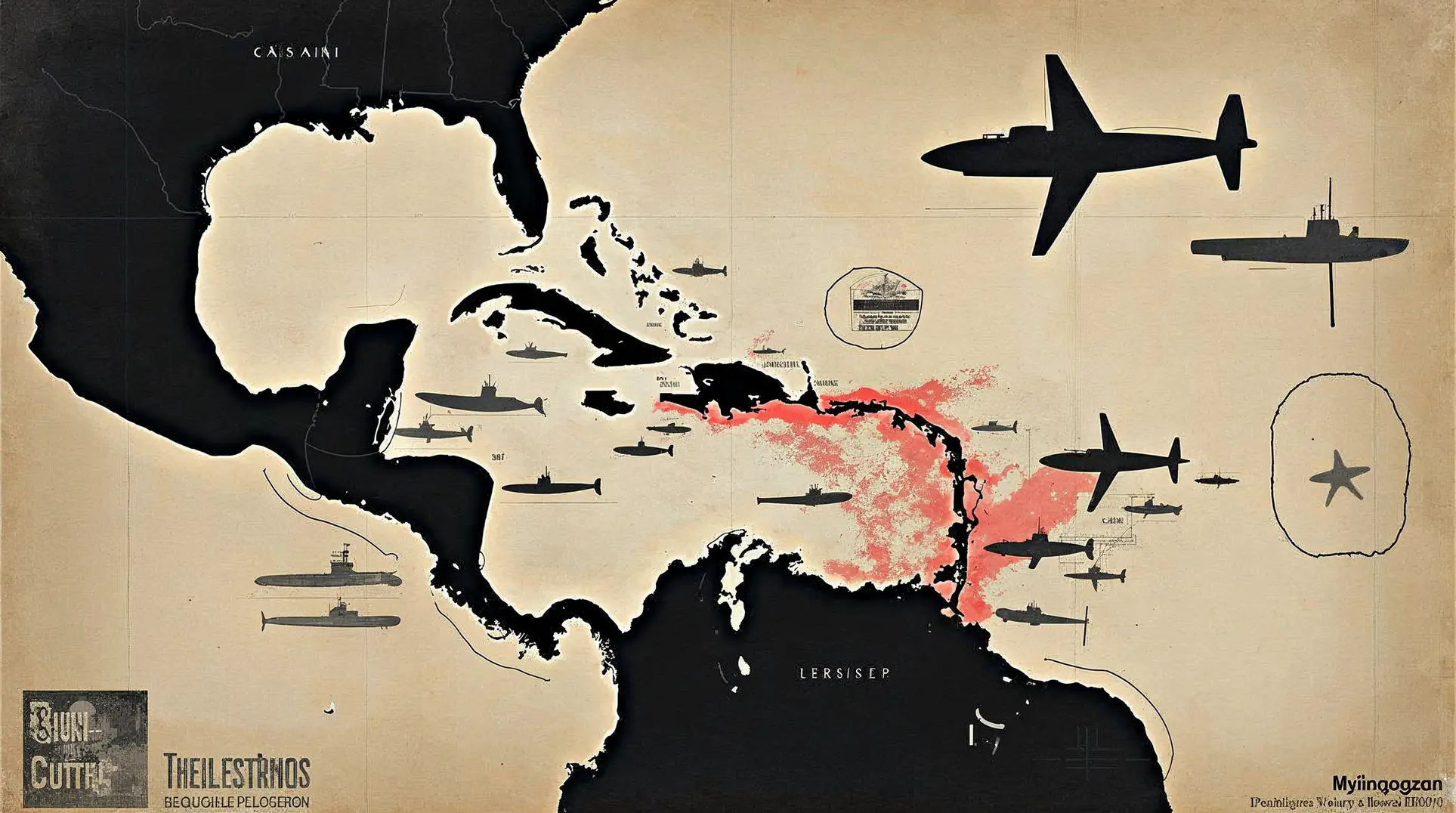
The USS Gerald R. Ford Carrier Strike Group has entered the U.S. Southern Command area of responsibility, officials confirmed Tuesday, marking the most significant escalation yet in a military buildup that has concentrated nearly 20% of the U.S. Navy's deployed warships in Latin American waters. The arrival of America's most advanced aircraft carrier adds formidable offensive capability to a force already including eight warships, a nuclear submarine, F-35 aircraft, and over 10,000 personnel—a concentration of military power unprecedented in the region since the Cold War.
The Pentagon frames this deployment as counter-narcotics operations, citing strikes against suspected drug vessels. But this narrative crumbles under scrutiny. Aircraft carriers don't intercept speedboats. Nuclear submarines don't chase cocaine shipments. The Ford strike group represents power projection designed for state-level confrontation, not law enforcement. The gap between official justifications and actual capabilities reveals a familiar pattern: the War on Drugs serving as pretext for broader geopolitical objectives.
The architecture of escalation
Venezuela has responded predictably to this military pressure with its own "massive deployment" of forces, creating precisely the action-reaction cycle that makes conflict more likely. The Senate's rejection of a war powers resolution preserves executive flexibility for military action without congressional constraint. This procedural detail matters enormously—it means operational decisions rest solely with an administration that has demonstrated willingness to move from economic warfare to kinetic options.
The Ford's arrival transforms the strategic calculus. This is a vessel capable of launching sustained air operations against hardened targets, providing the strike capability necessary for regime change scenarios that economic pressure alone cannot achieve. The carrier battle group's presence doesn't deter drug trafficking—it enables force projection against a sovereign state.
Members are reading: How this deployment reveals structural patterns of U.S. intervention that prioritize military solutions over addressing root causes of regional instability.
Historical echoes and future risks
This moment carries dangerous historical resonance. Latin America has repeatedly experienced U.S. military interventions justified through immediate security concerns that masked regime change objectives. Guatemala, Chile, Nicaragua, Panama—the list of countries subjected to Washington's definition of hemispheric security is long and instructive. Each intervention promised stability and democracy. Each generated enduring instability and undermined democratic institutions.
The current buildup differs in scale but not in logic. The Ford strike group's capabilities far exceed any conceivable counter-narcotics requirement, revealing that drug interdiction provides cover for strategic positioning against Venezuela. The question is not whether this deployment relates to regime change planning, but how far Washington will pursue that objective and what regional consequences will follow.
Venezuela's government bears responsibility for economic catastrophe and authoritarian governance that has driven millions into exile. But U.S. military intervention won't address institutional collapse, rebuild economic systems, or create democratic governance. It will generate casualties, regional instability, and precedents that further militarize how hemispheric powers respond to political crises. The pattern is predictable because we've seen it before.
Subscribe to our free newsletter to unlock direct links to all sources used in this article.
We believe you deserve to verify everything we write. That's why we meticulously document every source.


