


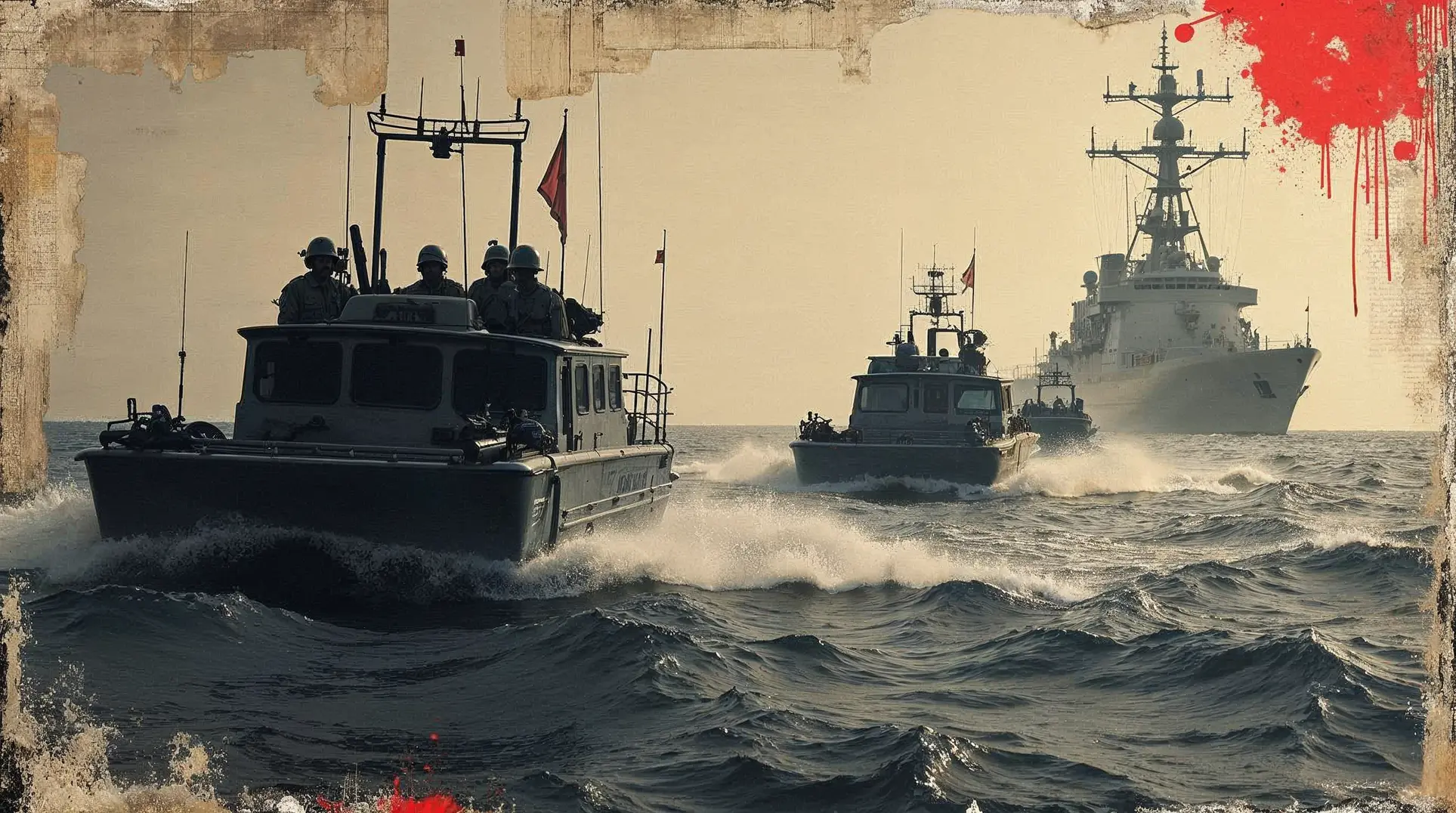
US Central Command forces initiated a blockade of all maritime traffic entering and exiting Iranian ports on April 13, 2026, at 10 a.m. ET, marking a significant escalation following the collapse of weekend peace talks in Pakistan. The blockade applies to vessels of all nationalities attempting to access Iranian ports and coastal areas in the Arabian Gulf and Gulf of Oman, though CENTCOM explicitly stated that freedom of navigation through the Strait of Hormuz to non-Iranian ports will not be impeded.
The military action follows the breakdown of US-Iran ceasefire talks in Islamabad on April 12, where Iran refused to accept American terms regarding its nuclear program and control of the Strait of Hormuz. Vice President JD Vance confirmed that negotiations stalled because Iran would not agree to refrain from developing nuclear weapons, dismantle enrichment facilities, or fully open the Strait without imposing tolls.
Trump threatens Iranian naval forces
President Donald Trump issued a stark warning via social media that any Iranian "fast-attack" ships approaching the blockade would be "immediately ELIMINATED." Trump stated US forces would use tactics similar to those employed against drug boats at sea, describing the approach as "quick and brutal." The president threatened to "finish up the little that is left of Iran" if Iranian forces engage US vessels during blockade enforcement.
Iran's Islamic Revolutionary Guard Corps responded with severe threats, declaring that "Security in the Persian Gulf and the Sea of Oman is either for everyone or for NO ONE." The IRGC warned that "NO PORT in the region will be safe" if Iranian ports remain threatened, with Iran's military and Revolutionary Guard threatening retaliation against ports of US-allied countries in the Persian Gulf and Gulf of Oman. Iranian armed forces accused the US of "piracy."
Economic impact and international reactions
Oil prices surged immediately following the blockade announcement. Brent crude rose over 8% to $103 per barrel, while US WTI climbed similarly to $104.7 per barrel. Stock markets declined on the news. Iranian Parliament Speaker Mohammad Bagher Ghalibaf warned of significant economic repercussions, stating Americans would soon be "nostalgic for $4–$5 gas."
The Strait of Hormuz has been effectively closed since early March following Iranian maritime operations responding to US military strikes on Iran's Kharg Island. Iran previously attacked multiple vessels transiting the waterway, which carries approximately 20% of global oil supplies, after the US-Israel war with Iran began six weeks ago.
Qatar urged both sides to keep maritime routes open and ensure freedom of navigation. The UK stated it would not participate in the blockade but remains focused on reopening the Strait. Russia criticized the US action, predicting negative impacts on international markets. Germany's Chancellor Friedrich Merz expressed low expectations for diplomatic progress and noted long-term economic effects.
Members are reading: Iran's binary choice and why the blockade structure leaves no diplomatic exit in the next 48-72 hours
Immediate escalation risk
The blockade began during a two-week ceasefire that followed six weeks of active conflict between the US-Israel coalition and Iran. The war has already seen over 3,000 US-Israeli strikes on Iranian military infrastructure, with Iran responding by effectively closing the Strait of Hormuz and attacking regional shipping. Oil prices have increased over 40% since the conflict began February 28, 2026, following the assassination of Iran's Supreme Leader.
Trump's immediate implementation timeline leaves minimal space for renewed diplomatic channels. The direct military confrontation occurring in contested waters raises the risk of miscalculation that could rapidly expand beyond the current ceasefire framework.
Subscribe to our free newsletter to unlock direct links to all sources used in this article.
We believe you deserve to verify everything we write. That's why we meticulously document every source.


