


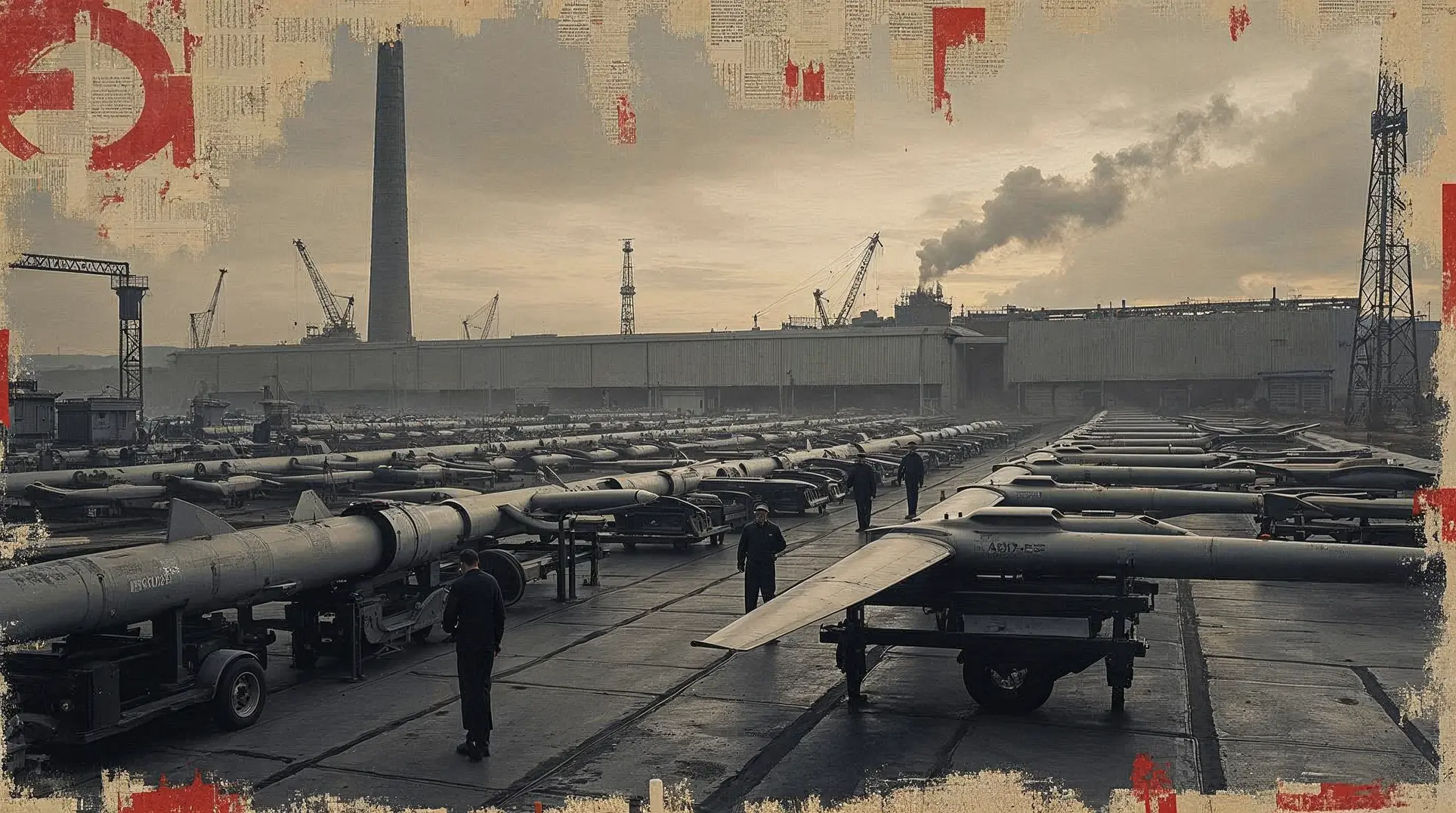
Russia could be ready to use military force against a NATO ally within five years, the alliance's Secretary General warned on 11 December 2025, delivering his most explicit timeline yet for potential conventional conflict. Mark Rutte's Berlin speech cited Russian war-production data showing near-peak industrial output—2,900 attack drones monthly, 2,000 cruise and ballistic missiles in 2025 alone—and a covert campaign that has already moved beyond military installations to target commercial warehouses and shopping centers with explosive parcels. The warning comes as airspace violations over Poland and Romania become routine, and as NATO governments reckon with the gap between declared ambition and near-term capability.
Rutte's five-year horizon sits comfortably within the range of allied intelligence assessments, which cluster around a 2027–2030 window for Russian force reconstitution. What distinguishes his intervention is the explicit linkage: Moscow's escalating hybrid activity against NATO societies is not a substitute for conventional preparation but a parallel track, designed to test thresholds, corrode cohesion, and normalize sub-Article 5 pressure. The Secretary General framed Ukraine's defense as the West's strategic buffer—"Ukraine's security is our security"—and urged allies to prepare for war on a scale not seen since the generation of 1945. That juxtaposition of grandfathers' wars and present-day parcel bombs captures NATO's central dilemma: how to accelerate readiness against a patient adversary already inside the wire.
The production surge and the timeline debate
Rutte's numerical case rests on Russian budget orientation and industrial output. He cited figures showing military spending consuming 44 percent of Russia's federal tax revenues, with the defense budget representing 7.2 percent of GDP and 37 percent of total federal spending, and casualty rates approaching 1,200 per day in 2025—part of an estimated 1.18 million Russian losses since the 2022 invasion. Against Ukraine alone, Russia has sustained a relentless air campaign through 2025, with strike complexes launched at regular intervals to degrade energy infrastructure and test Ukrainian air-defense inventory. Institute for the Study of War assessments from 10 December noted the intensifying winter strike cycle, with growing emphasis on decoy drones to saturate defenses ahead of cruise-missile waves.
This tempo matters for NATO's eastern members because it demonstrates Russia's willingness to absorb attrition while expanding production lines. The Atlantic Council, in analysis dated September 2024, flagged 2025–26 as a higher-risk window tied to the intersection of peak production, refurbishment, and training cycles. Rutte's five-year marker is neither alarmist nor outlying; it reflects the midpoint of allied estimates and introduces political urgency into budget negotiations that have long operated on autopilot. He also credited U.S. President Donald Trump's mediation effort, arguing that only Washington can compel Moscow to negotiate—but only if any settlement includes credible security guarantees robust enough to deter a second round.
The gray-zone squeeze below Article 5
Russia's covert campaign in 2025 has broadened beyond the predictable targets. Drone incursions now penetrate airports and airbases across Europe, GPS jamming disrupts civilian aviation, and suspected sabotage incidents have struck rail nodes, warehouses, and retail centers—spaces whose protection falls into bureaucratic seams between interior ministries, transport regulators, and defense commands. Rutte highlighted explosives concealed in commercial parcels, a tactic designed to maximize psychological impact while preserving deniability. The risk, as NATO's Supreme Allied Commander recently acknowledged in signaling a more proactive gray-zone posture, is normalization: each unanswered provocation lowers the threshold for the next.
NATO's legal architecture struggles with this gradient. Article 4 consultations can be triggered by any ally sensing a threat; Article 5's collective-defense guarantee requires consensus that an armed attack has occurred. Persistent low-intensity incidents—a drone over a Polish airfield, a severed data cable in the Baltic—live in the space between, testing alliance cohesion without crossing the tripwire. Finland and Sweden's accession has extended NATO's frontage with Russia by hundreds of kilometers, adding High North and Baltic Sea exposure that magnifies the infrastructure-protection challenge. The alliance has responded with named operations—Eastern Sentry exercises along the land border, Baltic Sentry maritime patrols—and initiatives like PURL, which relocates U.S.-origin Patriot missiles and munitions to frontline states using allied financing. Yet these measures address known gaps rather than the emerging threat: distributed, deniable attacks on civilian nodes that erode public confidence faster than they degrade military capability.
Members are reading: Why NATO's five-year Russia timeline collides with ten-year budget cycles, and which capability gaps matter most now.
From rhetoric to readiness
Rutte's core argument—that supporting Ukraine now reduces the probability of a wider war later—rests on the logic of deterrence by denial: demonstrating that aggression costs more than it gains. Yet deterrence also requires visible capability and the will to use it, both of which remain under construction. The near-term checklist is knowable: accelerate integrated air and missile defense deployment, scale counter-UAS systems beyond military bases, harden rail and port infrastructure, streamline attribution and response protocols, and build munitions stockpiles that can sustain operations measured in months rather than weeks.
The political question is whether NATO's consensus-driven institutions can move at the speed Rutte's timeline demands. Five years is 1,825 days—enough time to field new systems if procurement begins now, but not if budget negotiations drift into 2026 and contracting stretches into 2027. The alliance has spent three years strengthening its eastern flank against a conventional thrust; it has spent far less time preparing civilian infrastructure and legal frameworks for the hybrid campaign already underway. Russia's gray-zone pressure will not pause while NATO catches up, and each unanswered incident makes the next easier to execute and harder to punish. Rutte's warning is less a prediction than a deadline—one that measures not when Russia will be ready, but whether the alliance will be.
Subscribe to our free newsletter to unlock direct links to all sources used in this article.
We believe you deserve to verify everything we write. That's why we meticulously document every source.


