


- North Korea publicly commemorates Ukraine war dead with memorial, signaling confidence in Russia partnership despite 6,000+ casualties
- DPRK gains combat experience, weapons testing data, and advanced Russian technology access through sustained military deployment to Kursk
- Memorial construction reveals Pyongyang's strategic recalibration: prioritizing great-power partnerships over regional economic integration despite human costs
When Kim Jong Un broke ground for a memorial to North Korean soldiers killed in Ukraine, he didn't merely acknowledge their deaths. He reframed them. The memorial, announced by state media as a "sacred sanctuary" symbolizing "blood-forged" ties between Pyongyang and Moscow, represents something far more significant than architectural commemoration: it is a strategic declaration that North Korea has fundamentally recalibrated its regional positioning, using the Ukraine war as a laboratory for military modernization and diplomatic leverage.
This public acknowledgment marks a sharp departure from the previous year's studied ambiguity, when both Pyongyang and Moscow maintained implausible deniability about North Korean military involvement. The decision to build a monument—featuring sculptures, photos, and combat artwork—transforms what was once a liability into an asset, converting battlefield casualties into symbols of strategic partnership. Russian Ambassador Aleksandr Matsegora's presence at the groundbreaking ceremony underscores the reciprocal nature of this relationship: Russia gains manpower and munitions; North Korea gains battlefield experience, advanced weapons technology, and diplomatic cover.
The economic pragmatist's question isn't whether this partnership makes geopolitical sense—it's whether the returns justify the human and diplomatic costs. And for Pyongyang, the calculus appears increasingly favorable.
The evolution of North Korea's Ukraine deployment: From shells to shock troops
North Korea's involvement in Russia's war effort began not with soldiers but with artillery shells in late 2022, a relatively low-risk transaction that provided Moscow with desperately needed ammunition while generating hard currency for Pyongyang. This initial engagement followed a familiar pattern: North Korea has long monetized its military-industrial capacity through arms sales to regimes facing international isolation, from Syria to Myanmar.
The escalation to ballistic missiles represented a qualitative shift, allowing Pyongyang to field-test its weapons systems against NATO-supplied air defenses while demonstrating their operational viability to potential buyers. But the deployment of troops crossed an entirely different threshold. Estimates vary—South Korean intelligence suggests approximately 15,000 troops deployed since late 2024, while UK intelligence initially assessed 11,000 in the Kursk region—but the strategic implications remain consistent: North Korea has committed a significant military contingent to an active theater of war for the first time since the armistice agreement of 1953.
These are not symbolic advisors or token technical specialists. Reports indicate that special operations forces from the elite 11th Corps, known as the "Pok Pung" (Storm) Corps, have served as assault units on the front lines, playing instrumental roles in pushing Ukrainian forces from the Kursk region. This deployment follows a distinct operational pattern: North Korean units appear to function as shock troops in high-casualty operations, absorbing losses that would be politically untenable for Russian domestic audiences still sensitive to mobilization.
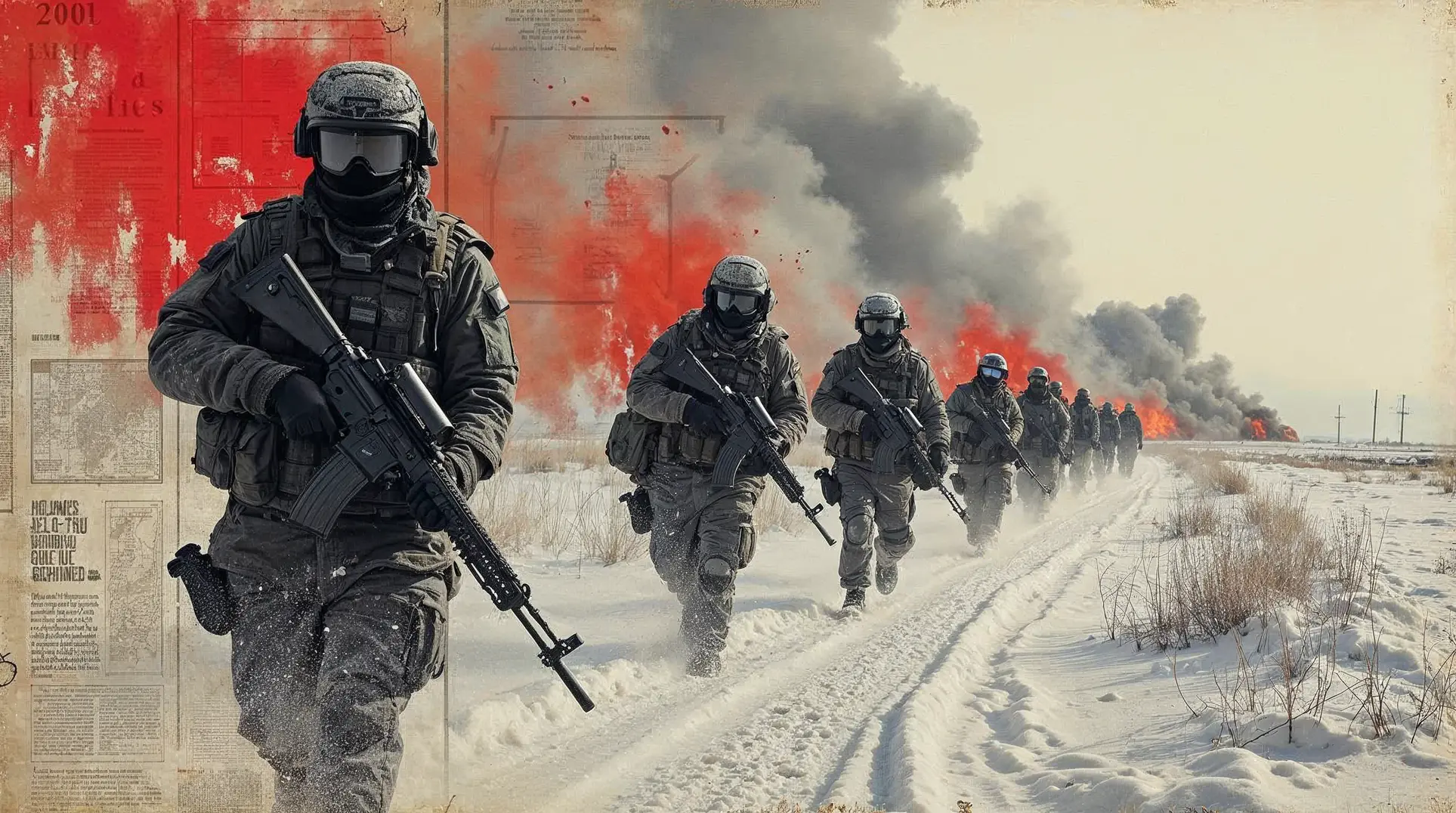
Discover the shocking casualty rates Pyongyang is willing to absorb—and the advanced weapons technology Russia is trading in return that could reshape the regional balance of power.
Historical context: North Korea's pattern of limited overseas deployments
North Korea's current Ukraine deployment represents an unprecedented scale, but not an unprecedented strategy. Pyongyang has a documented history of deploying military personnel to foreign conflicts when the strategic calculus favored engagement. During the Vietnam War, North Korea sent pilots and psychological operations specialists, providing limited but tactically significant support to Hanoi. In the Arab-Israeli wars, North Korean pilots flew combat missions while technical advisors assisted with Soviet-supplied weapons systems.
These deployments followed a consistent logic: they were limited in scope, focused on specialized capabilities, and framed domestically as defensive support for allied socialist states. Most importantly, they generated relatively few casualties, allowing Pyongyang to claim international solidarity without bearing significant domestic political costs.
The Ukraine deployment shatters this template. A 10,000-strong contingent engaged in sustained ground combat operations bears no resemblance to the advisory missions of previous decades. The scale of casualties—potentially exceeding 6,000—creates domestic political challenges that the Kim regime cannot ignore through propaganda alone.
This explains the memorial's significance. By publicly acknowledging the deaths and elevating fallen soldiers to the status of martyrs in the Russia-North Korea strategic partnership, Kim Jong Un attempts to control the narrative before domestic discontent can crystallize into political instability. The "blood-forged" rhetoric transforms what might be perceived as senseless foreign deaths into sacrifices for national security and great-power partnership.
Yet this public commemoration also signals something more strategic: confidence that the benefits of the Russia partnership outweigh the domestic political risks of acknowledging significant combat losses. North Korea would not build this memorial if it assessed the Ukraine deployment as a strategic failure.
Why Kim's calculated gamble terrifies Seoul and Tokyo: The mutual defense pact clause that could drag the Peninsula into unprecedented escalation—and how Beijing is losing its leverage.
Regional implications: ASEAN, Seoul, and the limits of economic pressure
North Korea's Ukraine deployment resonates beyond the immediate Russia-Ukraine theater, carrying significant implications for regional security architecture in Northeast and Southeast Asia. For South Korea, the deployment represents a strategic nightmare: North Korean soldiers gaining combat experience, accessing advanced Russian military technology, and strengthening ties with a nuclear power willing to defy Western pressure.
Seoul's response has been constrained by its own strategic calculations. While South Korea has provided humanitarian aid to Ukraine and participated in sanctions against Russia, it has stopped short of direct lethal aid to Kyiv, wary of provoking Russian retaliation that might manifest in enhanced military cooperation with Pyongyang. This caution reflects the same economic interdependence logic that shapes regional dynamics: South Korea cannot afford to fully alienate Russia without risking escalation on the Korean Peninsula.
Japan faces similar constraints, despite its more forward-leaning security posture in recent years. Tokyo has imposed sanctions and coordinated with Washington, but its ability to meaningfully pressure North Korea through Russia remains limited. The fundamental reality is that Russia's isolation from the West reduces its vulnerability to additional economic pressure from Northeast Asian democracies.
For ASEAN states, the North Korea-Russia partnership presents a more complex calculus. Vietnam maintains strong historical ties with both Russia and North Korea, complicating its ability to take strong positions on the Ukraine deployment. The Philippines, increasingly aligned with the United States on South China Sea issues, nevertheless maintains pragmatic engagement with Russia in certain domains. Singapore, while hosting significant Western military presence, has carefully calibrated its Ukraine-related positions to preserve diplomatic flexibility.
This regional fragmentation reflects a broader reality: the economic interdependence that has defined East Asian stability for decades increasingly operates at cross-purposes with security imperatives. Countries that share concerns about North Korean nuclear development nonetheless maintain economic relationships with Russia that limit their willingness to impose meaningful costs for the Ukraine deployment. The result is a permissive environment where Pyongyang can pursue strategic partnerships without facing the kind of unified regional pressure that might alter its calculations.
Strategic assessment: What the memorial reveals about Pyongyang's confidence
The construction of this memorial is not simply an act of domestic propaganda—it is a strategic signal about North Korea's assessment of its position in the evolving regional and global order. By publicly celebrating soldiers who died in a foreign war, Kim Jong Un communicates several messages simultaneously.
First, to domestic audiences: the regime is confident enough in its strategic partnerships and economic position to acknowledge significant combat casualties without fearing political instability. Second, to South Korea and Japan: North Korea possesses alternatives to regional economic integration and will not be coerced through isolation. Third, to China: Pyongyang has diversified its strategic relationships and no longer relies exclusively on Beijing's protection. Fourth, to Russia: North Korea is a committed partner willing to bear costs in blood, not just munitions sales.
Most significantly, the memorial signals to Western powers that their deterrence strategies face fundamental limitations. NATO has provided Ukraine with increasingly sophisticated weapons systems, imposed comprehensive sanctions on Russia, and organized diplomatic coalition-building on an impressive scale. Yet these measures have not prevented North Korea—one of the world's most sanctioned and isolated states—from deploying thousands of troops to active combat operations in support of Russia.
This reveals a critical gap in Western strategy: economic sanctions and diplomatic isolation work only when the targeted state values integration into the Western-led order. North Korea has long since abandoned that aspiration. Russia is rapidly moving in the same direction. The partnership between them creates a mutually reinforcing dynamic where traditional tools of economic statecraft lose their coercive power.
From an Asia-Pacific perspective, this development carries particular significance for supply chain security and economic stability. The deepening Russia-North Korea partnership exists in tension with the rules-based trading order that has underpinned regional prosperity for decades. It demonstrates that significant actors are willing to pursue strategic objectives through military force and sanctions evasion, regardless of economic costs.
Conclusion: The economics of strategic partnerships in a fragmenting order
North Korea's war memorial in Pyongyang stands as a monument to something larger than battlefield casualties—it symbolizes the emergence of alternative partnerships outside the Western-led international system. The soldiers it commemorates died not in defense of North Korean territory, but in service of a strategic partnership that provides Pyongyang with combat experience, advanced technology, hard currency, and diplomatic leverage.
For economic pragmatists analyzing the Asia-Pacific region, this development carries several critical implications. First, economic interdependence no longer reliably constrains security competition when states possess alternatives to integration with Western-led frameworks. Second, the traditional assumption that isolated states will eventually moderate their behavior to gain economic access is proving increasingly questionable. Third, deep strike capabilities and proxy relationships are reshaping how smaller powers pursue strategic objectives in an era of great-power competition.
The most pressing question is not whether North Korea will continue its Ukraine deployment—the memorial's construction suggests that decision has been made. Rather, the question is how regional actors will respond to a North Korea emboldened by combat experience, equipped with advanced Russian technology, and confident in its strategic partnerships. South Korea, Japan, and ASEAN states must navigate between security concerns and economic realities, between alignment with Western deterrence and preservation of regional stability.
North Korea's memorial to fallen soldiers is, ultimately, a monument to strategic calculation. It commemorates not sacrifice for abstract principles, but investment in concrete capabilities and partnerships that advance regime security and regional leverage. Understanding this distinction is essential for assessing how the Ukraine war's ripple effects will reshape Asia-Pacific security architecture for years to come.
The blood-forged ties that Kim Jong Un celebrates are not merely rhetorical—they represent a deliberate recalibration of North Korea's regional strategy, one that privileges great-power partnerships over regional integration, military capability over economic development, and strategic autonomy over diplomatic normalization. Whether this gamble proves sustainable will depend on factors ranging from the Ukraine war's trajectory to China's response to Pyongyang's diversification strategy to the resilience of sanctions enforcement regimes.
What remains clear is that North Korea has moved beyond the passive isolation of previous decades. It is actively leveraging global instability to advance strategic objectives, and it possesses sufficient confidence in these partnerships to publicly acknowledge their human costs. This is not the behavior of a regime under existential pressure—it is the calculated risk-taking of a state that believes the regional order is shifting in its favor.
Update:
 Layla Hassan
Subscribe to our free newsletter to unlock direct links to all sources used in this article.
We believe you deserve to verify everything we write. That's why we meticulously document every source.


