


Pre-dawn leaflets flutter through frozen air over Grozny on New Year's Eve, 1994. The black-and-white notices, dropped from Russian aircraft hours earlier, promise safe passage to civilians who flee and warn that resistance is futile. In basement shelters beneath Soviet-era apartment blocks, families huddle around kerosene lamps, rationing bread and melted snow. Above them, oil storage tanks ignite one by one across the city's northern industrial belt, pillars of acrid smoke merging into a pall that will hang over the Chechen capital for weeks. At the railway station and the approaches to the Presidential Palace—Dzhokhar Dudayev's seat of the breakaway Ichkerian government—Russian armored columns advance into the grey concrete canyons of the city center, expecting token resistance and a swift decapitation strike. Instead, they drive into carefully prepared kill zones. Rocket-propelled grenades streak from upper-story windows and basements; ZSU-23-4 self-propelled anti-aircraft guns repurposed as urban snipers rake the lead vehicles. By nightfall, the Maikop Brigade—an elite motorized rifle formation—has effectively ceased to exist, its burning tanks and armored personnel carriers blocking the very streets they were supposed to secure. The Sunzha River, threading through the city, becomes an improvised front line. Bodies lie uncollected in the snow. The wounded, pinned by sniper fire, wait in vain for evacuation that cannot come.
This catastrophic New Year's assault was neither an aberration nor a one-day debacle. It was the opening act of a thirty-month war that would kill tens of thousands, level Grozny in what multiple observers later called the heaviest bombardment in Europe since World War II, and expose the hollowed core of the post-Soviet Russian military. More profoundly, the First Chechen War became a formative crucible—operationally, politically, and psychologically—for the Russian state that emerged under Vladimir Putin. The tactical failures, the reliance on massed firepower to compensate for broken combined-arms coordination, the use of filtration camps and zachistka "cleansing operations," the brutal calculus that traded civilian casualties for political messaging: all these patterns, field-tested in the ruins of Grozny between 1994 and 1996, would be refined and deployed again in the Second Chechen War, exported to Syria, and applied—on a vastly larger scale—across Ukrainian cities from Mariupol to Bakhmut.
Today, thirty-one years after the December 11, 1994 invasion, the First Chechen War remains both a historical turning point and a living template. For policymakers seeking to understand Russian approaches to urban warfare, for analysts tracking the evolution of post-Soviet power structures, and for those grappling with cycles of insurgency and state violence in unresolved ethnic conflicts, the war offers uncomfortable, enduring lessons. It demonstrated how domestic political desperation can override military prudence, how information control and raw firepower can substitute for legitimacy, and how a "small victorious war" can instead incubate the leader and the methods that define an era.
Yet the war's legacy is not confined to Moscow's corridors of power or the doctrinal manuals of the General Staff. For hundreds of thousands of civilians—Chechens, ethnic Russians, and others caught in Grozny and the mountain villages—the conflict meant displacement, trauma, and a generation scarred by filtration camps and destroyed homes. For Chechnya itself, a brief, chaotic independence between 1996 and 1999 gave way to a second, even more devastating war and the imposition of authoritarian reconstruction under Ramzan Kadyrov. The unresolved tensions, the mass graves, the stories that survivors like journalist Abubakar Yangulbayev and analyst Thomas de Waal have worked to document—these too are part of the war's inheritance.
How did a post-Soviet state that inherited the world's second-largest military find itself unable to seize a medium-sized city without catastrophic losses? What drove Yeltsin's Kremlin to choose bombardment over negotiation, and how did that choice shape both the war's conduct and Russia's political trajectory? And what do the tactical adaptations, humanitarian costs, and strategic consequences of the First Chechen War tell us about the conflicts unfolding today?
The unraveling: From Soviet collapse to Dudayev's republic, 1990–1994
Dzhokhar Dudayev's path to the presidency of the self-declared Chechen Republic of Ichkeria began not in separatist conspiracy but in the chaotic vacuum of Soviet collapse. A former Soviet Air Force major general—the first Chechen to reach that rank—Dudayev returned to Grozny in 1990 amid the ferment of glasnost and rising ethno-national assertion across the USSR. In November 1990, Chechen intellectuals, clan elders, and nationalists convened the All-National Congress of the Chechen People, a parallel assembly that initially sought cultural autonomy and redress for historical grievances, above all the 1944 mass deportation of Chechens and Ingush to Central Asia under Stalin—Operation Lentil—which had killed roughly a quarter of the population and remained a searing collective memory.
By September 1991, in the weeks after the failed Moscow coup against Gorbachev, the Congress seized government buildings in Grozny, dissolved the Soviet-era Supreme Soviet of the Chechen-Ingush ASSR, and organized elections. Dudayev, charismatic and uncompromising, won the presidency on October 27, 1991. On November 1, he declared Chechen sovereignty and refused to sign the Russian Federation Treaty that other autonomous republics, including neighboring Tatarstan, eventually accepted. Moscow's response oscillated between bluster and inaction. Yeltsin declared a state of emergency and dispatched interior ministry troops in November 1991, but the forces withdrew within days under political and logistical pressure, setting a pattern of half-measures that would persist until 1994.
Three years of tense standoff followed. Ichkeria operated as a de facto independent state, issuing its own passports and currency, controlling oil infrastructure around Grozny, and asserting jurisdiction over the Chechen-majority population. Yet it was never diplomatically recognized, and Moscow treated it as a rogue entity within the Russian Federation's borders. Crucially, Dudayev's government presided over a security vacuum: Soviet-era law enforcement collapsed, weapons from abandoned arsenals circulated freely, and organized crime—kidnapping, extortion, the trans-shipment of stolen goods—surged. Ethnic Russians and other minorities, once nearly half of Grozny's population, began leaving; some accounts cite intimidation and local violence, though narratives around causality remain contested and entwined with broader post-Soviet displacement patterns.
Moscow's policy apparatus split between those advocating negotiation and hard-liners convinced that force could restore "constitutional order" at minimal cost. By mid-1994, with Yeltsin's approval ratings plummeting amid hyperinflation and "shock therapy" austerity, the Kremlin's calculus shifted decisively toward coercion. Defense Minister Pavel Grachev famously boasted he could seize Grozny "in two hours with a single airborne regiment." The Federal Security Service (FSK, successor to the KGB) and the Presidential Security Service backed a Chechen opposition front, the Provisional Council, led by figures willing to accept Moscow's authority. In October and November 1994, proxy assaults on Grozny by opposition militias—supported with Russian armor and "volunteer" contract soldiers—failed embarrassingly. Television footage showed captured Russian tank crewmen, exposing the pretense. The debacle forced Moscow's hand: if proxies could not deliver, direct intervention would.
On December 11, 1994, Russian forces launched a three-pronged invasion from the north, west, and east. The operation combined regular army units, interior ministry troops (MVD), and FSB assets, with air support from bases in Mozdok and the North Caucasus Military District. Official justifications invoked the need to disarm "illegal armed formations" and restore federal authority. Unofficially, the decision reflected inter-elite power struggles in Moscow—between Grachev's Defense Ministry, the FSB, and reformist politicians marginalized by the "power ministries"—and Yeltsin's personal conviction that a quick, decisive campaign would stabilize his presidency. The invasion began with air strikes on Grozny's airport and military installations, followed by ground columns advancing along three axes toward the capital. Initial resistance in rural districts was light. By mid-December, federal forces surrounded Grozny. The stage was set for what Russian planners imagined would be a rapid urban seizure. What followed instead was one of the costliest tactical disasters in modern Russian military history.
The cauldron: Urban catastrophe and the destruction of the Maikop Brigade, December 1994–March 1995
Russian operational planning for the assault on Grozny rested on assumptions inherited from Soviet doctrine and recent experience. Planners envisioned Grozny as largely empty of civilians, who would heed warnings and flee; they expected Dudayev's forces—estimated at a few thousand lightly armed fighters—to collapse under combined-arms pressure; and they assumed time to rehearse complex urban maneuvers, as Soviet doctrine prescribed for city fighting. None of these assumptions held. Civilians remained in their tens of thousands, either unable to leave, protecting property, or distrusting Russian "safe corridors." Chechen defenders, organized in mobile groups of five to fifteen fighters coordinated by clan and neighborhood ties, employed an "occasional defense" that exploited intimate knowledge of the city's layout. And Moscow's political imperative—achieve a New Year's victory to demonstrate control—compressed timelines catastrophically, leaving no opportunity for reconnaissance or combined-arms integration.
The New Year's Eve assault plan called for three mechanized columns to converge on the Presidential Palace in central Grozny, decapitate Dudayev's government, and force a surrender. The 131st Independent Motorized Rifle Brigade—the Maikop Brigade—drew the main axis from the northwest via the railway station. Armored personnel carriers and tanks, many crewed by hastily mobilized conscripts with minimal urban training, rolled into the city in column formation. Radio jamming intended to disrupt Chechen communications also blinded Russian units to one another, contributing to fratricide. Chechen fighters, positioned in basements and upper stories, allowed the lead elements to pass, then struck the middle and rear of the columns with RPGs, isolating vehicles and preventing mutual support. Burning wrecks blocked streets; attempts to maneuver into side alleys met pre-sighted ambushes. By the morning of January 1, 1995, the Maikop Brigade had lost the majority of its armor and suffered hundreds of casualties. Surviving personnel, trapped in pockets, fought building-to-building or surrendered. The 81st Guards Motorized Rifle Regiment, advancing from the east, fared only marginally better. Russian forces controlled the northern industrial zones and approached the city center, but the cost in men and machines shocked the General Staff and shattered the narrative of a quick victory.
The tactical failures were manifold, documented in granular detail by post-conflict analyses including the Canadian Forces' 2023 study "Soft Logistics and Concrete Canyons." Russian units operated without adequate dismounted infantry to screen armor; tanks advanced alone, vulnerable to RPG fire from basements and rooftops. Logistics chains, planned for conventional open terrain, broke down in the urban labyrinth: soft-skinned supply trucks could not enter contested streets, forcing repeated transloading of fuel, ammunition, and rations onto armored vehicles, which then had to double as casualty evacuation platforms. Fuel convoys became priority targets; units advancing into the city center often did so with half-empty tanks and minimal reserves. Water sanitation collapsed—troops drank from contaminated sources, triggering hepatitis and cholera outbreaks that, by some accounts, incapacitated more soldiers than combat in certain periods. Medical evacuation, the sine qua non of modern casualty care, failed catastrophically. Soft-skinned ambulances were targeted by snipers; helicopter medevac attempts drew intense fire, and several Mi-8s were shot down. Desperate commanders repurposed BTR-80 armored personnel carriers for casualty runs, but the numbers overwhelmed capacity.
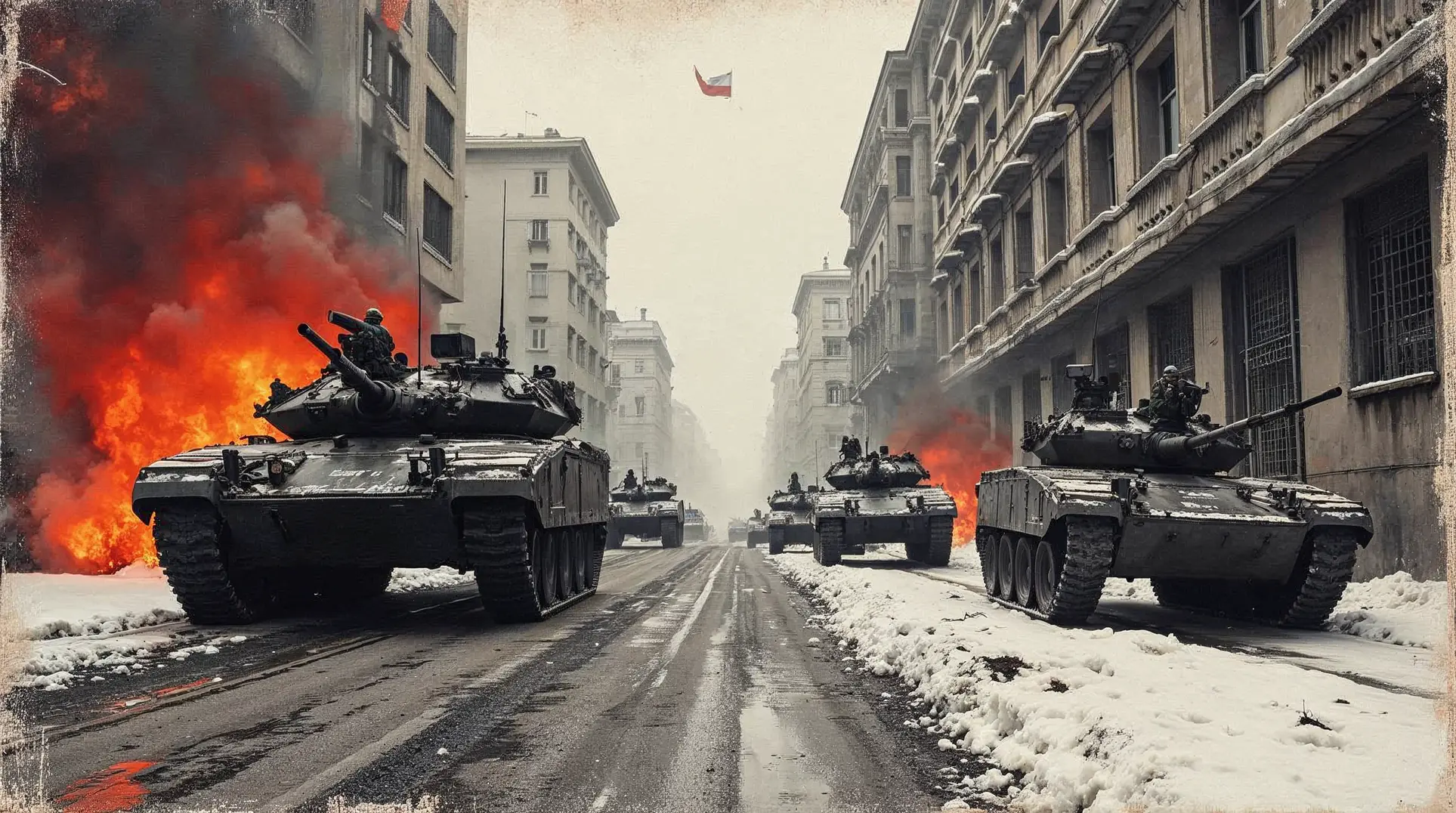
Members are reading: Inside the logistics breakdown, combat casualty profiles, and medical evacuation failures that turned Grozny into a graveyard for Russian armor and morale.
The human toll: Civilian death, displacement, and the infrastructure of suffering
The humanitarian catastrophe in Grozny during the winter of 1994–95 unfolded on a scale not seen in Europe since 1945. Early estimates of civilian casualties, derived from Russian human rights advisers and later corroborated by international observers, placed the death toll in the first five weeks of fighting at between 27,000 and 35,000. Official Russian military sources acknowledged the figures privately, though public statements minimized losses. Over the course of the entire First Chechen War, commonly cited estimates suggest that approximately 100,000 people—combatants and civilians combined—were killed, with civilian deaths comprising the majority. Casualty figures remain contested and vary across Russian, Chechen, and international sources; presenting them as ranges with clear attribution is essential given the absence of comprehensive documentation.
Ethnic Russians, who had constituted a significant portion of Grozny's pre-war population, suffered disproportionately in the early bombardment. Many lacked the rural clan networks that enabled ethnic Chechens to evacuate to mountain villages and were more likely to remain in the city, sheltering in apartment basements. Testimonies collected by journalists, including Thomas de Waal, describe these basement ecosystems: extended families and neighbors pooled food and water, melted snow for sanitation, and emerged only during lulls to scavenge or bury the dead. When buildings were hit—by artillery, multiple-launch rocket systems, or aerial bombs—entire basement communities were entombed.
Displacement patterns mirrored the conflict's phases. By August 1995, the Chechen conflict had caused an estimated 250,000 people to flee to neighboring republics, including Ingushetia, according to United Nations estimates. Russian emergency management authorities (EmerCom) and United Nations agencies worked to assist internally displaced persons and refugees in Ingushetia and neighboring regions. Over the course of both Chechen wars, total displacement figures reached several hundred thousand, with peaks during major offensives. The ICRC and OSCE attempted to facilitate humanitarian corridors, but access was inconsistent. Russian military authorities often restricted ICRC movements, citing security concerns; Chechen fighters, in turn, were accused of using civilian areas for cover, a charge that international human rights organizations acknowledged while emphasizing that this did not absolve federal forces of obligations under international humanitarian law.
Filtration camps—detention centers run by the MVD and FSB—became a hallmark of the war and a source of enduring grievance. Men of fighting age fleeing Grozny or detained in sweep operations were channeled through these facilities, ostensibly to screen for combatants. In practice, filtration camps became sites of abuse: beatings, extortion, summary executions, and "disappearances" documented by Human Rights Watch and the Russian NGO Memorial. The ICRC struggled to gain access and trace detainees, complicating efforts to reunify families. The filtration system, refined during the First Chechen War, became a central feature of the Second War and later Russian operations.
Infrastructure destruction compounded civilian suffering. Grozny's power grid, water treatment, and sewage systems were shattered by bombardment. EmerCom crews, working under fire, restored electricity lines, repaired bakeries and hospitals, and jury-rigged water supplies even as fighting continued. These efforts, while laudable, could not mitigate the strategic use of infrastructure targeting as a tool of coercion. Survivors recount months without running water, reliance on communal wells vulnerable to contamination, and the spread of disease. Abubakar Yangulbayev, a Chechen human rights lawyer who was a child during the war, recalled in a 2021 Voice of America interview the pervasive fear, the sound of artillery, and the disorientation of a shattered city. Such testimonies, while individual, reflect the broader generational trauma that the war inflicted.
Turning points: Samashki, Budyonnovsk, and the strategic shock of terror
As Russian forces consolidated control over Grozny's ruins through spring 1995, the operational theater expanded into Chechnya's rural south and west. Federal commanders, learning from the urban debacle, adopted zachistka ("cleansing") operations: surround a village suspected of harboring fighters, bombard it, then sweep through with troops to detain or kill suspected militants. Samashki, a town west of Grozny, became the most notorious example. In early April 1995, OMON (special police) and federal forces launched a multi-day assault. Human Rights Watch and Memorial documented allegations that hundreds of civilians were killed, homes burned with flamethrowers, and men detained en masse. The Russian government denied mass atrocities but acknowledged "excesses." Samashki intensified both Chechen resistance and international condemnation, galvanizing calls for accountability that the Russian state largely ignored.
Yet it was an event 200 kilometers inside Russian territory that truly shifted the war's trajectory. On June 14, 1995, a Chechen force led by field commander Shamil Basayev, numbering roughly 150 fighters, infiltrated across the border into Stavropol Krai and seized the town of Budyonnovsk. Basayev's men took over the local hospital, herding more than a thousand hostages—patients, staff, and townspeople—into the building. Russian special forces launched two assaults to retake the hospital; both failed, resulting in numerous hostage deaths and a public relations disaster broadcast live on Russian television. After tense negotiations aired on national TV, Moscow agreed to a ceasefire and safe passage for Basayev's group back to Chechnya in exchange for the hostages' release. The Budyonnovsk crisis had immediate and far-reaching effects: it exposed catastrophic failures in Russian internal security, forced Yeltsin's government to negotiate directly with Chechen commanders, and demonstrated that high-impact terror could compel strategic concessions.
From a European security perspective, Budyonnovsk also internationalized the conflict in a way that scattered skirmishes in the mountains could not. Western governments, previously content to treat Chechnya as an internal Russian matter, faced renewed scrutiny over their muted response. The OSCE Assistance Group, deployed in April 1995 to monitor ceasefires and human rights, gained greater visibility. The Council of Europe criticized Russia's conduct, and humanitarian organizations intensified appeals. Yet the geopolitical calculus remained: Western capitals, led by Washington, prioritized support for Yeltsin's "democratic transition" and market reforms over accountability for Chechnya, a trade-off candidly acknowledged in retrospect by U.S. officials like Thomas Graham. The ceasefire negotiated after Budyonnovsk held for several weeks, then frayed as low-intensity fighting resumed.
Members are reading: How Budyonnovsk's hostage crisis forced Moscow to negotiate, why Dudayev's assassination failed to break resistance, and the hybrid-warfare lessons encoded in Chechen coercive tactics.
August 1996: The Grozny gambit and the road to Khasavyurt
On August 6, 1996, Chechen forces under Aslan Maskhadov and Shamil Basayev launched a coordinated assault to retake Grozny. Approximately 1,500 to 2,000 fighters infiltrated the city in small groups, using the same intimate knowledge of terrain that had devastated Russian columns eighteen months earlier. Within hours, they had isolated MVD garrisons, police stations, and federal checkpoints, cutting communications and mining approach routes. Russian commanders, caught off-guard, struggled to coordinate a response. Relief columns dispatched from bases outside the city drove into ambushes; armored vehicles were destroyed by mines and RPG fire, often within sight of besieged garrisons. Over the following two weeks, Chechen fighters systematically encircled federal strongpoints, extracted hostages (including captured Russian soldiers used as bargaining chips), and demonstrated operational initiative that Moscow had assumed was broken.
Federal losses mounted rapidly. General Konstantin Pulikovsky, appointed to command the response, issued an ultimatum on August 19: civilians must leave Grozny within 48 hours, after which the city would be leveled by artillery and air strikes. The ultimatum, broadcast via loudspeaker and leaflet, triggered panic among the remaining population and international outcry. Before Pulikovsky's deadline expired, General Alexander Lebed—Yeltsin's new Security Council secretary and a political rival to the Defense Ministry—arrived in Grozny and opened direct negotiations with Maskhadov. On August 22, a ceasefire halted the fighting. The negotiations continued in the Dagestani town of Khasavyurt.
The Khasavyurt Accord, signed on August 31, 1996, outlined a sequenced withdrawal of federal forces, demilitarization measures, and—critically—deferred the question of Chechnya's political status until December 31, 2001. In practical terms, Khasavyurt granted Ichkeria de facto independence: Russian troops withdrew by year's end, Chechen authorities regained control, and Moscow tacitly accepted a frozen conflict within its borders. For Yeltsin, the accord offered a face-saving exit from an unwinnable war ahead of his re-election. For Maskhadov and the Chechen leadership, it was a hard-won, if fragile, victory.
Interregnum and the seeds of the second war, 1996–1999
The three years between Khasavyurt and the outbreak of the Second Chechen War in 1999 were marked by Ichkeria's attempt to govern as an unrecognized quasi-state and Moscow's simmering determination to reassert control. Aslan Maskhadov won presidential elections in January 1997 in a poll that OSCE monitors deemed free and fair. He faced immense challenges: a war-shattered economy, no international recognition, a population traumatized and displaced, and a proliferation of armed groups that rejected his authority. Criminality—especially kidnapping of Russian citizens and foreigners for ransom—surged, tarnishing Ichkeria's international image and providing Moscow with a pretext to frame the territory as a lawless haven. Public executions and the imposition of aspects of Sharia law, reported by international organizations and condemned by the Council of Europe and Amnesty International, further isolated Maskhadov's government.
Internally, Maskhadov struggled to monopolize the use of force. Warlords like Shamil Basayev, increasingly influenced by radical Islamist networks including the Saudi-born commander known as Khattab, pursued their own agendas. The August 1999 incursion into neighboring Dagestan by a force led by Basayev and Khattab—ostensibly to support Islamist militants there—handed Moscow the casus belli it sought. Simultaneously, a series of apartment bombings in Russian cities in September 1999 killed nearly 300 people. Russian authorities attributed the attacks to Chechen terrorists; alternative theories, including allegations of FSB involvement, have circulated but remain unproven and beyond the scope of documented evidence. What is clear is that the bombings, combined with the Dagestan incursion, generated public support for a renewed military campaign.
Vladimir Putin, newly appointed Prime Minister in August 1999, staked his political rise on a forceful response. Rejecting negotiation, he framed the operation as counter-terrorism and vowed to pursue militants "in the outhouse." The Second Chechen War, beginning in September 1999, reflected lessons learned—and brutally applied—from the first. Federal forces avoided premature urban assault, instead encircling Grozny and subjecting it to months of artillery, air, and thermobaric bombardment. Civilians were warned to flee or be considered combatants. When Russian troops entered the city in early 2000, much of it was already rubble. The United Nations, in a 2003 survey, designated Grozny the most destroyed city on Earth. By 2009, after years of reconstruction under Kremlin-installed leadership and massive subsidies, Grozny had been physically rebuilt—but the political settlement imposed a Chechen authority loyal to Moscow, led eventually by Ramzan Kadyrov, and underwritten by federal funds and coercive control.
Members are reading: How Grozny's siege doctrine migrated to Syria and Ukraine, why filtration camps became institutional practice, and the international paralysis that set precedents for decades.
Survivor voices and generational memory
Beyond doctrine and geopolitics, the First Chechen War left a legacy measured in individual lives and collective trauma. Thomas de Waal, a journalist and Caucasus specialist, recounted harrowing testimonies from civilians trapped in Grozny basements: families running out of food, elderly residents unable to flee, neighbors killed by shrapnel while fetching water. Abubakar Yangulbayev, now a prominent human rights lawyer in exile, was eight years old when the war began. In a 2021 interview with Voice of America, he recalled the terror of bombardment, the disintegration of normalcy, and the pervasive sense that the world had abandoned Chechnya. "We grew up in ruins," he said, "and the ruins were both physical and moral."
Displacement shaped a generation. Families scattered across the North Caucasus, into Central Asia, and—for a few—into Europe. Chechen diaspora communities in Austria, France, and elsewhere became loci of memory and activism, documenting war crimes and advocating for accountability. Inside Chechnya, the reconstruction under Kadyrov imposed a state-enforced narrative of stability and loyalty, marginalizing independent memory and suppressing dissent. Survivors who speak out risk detention or worse; Memorial, the Russian human rights organization that meticulously documented abuses in both Chechen wars, was forcibly dissolved by the Russian state in 2021, its archives seized.
The intergenerational transmission of trauma—parents who cannot speak of what they endured, children raised in a climate of fear and enforced forgetting—complicates any reckoning. Yet testimonies, whether gathered by organizations like Memorial, journalists like Anna Politkovskaya (who was murdered in 2006 after years reporting on Chechnya), or survivors themselves, form an essential counter-narrative to official histories. They remind analysts and policymakers that wars are experienced not as grand strategies or operational case studies, but as intimate catastrophes of loss, displacement, and enduring grief.
Conclusion: The inheritance of Grozny
Thirty-one years after Russian tanks rolled toward Grozny in the winter of 1994, the First Chechen War endures as both historical turning point and operational template. It exposed the fragility of the post-Soviet Russian state, the willingness of Yeltsin's Kremlin to wage a war of devastation on its own territory to preserve federal authority, and the tactical inadequacies of a military that had inherited vast arsenals but lost the combined-arms proficiency and logistical discipline necessary for complex operations. The catastrophic New Year's assault, the logistical breakdown, the medical evacuation failures, the shift to siege bombardment—all became subjects of study within the Russian General Staff and, in adapted form, reappeared in Chechnya's second war, in Syria, and across Ukraine's shattered cities.
Politically, the war incubated Vladimir Putin's rise and the security-state model that defines contemporary Russia. The conflation of separatism, criminality, and terrorism; the use of filtration camps and zachistka operations; the information control and rejection of international accountability—these are not aberrations but features forged in the Chechen crucible. For Chechnya, the brief independence between 1996 and 1999 proved a tragic interlude. The second war imposed a settlement that traded reconstruction for loyalty and subordinated Chechen society to authoritarian structures sustained by federal subsidy and coercive force.
For international observers, the war poses uncomfortable questions about the consistency of humanitarian intervention, the enforcement of international law, and the limits of deterrence when violators calculate—correctly—that geopolitical considerations will temper consequences. The muted Western response to Chechnya, rationalized by the imperative to support Yeltsin's "democratic transition," set precedents that echoed in Aleppo and Mariupol.
Yet the war's legacy is not confined to doctrine or geopolitics. It is measured in the hundreds of thousands displaced, the mass graves, the filtration camp survivors, and the children like Abubakar Yangulbayev who grew up in ruins and carry that memory into advocacy and resistance. It is present in the continued suppression of independent historical inquiry in Russia, the dissolution of Memorial, and the state-enforced silence around atrocities. And it persists in the operational reality that urban warfare, when waged without constraint, can achieve objectives at costs that democratic publics may balk at but authoritarian regimes will bear.
The question that Grozny poses to contemporary strategists, policymakers, and analysts is not merely tactical—how to defend or assault cities—but political and moral: under what conditions does the international community impose costs for the deliberate destruction of urban centers and civilian populations, and what are the long-term consequences when it does not? The lessons of the First Chechen War, encoded in rubble and memory, remain urgently relevant.
Subscribe to our free newsletter to unlock direct links to all sources used in this article.
We believe you deserve to verify everything we write. That's why we meticulously document every source.


