


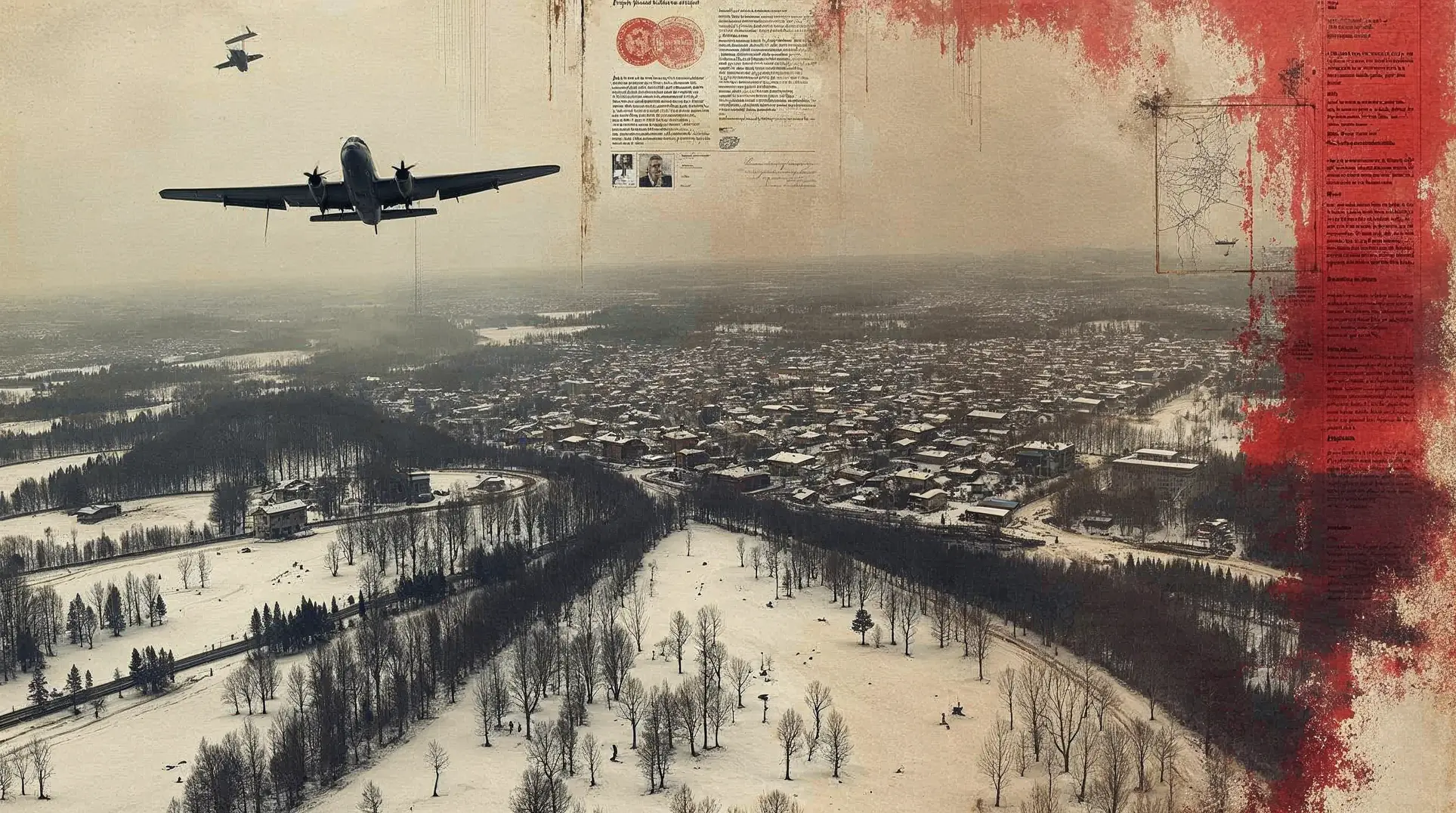
At 5:30 a.m. on December 16, 1944, the fog-shrouded forests of the Ardennes erupted. German artillery opened a massive barrage across a 130-kilometer front, the concussive waves shattering the pre-dawn stillness and sending tree bursts of freezing shrapnel down onto thinly held American positions in the Schnee Eifel and Losheim Gap. U.S. signal platoons, regimental command posts, and forward outposts—many manned by green replacements from the 106th Infantry Division or exhausted survivors of the Hürtgen Forest—jolted awake to the nightmare thud of 88mm and 105mm shells walking through their foxholes. Within ninety minutes, German grenadiers in snow smocks and Panther tanks loomed as dark silhouettes through the mist, advancing on narrow forest tracks and overrunning stunned defenders. The largest German offensive in the West since 1940 had begun, and Allied intelligence had missed it entirely.
Unlock this in-depth audio analysis. This content is reserved for Front Line Members.
Eighty-one years later, on December 16, 2025, wreath-laying ceremonies at Bastogne's Mardasson Memorial and the Bastogne War Museum's "NUTS Weekend" commemorations reminded a new generation of the battle that cost the United States roughly 19,000 dead, 47,000 wounded, and 23,000 missing or captured—and Germany perhaps 100,000 casualties it could never replace. Yet the Battle of the Bulge endures not merely as a human tragedy or a test of American resilience, but as a master class in operational deception, the tyranny of logistics, and the fragility of strategic ambition untethered from material reality. How did the Wehrmacht achieve complete surprise despite Allied air superiority, Ultra intercepts, and numerical dominance? Why did Hitler stake Germany's last armored reserves on a thrust toward Antwerp when fuel stocks could barely sustain a week of mobile operations? And what battlefield decisions—by Eisenhower, Montgomery, Bradley, Patton, and their German counterparts Model and von Manteuffel—determined whether the Meuse would be crossed or the offensive choked in the frozen road junctions of St. Vith and Bastogne?
This analysis reconstructs the Ardennes offensive from its inception in Hitler's East Prussian headquarters through the final restoration of Allied lines on January 25, 1945. It examines the deception mechanisms that blinded Allied intelligence, the operational decisions that shaped six weeks of attritional combat, the role of weather and terrain in determining outcomes, and the strategic consequences for both the Western and Eastern Fronts. Drawing on U.S. Army Center of Military History records, contemporary after-action reports, and declassified intelligence assessments, it offers a realpolitik accounting of what happens when operational art collides with logistical arithmetic—and why the Bulge remains instructive for modern planners contemplating armored maneuver, coalition command under shock, and the enduring primacy of fuel and road capacity as centers of gravity.
The central question is not whether American forces displayed courage at Bastogne or whether German tankers exhibited tactical skill—both are beyond dispute. The question is whether strategic vision, however bold, can succeed when divorced from the material sinews of war. The answer written in the snow and blood of the Ardennes is unambiguous: it cannot.
Strategic desperation and the genesis of Wacht am Rhein
By autumn 1944, Germany's strategic position was terminal. In the east, Soviet armies stood on the Vistula and had cleared the Balkans; in the west, Allied forces had liberated France and closed on the Reich's frontier. Yet Adolf Hitler, ensconced at the Wolfsschanze in East Prussia, refused to accept the logic of two-front encirclement. Instead, he conceived a counter-offensive of Napoleonic ambition: a thrust through the weakly held Ardennes sector to seize the port of Antwerp, split the Anglo-American armies, and fracture the Western coalition. The operation, code-named *Wacht am Rhein* ("Watch on the Rhine") to suggest a defensive posture, would commit over 200,000 troops and nearly 1,400 tanks and assault guns—Germany's remaining operational armored strength in the West—to a roll of the dice on the Western Front.
Field Marshal Walther Model, commanding Army Group B, understood the plan's implausibility. Reaching Antwerp required a 125-mile advance through hostile territory, crossing the Meuse River under Allied air attack, and sustaining mechanized spearheads on fuel stocks that German quartermasters knew were inadequate. Model and his army commanders—SS-Oberstgruppenführer Sepp Dietrich (6th SS Panzer Army), General Hasso von Manteuffel (5th Panzer Army), and General Erich Brandenberger (7th Army)—presented modified, more modest objectives. Hitler overruled them. The Führer's calculus was political as much as military: a dramatic success in the west might drive a wedge between Washington and London, buy time to deploy new Wunderwaffen, and allow the redeployment of forces eastward before the Red Army's anticipated winter offensive. In strategic terms, it was a gamble predicated on enemy disunity and logistical miracles—both proven illusions by 1944.
The offensive's architecture reflected this desperation. Dietrich's 6th SS Panzer Army would deliver the main effort in the north, driving toward Liège and the Meuse crossings via the Elsenborn Ridge and Malmedy. Von Manteuffel's 5th Panzer Army, the operational center of gravity, would punch through the thin VIII Corps line, seize the critical road junctions at St. Vith and Bastogne, and race for the Meuse between Namur and Dinant. Brandenberger's 7th Army would guard the southern flank against counterattack from Patton's Third Army. Supporting the assault were two unconventional operations: Greif, led by SS-Obersturmbannführer Otto Skorzeny, deployed English-speaking commandos in captured American uniforms to seize Meuse bridges and sow confusion; and Stösser, a paratroop drop aimed at securing crossroads near Malmedy. Both failed operationally but contributed to the psychological shock that paralyzed parts of the Allied command in the offensive's opening hours.
What made Wacht am Rhein operationally feasible—for seventy-two hours—was deception and Allied complacency in equal measure.
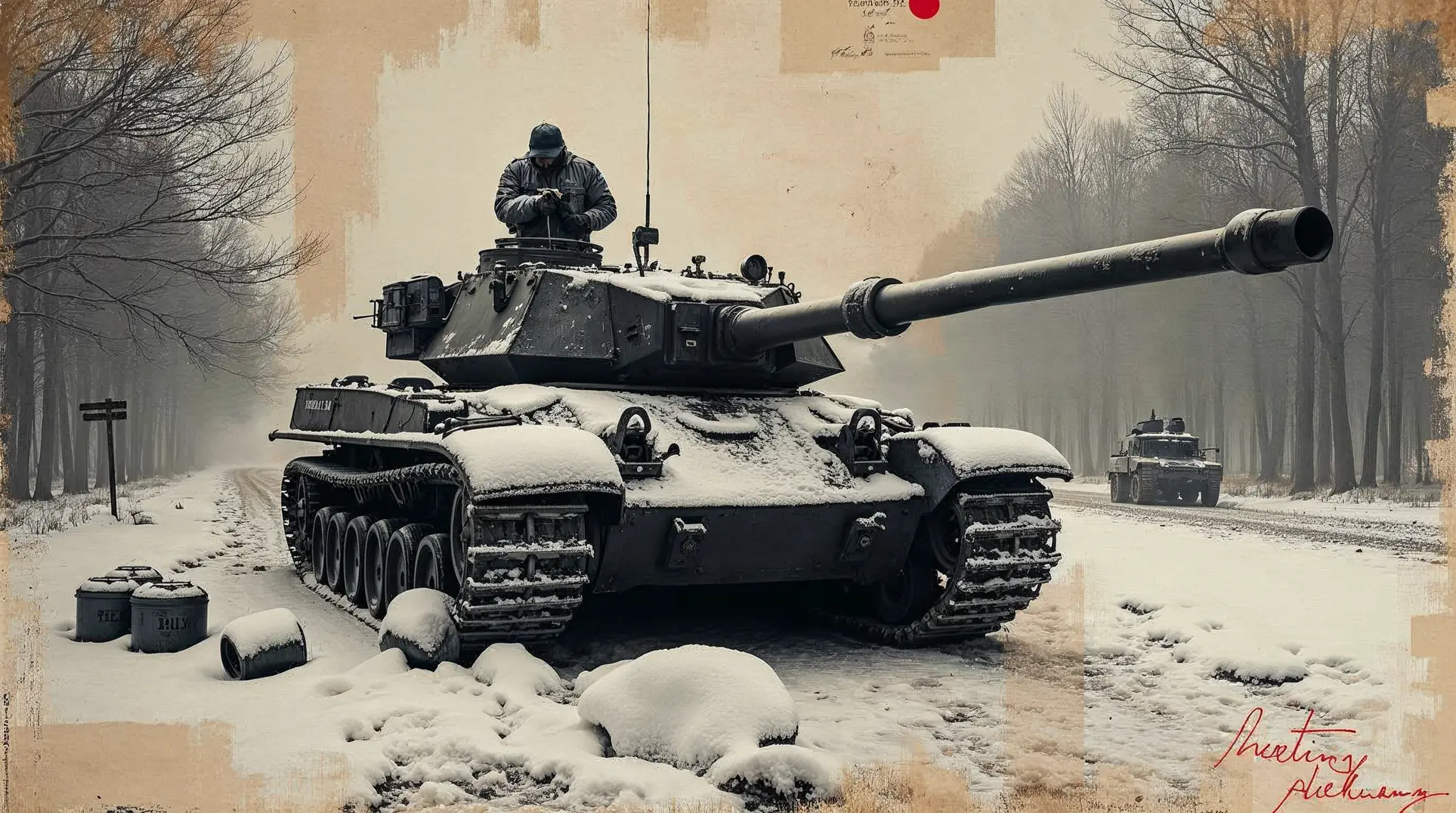
Members are reading: How fuel scarcity and road congestion doomed Hitler's armored spearheads—and why Peiper's race to Stavelot epitomizes the logistical fantasy at the offensive's core.
The northern shoulder: Elsenborn Ridge and the blocking of Dietrich's thrust
While von Manteuffel's 5th Panzer Army achieved the deepest penetrations in the central sector, the northern prong of the offensive—Sepp Dietrich's 6th SS Panzer Army—stalled almost immediately against unexpectedly tenacious American resistance on Elsenborn Ridge. This elevated, forested terrain east of the town of Elsenborn commanded the road network leading northwest toward Liège and the Meuse crossings. Defending the ridge were the U.S. 99th and 2nd Infantry Divisions, the former a green unit that had arrived in the sector only weeks earlier, the latter a battle-hardened formation that had fought from Normandy to the German frontier.
The German assault on Elsenborn began on December 16 with massed infantry attacks by the 12th SS Panzer Division and supporting volksgrenadier units. The Americans, dug into snow-covered foxholes and reinforced by pre-registered artillery, met the attacks with concentrated firepower. U.S. artillery battalions fired over 10,000 rounds in the first twenty-four hours, breaking up German assault formations before they could close with American lines. The defenders, many wearing improvised white camouflage fashioned from bedsheets, held their positions under relentless pressure. By December 20, after repeated failed assaults, Dietrich's commanders recognized that Elsenborn was a fortress they could not reduce. The 6th SS Panzer Army's main effort shifted south, seeking alternate routes, but the critical delay had been imposed. Historian John S.D. Eisenhower later assessed the stand at Elsenborn as potentially the most decisive action of the entire campaign in the north, because it blocked the most direct routes to the Meuse and forced German armor onto secondary roads already clogged with traffic.
The defense of Elsenborn illustrated the interplay of terrain, firepower, and morale. The ridge's elevation provided observation and fields of fire; the American artillery, linked by intact communications, could mass fires rapidly; and the infantry, despite shock and casualties, did not break. This contrasted sharply with sectors farther south where green units, isolated and overrun, surrendered en masse. The difference was leadership, preparation, and the simple fact that the 2nd Infantry Division had veteran NCOs and officers who knew how to organize a defense under pressure. Tactical competence, in short, mattered as much as numbers or firepower.
St. Vith: Delay, decision, and the cost of time
If Elsenborn was the northern anchor, St. Vith became the hinge of the central sector's defense. This small Belgian town sat astride a critical road junction linking the eastern penetration routes to the westward axes toward the Meuse. Von Manteuffel's operational plan required the rapid seizure of St. Vith to open routes for his panzer divisions; American determination to hold it imposed a week-long delay that fatally disrupted German timetables.
The defense of St. Vith was improvised and chaotic. Elements of the 7th Armored Division, rushed south from the Netherlands, arrived on December 17 and formed the core of a composite force that included survivors from the shattered 106th Infantry Division (two of whose regiments had been encircled and forced to surrender in the Schnee Eifel), detachments of the 9th Armored and 28th Infantry Divisions, and scattered engineer and artillery units. Command responsibility fell to Brigadier General Bruce Clarke (7th Armored) and Brigadier General Robert Hasbrouck, who cobbled together a perimeter defense anchored on the town and its surrounding ridges.
For six days, this ad hoc force held against converging attacks by multiple German divisions. The fighting was close-quarter and brutal: tank engagements at ranges under 500 meters in narrow streets, infantry firefights in cellars and rubble, and constant German artillery barrages. American defenders lacked the numbers to seal every penetration; German attackers lacked the fuel and infantry to exploit breaches. By December 21, with St. Vith nearly surrounded and supply routes cut, Field Marshal Bernard Montgomery—who had assumed command of all Allied forces north of the Bulge on December 19 at Eisenhower's direction—ordered withdrawal. The defenders pulled back across the Salm River on the night of December 21–22, abandoning the town but preserving most of their combat power.
The strategic value of St. Vith's week-long stand cannot be overstated. Each day of delay consumed German fuel, tied down divisions needed elsewhere, and allowed Allied reinforcements to move into blocking positions farther west. Von Manteuffel later acknowledged that the protracted fight for St. Vith cost his army the operational tempo necessary to reach the Meuse before Allied reserves could concentrate. In realpolitik terms, St. Vith was a defeat—the Americans withdrew—but operationally it was a victory, because it bought time, the currency that mattered most in December 1944.
Bastogne: Symbol, siege, and the "NUTS!" that echoed
No engagement of the Ardennes offensive has achieved greater symbolic weight than the siege of Bastogne. The town, a minor provincial center in southern Belgium, became the campaign's strategic and psychological focal point because of its road network: seven major highways radiated from Bastogne, making it indispensable for German logistics and maneuver. Recognizing this, the U.S. VIII Corps headquarters, based in Bastogne, rushed the 101st Airborne Division and elements of the 10th Armored Division into the town on December 18–19, even as German columns closed from the north, east, and south.
By December 21, Bastogne was encircled. German forces—elements of the 26th Volksgrenadier Division, Panzer Lehr, and 2nd Panzer Division—surrounded the town, severing ground resupply routes. Inside the perimeter, approximately 18,000 American troops under the acting command of Brigadier General Anthony McAuliffe (the 101st's commander, Major General Maxwell Taylor, was in Washington) organized a circular defense anchored on strong points in the villages surrounding Bastogne—Foy, Bizory, Marvie—and dug into the frozen earth of Bois Jacques and other forested positions north and west of town.
The siege tested logistics, morale, and medical capacity. Ammunition stocks dwindled; by December 22, artillery batteries were rationed to a few rounds per gun per day. Casualty clearing stations, including the aid station in Bastogne where Belgian nurse Renée Lemaire worked, overflowed with wounded. On the evening of December 24, a German bomber struck the aid station, killing Lemaire and numerous patients—a stark reminder that the siege's human cost extended beyond combatants. Yet the weather break on December 23–24 allowed C-47 transports to drop supplies by parachute into the shrinking perimeter, delivering ammunition, medical supplies, and a psychological boost that sustained the defense.
The most famous moment of the siege came on December 22, when German officers delivered a surrender ultimatum to McAuliffe. His one-word reply—"NUTS!"—was formalized in a typed message and returned to the German emissaries, who required an explanation of the American idiom. Translated as a rejection, the response resonated far beyond Bastogne, becoming an emblem of American defiance and humor under pressure. Operationally, McAuliffe's refusal to surrender denied the Germans the road network and forced them to commit divisions to contain Bastogne that were desperately needed elsewhere.
Relief came on December 26, when lead elements of the 4th Armored Division—part of Lieutenant General George S. Patton's Third Army—punched through the German cordon from the south, opening a narrow corridor into Bastogne. The linkup was not the end of the battle; fighting around Bastogne continued into January. But the symbolic and operational significance of the relief was immense: it demonstrated Allied operational agility, validated the decision to hold Bastogne, and marked the point at which the German offensive's momentum irreversibly stalled.
Members are reading: Examining the Malmedy and Chenogne massacres—how atrocities shaped morale, hardened resistance, and reveal the fragility of discipline under existential combat stress.
The Meuse line and the western limit of German advance
As German spearheads pushed west in late December, the critical question became whether they would reach and cross the Meuse River. The Meuse, running north-south through Belgium between Liège and Givet, was the geographic and operational threshold of the offensive: crossing it would open the road to Antwerp and validate Hitler's strategic vision; failing to cross it would condemn the offensive to culmination in the Ardennes forests. By December 23, the answer was becoming clear.
The westernmost German penetration was achieved by the 2nd Panzer Division, which reached the village of Foy-Notre-Dame—roughly four kilometers from the Meuse at Dinant—on December 24. This was the high-water mark. American and British forces had rapidly organized a defense of the Meuse crossings. British XXX Corps, under Lieutenant General Brian Horrocks, moved into blocking positions covering the bridges at Namur, Dinant, and Givet; British 6th Airborne Division and 53rd Infantry Division reinforced the western tip of the salient. American units, including the 84th Infantry Division at Marche and the 2nd Armored Division, counterattacked the exposed flanks of German columns.
On December 24–25, the U.S. 2nd Armored Division struck the 2nd Panzer Division's flank near Celles, destroying much of its combat strength and forcing survivors to withdraw. The engagement was brief but decisive: German tanks, immobilized by fuel shortages and caught in the open by American armor and artillery, were systematically destroyed. The wreckage near Celles—burned-out Panthers and Mark IVs littering the snow-covered fields—symbolized the offensive's operational failure. The Meuse would not be crossed; the window for operational success had closed.
The Meuse defense illustrated the advantages of interior lines and operational reserves. Because the Allies controlled the road and rail networks west of the bulge, they could shift divisions—British, American, and even Canadian units farther north—into blocking positions faster than the Germans could sustain their advance. The German offensive, stretched over a salient nearly fifty miles deep, faced lengthening supply lines, constant flank threats, and collapsing logistics. The Meuse, as both geographic feature and operational objective, became the line where strategic ambition met material reality and lost.
The weather breaks: Air power's return and the culmination of the offensive
The clearing skies over the Ardennes on December 23–24 marked a turning point as significant as any ground engagement. For the first week of the offensive, persistent fog and overcast had grounded Allied tactical air, neutralizing one of the Allies' decisive advantages. German columns moved by day with relative impunity; supply convoys operated without fear of interdiction; and Luftwaffe fighters made rare appearances over the battlefield, providing fleeting air support.
When the weather broke, the full weight of Allied airpower descended. The U.S. Ninth Air Force and RAF Second Tactical Air Force launched thousands of sorties, striking German columns, bridges, supply dumps, and troop concentrations. P-47 Thunderbolts, equipped with rockets and bombs, hunted tanks and trucks along the narrow Ardennes roads; medium bombers struck marshaling yards and road junctions; and tactical reconnaissance flights finally provided real-time intelligence on German dispositions. Simultaneously, C-47 transports began aerial resupply missions into Bastogne, dropping over 250 tons of ammunition, medical supplies, and food by parachute on December 23 alone.
The operational impact was devastating for German forces. Columns that had advanced relatively unmolested were now subject to near-continuous air attack. Movement by day became suicidal; German units shifted to night movement, sacrificing tempo. Fuel trucks and ammunition convoys, already scarce, were destroyed in large numbers, exacerbating the logistics crisis. German commanders later cited the resumption of Allied air operations as the single factor that most decisively shifted the operational balance.
For the Allies, the weather break validated the investment in tactical air forces and joint air-ground coordination. Close air support missions were coordinated through forward air controllers embedded with ground units; air interdiction missions targeted the German rear systematically. The integration of airpower into the ground battle—still a relatively new operational capability in 1944—demonstrated its potential to shape outcomes even in terrain considered unsuitable for air operations.
January counteroffensives: The collapse of the bulge
By early January 1945, the German offensive had culminated. Fuel exhaustion, personnel attrition, equipment losses, and relentless Allied pressure from north and south turned the salient into a trap. Hitler, predictably, refused to authorize a timely withdrawal, insisting that every kilometer of captured ground be held. The result was a slow-motion collapse that consumed what remained of Germany's armored reserves in the West.
The Allied counteroffensive unfolded on two axes. From the north, Montgomery's 21st Army Group—including the U.S. First Army, now returned to Bradley's command on January 17—attacked south toward Houffalize. From the south, Patton's Third Army drove north. The pincers closed slowly; German forces conducted a stubborn fighting withdrawal, contesting every village and ridgeline. Conditions were nightmarish: temperatures plunged below zero, snow blanketed the landscape, and roads became ice sheets. American soldiers advancing through the same ground that had been contested in December encountered frozen German and American corpses from earlier battles, a grim reminder of the human cost.
By January 16, U.S. First and Third Armies linked up at Houffalize, cutting the bulge in half. German units withdrew east across the Our River, abandoning hundreds of vehicles, guns, and heavy equipment that could not be recovered. By January 25, the front had been restored to approximately its December 15 positions. The Battle of the Bulge was over.
The butcher's bill was staggering. U.S. forces sustained approximately 75,000–83,000 casualties, including 19,000 killed, 47,000 wounded, and 23,000 captured or missing. German losses, less precisely documented, likely totaled 80,000–100,000, including a disproportionate share of experienced NCOs, tank crews, and officers. Hundreds of German tanks, assault guns, and vehicles—irreplaceable given Germany's collapsing industrial capacity—littered the Ardennes. Thousands of Belgian and Luxembourg civilians had been killed; entire villages, including Bastogne, Stavelot, and La Gleize, lay in ruins.
Members are reading: Why the Bulge's strategic consequences—hollowing Wehrmacht reserves, accelerating Soviet offensives, and validating coalition warfare—offer critical lessons for modern operational planners facing logistics constraints and coalition friction.
Conclusion: Memory, arithmetic, and the primacy of material reality
On December 16, 2025, as dignitaries laid wreaths at the Mardasson Memorial and reenactors in period uniforms walked the frozen trails of Bois Jacques during Bastogne's "NUTS Weekend," the commemorations honored sacrifice but also transmitted a harder lesson: strategic ambition unsupported by material reality is a path to catastrophe. The Battle of the Bulge was not lost by German soldiers, who displayed tactical competence and resilience under appalling conditions, nor won solely by American courage, though that was plentiful. It was decided by fuel stocks, road capacity, weather patterns, and the unforgiving arithmetic of logistics—the same arithmetic that has shaped every major campaign from Stalingrad to Baghdad.
Hitler's Ardennes gamble rested on assumptions that were strategically seductive but operationally implausible: that surprise would paralyze Allied response, that captured fuel would sustain the advance, that weather would neutralize Allied airpower long enough to reach the Meuse, and that a dramatic success would fracture the Anglo-American coalition. Every assumption failed. Allied forces, after initial shock, adapted with speed and cohesion; fuel remained scarce and uncaptured; weather turned against the Germans; and the coalition, despite frictions, held. By late January 1945, Germany's last armored reserves in the West had been consumed in a salient that never reached its objectives, accelerating the Reich's final collapse.
For military professionals and historians examining the Bulge eighty-one years later, the campaign's value lies not in its drama—though the siege of Bastogne and McAuliffe's "NUTS!" will always resonate—but in its demonstration of what happens when operational planning ignores constraints. Modern militaries, equipped with precision weapons, real-time intelligence, and networked command systems, are not immune to the same error. Technological sophistication does not exempt forces from the need for fuel, ammunition, spare parts, and trafficable routes; it often increases those dependencies. The lesson of the Bulge is that wars are contests of logistics and sustainment as much as firepower and maneuver, and that adversaries who forget this arithmetic pay in blood, equipment, and strategic failure.
The American soldiers who held the Elsenborn Ridge in bedsheet camouflage, who defended St. Vith's rubble-strewn streets, and who endured Bastogne's frozen foxholes earned their place in history. But the deeper tribute to their sacrifice is to study the battle with clear eyes: to understand not only what they endured but why the offensive they stopped was doomed from inception. The Ardennes was Hitler's last roll of the dice, a strategic fantasy that collided with the iron realities of fuel, terrain, and Allied material preponderance. That collision defined the war's final months and offers a template for understanding modern conflict: great power competition, coalition warfare, and armored maneuver all remain subject to the same constraints that shaped the snows of December 1944. Ignore them at your peril.
Subscribe to our free newsletter to unlock direct links to all sources used in this article.
We believe you deserve to verify everything we write. That's why we meticulously document every source.


