


Update: Maduro & Partner captured by U.S. forces
 Viktor Petersen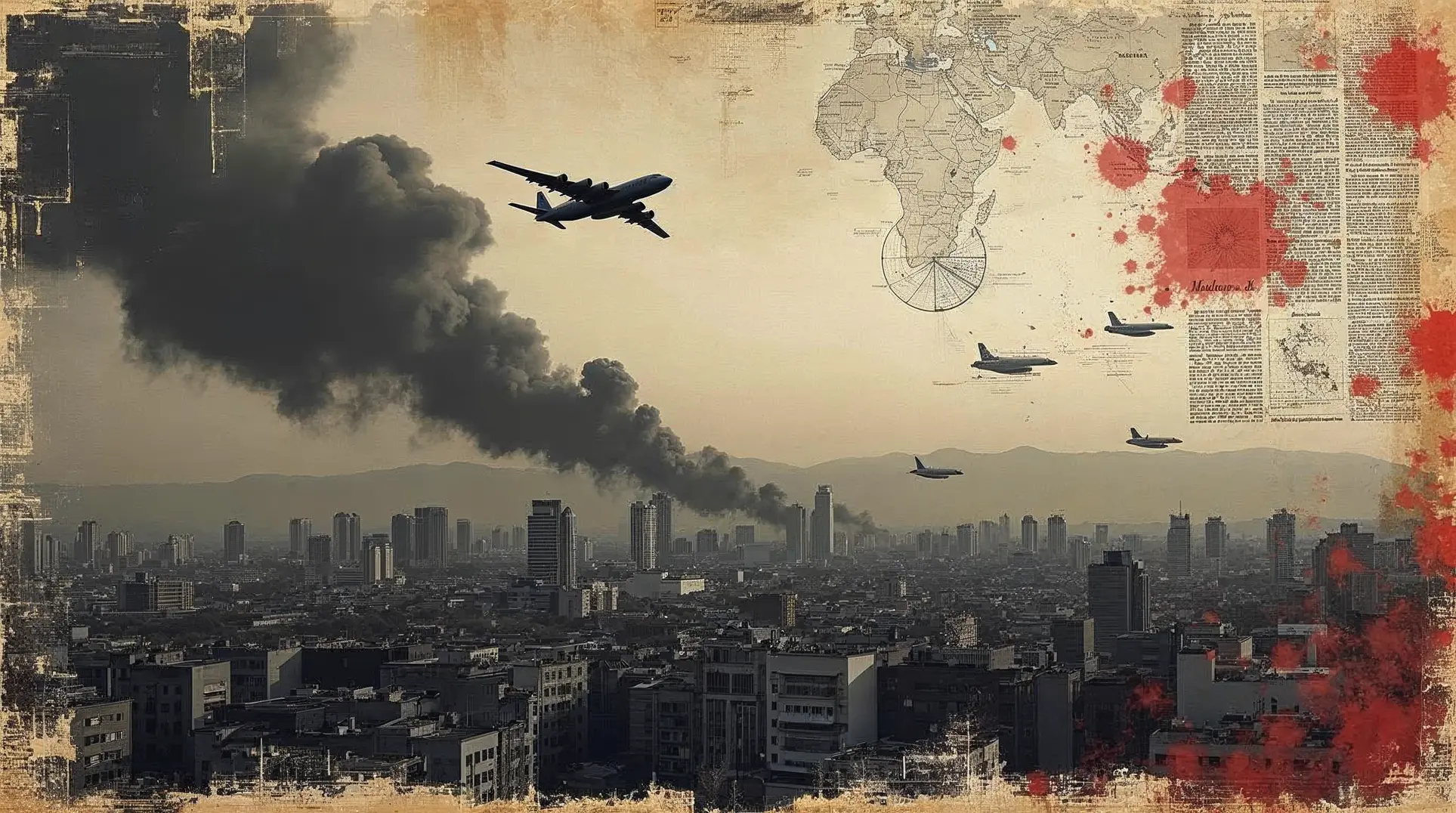
In the early hours of Saturday, January 3, 2026, at least seven explosions ripped through southern Caracas, concentrated near Venezuela's most significant military installations. Eyewitnesses reported the sound of low-flying aircraft and helicopters over the Fuerte Tiuna military base and La Carlota airbase around 2 a.m. local time, followed by columns of black smoke rising over the capital's southern districts. Power outages spread through surrounding neighborhoods as residents scrambled for information amid the chaos. The Venezuelan government immediately accused the United States of conducting direct military strikes on both civilian and military infrastructure, while Washington has offered no public response.
The explosions do not represent an isolated incident, but rather the potential kinetic escalation of a months-long confrontation between the Trump administration and the Maduro regime. The strategic ambiguity surrounding the strikes—who conducted them, under what authority, and toward what objective—matters less at this moment than the structural reality they reveal: two governments locked in an escalatory pattern that has now produced explosions over a national capital. The question is no longer whether this conflict will turn violent, but whether either side retains the capacity to control its trajectory.
The architecture of escalation
The Caracas strikes emerge from a deliberate US policy architecture designed to maximize pressure on the Maduro government through increasingly coercive measures. Over the past three months, the Trump administration has deployed a carrier strike group to the Caribbean, positioned thousands of troops across regional bases, and signaled imminent land operations predicated on Venezuela's designation as a "narco-terrorist" state. This legal framing has functioned as a pretext for bypassing traditional constraints on the use of force, allowing the administration to present military action as counterterrorism rather than interstate warfare.
The pattern of violence has already crossed the threshold from threat to action. In December, US forces conducted lethal strikes on what were officially described as drug-smuggling vessels in Venezuelan waters—attacks that many international legal experts characterized as extrajudicial killings absent due process or transparent evidence. President Trump himself publicly acknowledged a US "hit" on Venezuelan soil, a rare admission that blurred the line between covert operations and declared military policy. The preparation of strikes on Venezuelan military installations had been reported in recent weeks, creating an operational environment where Saturday's explosions appear less as aberrations than as logical extensions of an established trajectory.
Venezuela's response has mirrored this escalation. The Maduro government launched a massive military mobilization in direct response to the US Caribbean buildup, positioning anti-aircraft batteries, conducting live-fire exercises, and publicly preparing its population for external attack. This mutual military posturing has created the conditions for miscalculation, where conventional deterrence signals can be misread as preparation for offensive action, and defensive measures interpreted as aggressive intent.
Members are reading: How the strategic ambiguity around the Caracas strikes reveals three escalation pathways—and why none offer a clear exit.
The point of convergence
Regardless of attribution, the Caracas explosions have produced a tactical situation where both governments face constrained options. For the Maduro regime, the strikes—real or exploited—provide an opportunity to position Venezuela as the victim of imperialist aggression, a narrative with deep resonance across Latin America and among non-aligned nations. Domestically, external attack justifies the suspension of remaining civil liberties, the arrest of opposition figures on collaboration charges, and the militarization of Venezuelan society under emergency conditions.
For the United States, silence carries its own message. Failure to deny the strikes will be interpreted globally as tacit confirmation of a military operation outside any international legal framework. An explicit denial, conversely, risks being undermined by subsequent reporting or intelligence leaks, damaging US credibility. More fundamentally, the Trump administration's declared policy of regime change in Venezuela makes denials strategically incoherent—having publicly threatened military action, disavowing it when it apparently occurs creates operational confusion among allies and adversaries alike.
The security dilemma now operates at maximum intensity. Each defensive measure taken by Venezuela—mobilizing reserves, dispersing military assets, activating air defenses—appears to Washington as preparation for attacks on US personnel or regional allies. Each US military movement in the Caribbean—repositioning naval assets, conducting reconnaissance flights—appears to Caracas as the final preparation for invasion. In this environment, accidents, miscommunications, or unauthorized actions by mid-level commanders can trigger responses that rapidly exceed both governments' control.
The explosions over Caracas may ultimately prove less significant for their immediate tactical impact than for what they reveal about the deterioration of crisis management mechanisms between the two governments. With no diplomatic channels, no shared understanding of red lines, and no mutual interest in de-escalation, the structural conditions exist for this confrontation to expand beyond either government's original intentions. The hemisphere has entered a period where events, rather than strategies, may determine outcomes.
Subscribe to our free newsletter to unlock direct links to all sources used in this article.
We believe you deserve to verify everything we write. That's why we meticulously document every source.


