


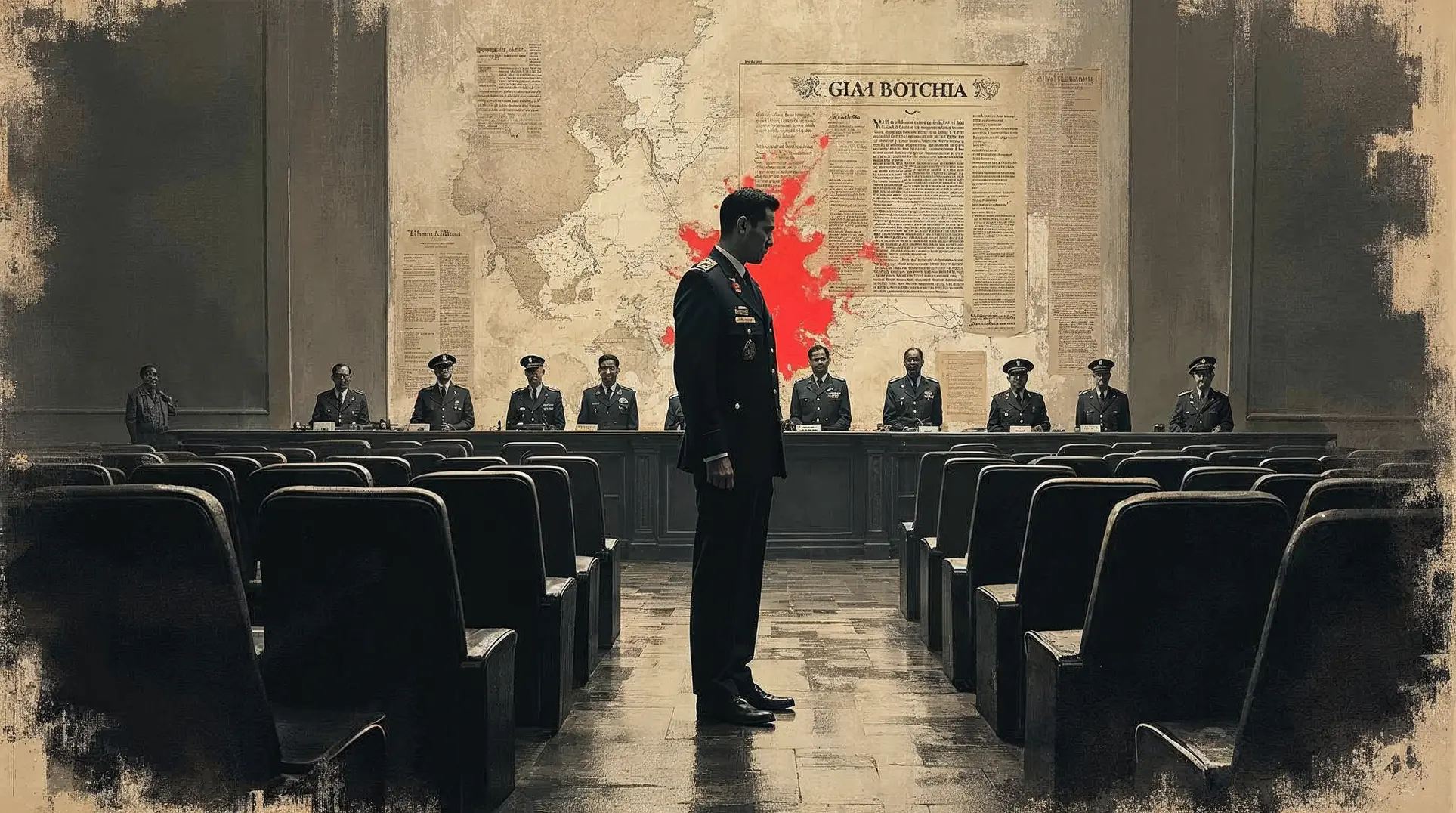
The pattern recognition is unambiguous. When General Zhang Youxia, one of China's most senior military officials and a princeling with actual combat experience, vanished from public view in late 2024 and was subsequently purged from the Central Military Commission, it marked not merely another casualty in Xi Jinping's anti-corruption campaign—it signaled the completion of what analysts are calling the "total annihilation of the high command." My analysis of the data reveals a troubling trajectory: Xi's purges have evolved from a strategic tool of political consolidation into a self-destructive cycle that is systematically degrading the People's Liberation Army's command structure, operational readiness, and institutional memory.
This matters profoundly because the conventional wisdom—that internal turmoil in the PLA buys time for the United States and its allies—misses the central dynamic. The real danger isn't a strong, confident Chinese military; it's a weakened, inexperienced one led by officers whose primary qualification is loyalty rather than competence. A PLA in disarray, desperate to prove its resolve to an increasingly paranoid supreme commander, represents a far greater risk of catastrophic miscalculation, particularly regarding Taiwan. Xi has created a military machine that is simultaneously less capable and more volatile—a combination that destabilizes the entire Asia-Pacific security architecture.
The systematic hollowing of military leadership
The scale of the purge is unprecedented in the PLA's modern history. Since 2023, Xi has removed or investigated at least nine senior generals, including two defense ministers in succession—Li Shangfu and his predecessor Wei Fenghe. The Rocket Force, responsible for China's nuclear arsenal and conventional missile capabilities, has been gutted. But Zhang Youxia's removal represents something qualitatively different.
Zhang wasn't simply another general. He was a "princeling"—his father fought alongside Xi's father during the revolution—giving him the pedigree that typically confers immunity in Chinese elite politics. He was vice chairman of the Central Military Commission, the apex of military power reporting directly to Xi. Most critically, Zhang belonged to a vanishing generation: officers with actual combat experience from the 1979 Sino-Vietnamese War. In a military that hasn't fought a major conflict since that disastrous border war, combat veterans provide the institutional memory and hard-won lessons that cannot be learned from exercises or simulations.
As Lyle Morris, senior fellow for foreign policy and national security at the Asia Society Policy Institute, observed: "The PLA is in disarray." Christopher K. Johnson, president of the China Strategies Group, put it more starkly: this represents the "total annihilation of the high command." My analysis of PLA leadership turnover data shows that the current rate of senior officer removal exceeds even the chaos of the Cultural Revolution when measured against the size of the modern command structure. Xi is not pruning his military—he is cannibalizing its brain trust.
The official narrative frames these purges as anti-corruption measures, and corruption within the PLA is indeed endemic. But the pattern suggests something darker: the elimination of anyone who might possess independent judgment, institutional power, or the credibility to question Xi's decisions. When you remove corruption as a real constraint *and* eliminate experienced voices as a check on poor judgment, you don't get a cleaner, more effective military. You get one that is both weaker and more reckless.
Members are reading: How the purge creates perverse incentives that make miscalculation on Taiwan more likely, not less.
The erasure of institutional communication channels
The strategic implications extend beyond China's borders. At precisely the moment when the new U.S. National Defense Strategy emphasizes stable military-to-military communication to prevent miscalculation, Beijing is systematically destroying its own communication channels. Zhang Youxia was not just known to U.S. defense officials—he was respected as a serious, experienced counterpart capable of candid dialogue.
Former U.S. officials have expressed alarm at this loss. The relationship between senior military leaders of rival powers serves a critical function: it provides a mechanism for de-escalation, clarification of intent, and prevention of inadvertent conflict. During the Cold War, the U.S. and Soviet militaries maintained backchannel communications precisely because both sides understood that miscommunication could trigger nuclear war. The Asia-Pacific today lacks even that fragile architecture.
With Zhang gone and the CMC in flux, who does the U.S. contact in a crisis? Which PLA leader has the authority, experience, and confidence to engage in the kind of frank exchange that might prevent an incident from spiraling? The military-to-military relationship, already fragile, now faces a black box where institutional knowledge and trusted relationships have been purged along with the generals who held them. This isn't just an American problem—it's a regional stability problem. <a href="https://crisis.zone/u-s-intelligence-doubts-venezuela-s-interim-leader-will-cut-ties-with-adversaries-as-rubio-threatens-force">As we've seen in other theaters</a>, when communication channels collapse, miscalculation thrives.
The instability paradox
The conventional analysis in Washington and allied capitals suggests that PLA turmoil provides a window of opportunity—that internal disarray will delay or deter Chinese military action, particularly regarding Taiwan. This assessment is dangerously incomplete. It assumes rational, confident decision-making by a leadership secure in its power and patient in its timeline. But Xi has demonstrated neither quality.
The real danger of a weakened, purged military is that it creates pressure for demonstrative action. A PLA leadership desperate to prove loyalty and competence to a paranoid supreme commander might advocate for aggressive moves not despite their weakness, but because of it. History is replete with examples of unstable regimes initiating conflicts to shore up domestic legitimacy or prove their resolve. <a href="https://crisis.zone/trump-weighs-targeted-strikes-on-iran-as-pressure-campaign-intensifies">The pattern repeats across different theaters and ideologies</a>—insecurity breeds aggression.
Moreover, the purge's impact on operational readiness is non-linear. A military doesn't simply perform less well when its command structure is gutted; it becomes unpredictable. Orders may be misunderstood, coordination may fail, units may act on outdated assumptions or out of fear of appearing weak. In a crisis scenario—a confrontation in the Taiwan Strait, an incident in the South China Sea—this unpredictability dramatically increases the risk of escalation that neither side intended.
The architecture of miscalculation
Xi Jinping's obsession with absolute control has produced a profound paradox: in seeking to make the PLA a perfectly loyal instrument of his will, he has made it a less capable and more dangerous actor. The data is clear. The institutional decay is measurable. What remains uncertain is whether Xi recognizes the trap he has constructed, or whether he is surrounded by too many loyalists to receive that message.
For the United States, its allies, and the region, the task now is not to celebrate Chinese military weakness but to prepare for the instability it generates. The most dangerous moment in great power competition is not when your adversary is strong and confident, but when they are weak and desperate. Xi has built that moment into the structure of his own military. The question is no longer whether the PLA can execute a successful Taiwan invasion—it's whether a hollowed-out command structure, led by inexperienced sycophants, will miscalculate its way into trying. That is the true crisis the purge has created, and it makes the Indo-Pacific more volatile with each general who disappears.
Subscribe to our free newsletter to unlock direct links to all sources used in this article.
We believe you deserve to verify everything we write. That's why we meticulously document every source.


