


On December 25, 2025, US military assets struck Islamic State militants in Sokoto State, Northwest Nigeria, in what both governments described as a coordinated operation. President Donald Trump's announcement on Truth Social, however, told a starkly different story than the one emerging from Abuja. He framed the action as righteous intervention against "ISIS Terrorist Scum" who had been "targeting and viciously killing, primarily, innocent Christians, at levels not seen for many years, and even Centuries!" Defense Secretary Pete Hegseth's follow-up—"More to come..."—signaled this was just the opening salvo of a broader campaign.
The Nigerian government acknowledged the joint operation but has conspicuously refused to endorse Washington's characterization. President Bola Ahmed Tinubu's Christmas message emphasized interfaith harmony, while official statements carefully noted that armed groups threaten both Muslim and Christian communities. This isn't diplomatic nicety—it reflects a fundamental disagreement about what is actually happening in Northwest Nigeria, and who gets to define it. The battle over this narrative carries implications that extend far beyond one airstrike.
Domestic messaging dressed as counterterrorism doctrine
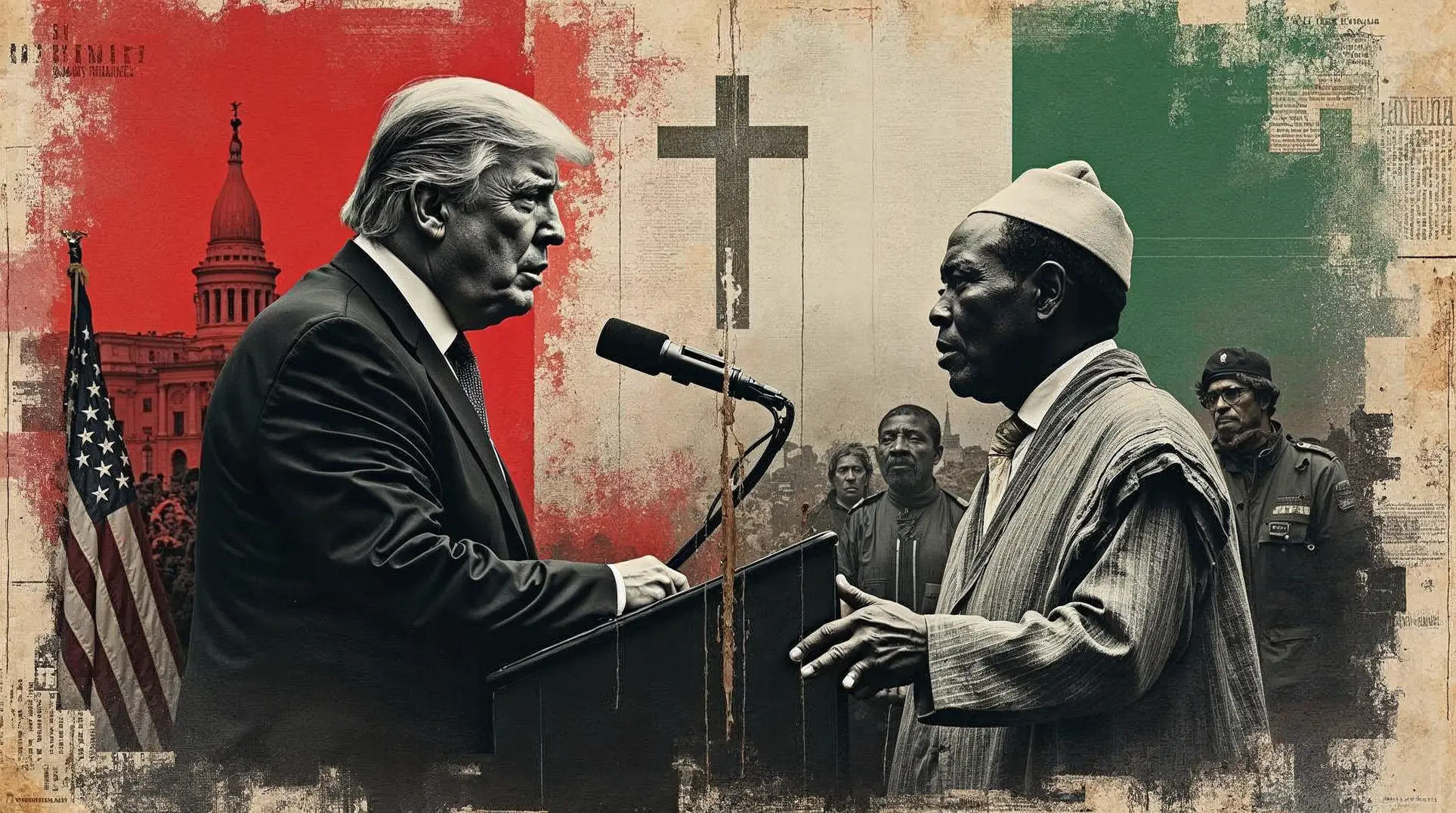
Trump's framing was calibrated for a specific American audience, not Nigerian reality. The Christmas Day timing, the apocalyptic language about persecution at levels "not seen for...Centuries," the moral clarity of protecting innocent Christians from terrorist evil—these are elements of a story designed to resonate with the right-wing evangelical base that has pushed him since October to intervene militarily on this precise issue. It simplifies an extraordinarily complex security landscape into a digestible narrative of good versus evil, righteous America versus jihadist barbarism.
This rhetorical strategy isn't new for Trump, but deploying it to describe a sovereign African nation's internal security crisis creates immediate friction. Nigeria isn't asking for a civilizational crusade; it's managing a multifaceted conflict that involves resurgent Boko Haram factions, bandit networks, resource competition, and yes, jihadist cells including the likely target of this strike—Lakurawa operatives linked to Islamic State Sahel Province. Reducing this to a Christian persecution narrative doesn't clarify the situation; it actively distorts it for domestic political consumption.
The Nigerian government's position reflects this tension. Abuja needs the strike capability—its military is overstretched across multiple fronts, and regional security dynamics are increasingly volatile. But accepting Washington's framing would be catastrophic domestically, potentially inflaming religious divisions in a nation roughly split between Muslim and Christian populations, where careful interfaith balance is essential to stability.
Members are reading: The strike reveals a sovereignty trap where Nigeria needs military capabilities but loses control over its own security narrative.
Navigating the narrative battlefield
The Nigerian government's careful response reflects awareness that this is as much a communications challenge as a security operation. Tinubu cannot afford to alienate Washington—the military relationship provides real capabilities against genuine threats. But he also cannot afford to let an external power define Nigeria's conflicts in terms that could destabilize the delicate sectarian balance his administration works to maintain.
What emerges is a pattern where the physical strike and the narrative strike are almost separate operations. On the ground, Nigerian and US forces targeted ISSP-linked militants in a coordinated action that likely degraded the Lakurawa cell's operational capacity. In the information space, two governments are telling fundamentally different stories about what that action means and why it happened. One narrative centers Christian victimhood and American intervention; the other emphasizes joint operations against shared threats to all Nigerian communities.
The question isn't which narrative is more accurate—the facts on the ground clearly support Nigeria's more complex characterization. The question is which narrative gains traction, and what that means for future operations. If Washington's framing dominates internationally, it constrains Abuja's room for maneuver, potentially complicating Muslim-majority northern Nigeria's relationship with the federal government and feeding regional perceptions of Western imposition.
Stability deferred
The airstrike may have eliminated specific militants, but it has introduced new variables into an already volatile equation. Nigeria's security challenges require both military action and political legitimacy. External intervention framed in civilizational terms threatens the latter even while providing the former. For a government trying to maintain partnership with the West while navigating domestic religious complexity and regional skepticism of Western motives, Trump's rhetoric creates obstacles as significant as the jihadist threat it purports to address.
The battle for Sokoto may be ongoing, but the battle over who controls the narrative—and what that means for African sovereignty in an era of renewed great power competition—has only just begun.
Subscribe to our free newsletter to unlock direct links to all sources used in this article.
We believe you deserve to verify everything we write. That's why we meticulously document every source.


