


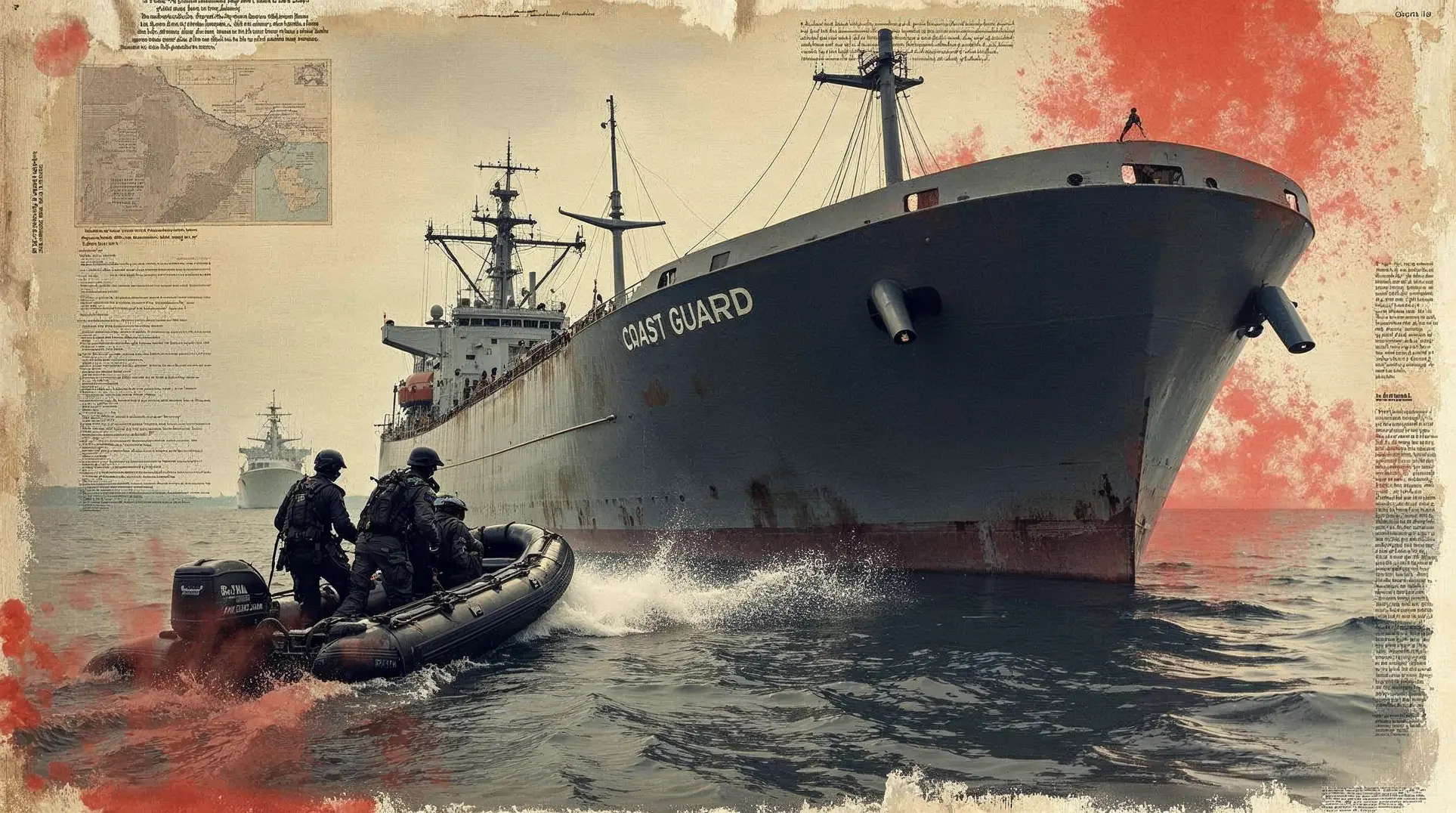
President Donald Trump's declaration that "if [Maduro] plays tough, it'll be the last time he's ever able to play tough" signals more than rhetoric. On December 16, 2025, Trump ordered a "total and complete blockade" of U.S.-sanctioned oil tankers entering and leaving Venezuela, designated the Maduro government a foreign terrorist organization, and authorized seizures that have already netted at least two vessels and nearly two million barrels of crude. The U.S. Coast Guard remains in active pursuit of a third tanker, the Bella 1, which refused to stop, according to Reuters.
This is no longer a sanctions regime enforced through banks and paperwork. The shift to at-sea interdiction—backed by what Trump calls "the biggest [armada] we've ever had in South America"—crosses a legal threshold that transforms economic pressure into something closer to an act of war. With Russia and China condemning the move on December 23 and Caracas signaling it will deploy naval escorts for tankers, the Caribbean has become a compressed theater where miscalculation could ignite a crisis that draws in powers far beyond Caracas and Washington.
From paper to steel: the operational reality
The Coast Guard seizures mark the culmination of a maritime enforcement campaign that has escalated sharply since September. U.S. forces have conducted more than two dozen strikes on boats alleged to carry drugs in the Pacific and Caribbean, resulting in approximately 95–100 deaths. The December 16 blockade order formalizes what was already underway: physical interdiction of vessels in or near international waters, regardless of flag state.
Trump has made clear he intends to keep what the U.S. seizes. "We're keeping it. We're keeping the ships also," he said of the 1.9 million barrels aboard one captured tanker, adding that the crude might be sold or added to the Strategic Petroleum Reserve. This is not temporary asset freezing—it is confiscation under a claim that Venezuela's oil and land were "stolen from the U.S.," a reference to the 2007 nationalizations under Hugo Chávez that forced out ExxonMobil and ConocoPhillips when PDVSA took majority stakes.
Venezuela responded immediately. On December 17, Caracas condemned the blockade as a "grotesque threat" and violation of international law, free trade, and sovereignty, vowing to challenge the U.S. at the United Nations. Maduro has declared that oil trade will continue and framed American intentions as colonial theft of natural resources. The Venezuelan navy, according to government statements, will escort tankers—a move that places armed state vessels in proximity to U.S. Coast Guard cutters enforcing what Washington calls sanctions compliance and what Caracas calls piracy.
Members are reading: How the legal ambiguity of high-seas interdiction and China's stake in Venezuelan crude create pathways to miscalculation and great-power confrontation.
Strangling the revenue stream and what comes next
Oil is Maduro's principal lifeline. The U.S. sanctions regime since 2019 pushed Venezuela into reliance on a shadow fleet of spoofing tankers moving crude to China, with a licensed carveout for Chevron's operations. Analysts expect that seizures will quickly cut export capacity, fill onshore storage, and force production cuts. The second tanker seizure has already signaled that this is not a one-off action but a sustained campaign.
Historically, when oil revenue contracts, regimes like Maduro's have turned to alternative rents—gold mining, cocaine trafficking, and other illicit economies—to sustain patronage networks and state functions. The humanitarian cost of tighter economic pressure will likely deepen, even as the strategic calculus in Washington focuses on regime change or capitulation. Whether that pressure translates into political fracture inside Venezuela or simply further entrenchment remains an open question, one shaped as much by Caracas's ability to secure alternative revenue as by the durability of its security apparatus.
The next two weeks will clarify intent and risk. Watch whether the U.S. interdicts a China-bound cargo and how Beijing responds beyond statements. Watch for any reported incidents at sea involving Venezuelan escorts or contested boardings. Watch the UN, where Caracas will seek to isolate Washington diplomatically, and the oil markets, where storage constraints will force Maduro to cut output or find new routes. Trump's Venezuela oil blockade has moved the conflict from the realm of economic coercion into the domain of kinetic enforcement. The question now is whether the architecture of deterrence holds, or whether the Caribbean becomes the theater where legal ambiguity and great-power friction converge into something no one fully controls.
Subscribe to our free newsletter to unlock direct links to all sources used in this article.
We believe you deserve to verify everything we write. That's why we meticulously document every source.


