


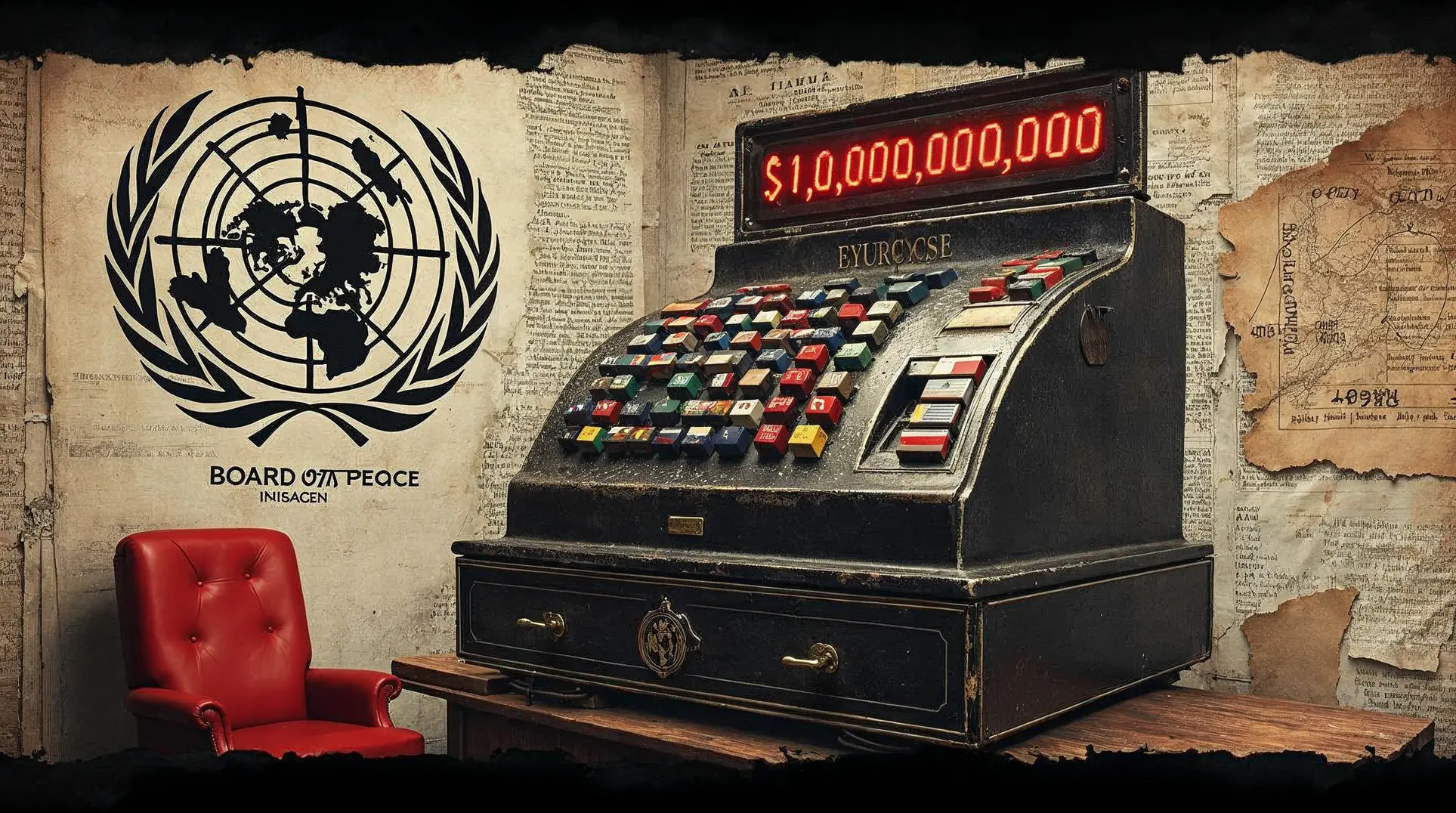
The 'Board of Peace' is not a humanitarian initiative. It is a business model. President Trump has created something unprecedented in modern statecraft: a parallel power structure where permanent membership costs $1 billion, temporary seats are granted at his discretion, and all decisions flow through a single chairman with monarchical authority. This is not diplomacy; it is the privatization of geopolitical influence, and it represents the most honest articulation yet of how power actually operates in our post-multilateral era.
The conventional analysis will focus on Gaza's reconstruction needs or the plan's viability. That misses the point entirely. The Board of Peace is Gaza in name only. Its charter—kept deliberately vague and unpublished—doesn't even mention Gaza specifically. The real product being sold is proximity to American power, and judging by Hungary and Vietnam's immediate acceptance, there's already a market for it. We are witnessing the logical endpoint of 'America First' foreign policy: the creation of a subscription-based world order where influence is not inherited or earned through institutional seniority, but purchased outright.
The illusion of legitimacy, the reality of ownership
The Board's defenders will point to UN Security Council Resolution 2803, which endorsed Trump's broader Gaza plan, as proof of legitimacy. This is sophistry. Yes, the resolution passed—largely because the alternative was continued catastrophe—but the board's actual structure bears no resemblance to multilateral norms. The United Nations operates on the principle that sovereign states, regardless of wealth, possess equal legal status. The Security Council's permanent members hold their seats because they won World War II, not because they paid admission fees.
The Board of Peace inverts this entirely. Power is explicitly for sale. A three-year rotating membership requires no financial contribution at all, creating a two-tier system: those who pay for permanence and those who serve at the chairman's pleasure. This isn't even subtle. The US official who leaked the charter details specified that the $1 billion would "go to rebuilding Gaza," as if that justifies the structure. But follow the logic: if the goal is reconstruction, why not channel funds through existing mechanisms like the World Bank or UN agencies? Because reconstruction is the pretext, not the purpose.
The board's true function is revealed in its composition. Current members include Hungarian Prime Minister Viktor Orbán, Vietnamese officials, Argentine President Javier Milei, and a collection of businesspeople with no diplomatic experience but proven loyalty to Trump. This is not a coalition of the willing; it is a coalition of the purchased. Each member brings something Trump values—Orbán brings European disruption, Vietnam brings Southeast Asian positioning against China, Milei brings ideological alignment—and in return, they receive what money cannot usually buy: institutionalized access to the world's dominant military and economic power.
The chairman's absolute domain
Here is where the façade of collective governance collapses entirely. According to the leaked charter, the chairman—currently Trump himself—holds six decisive powers: he invites all members, he renews all three-year terms, he approves all spending decisions, he sets the agenda for all meetings, he can remove members, and he delegates authority as he sees fit. This is not a board; it is a court. And courts have subjects, not partners.
Compare this to the UN Security Council, where even the United States cannot unilaterally set the agenda or remove members. The P5 structure is oligarchic, certainly, but it requires negotiation among peers. Trump's board requires only his signature. The implications are profound. Any member state that displeases the chairman—perhaps by voting the wrong way at the UN, or by refusing to support other American initiatives—can be expelled. Any proposal that conflicts with US interests can be vetoed before it reaches discussion.
Members are reading: The strategic logic behind the board's structure, and why mid-sized powers are calculating that $1 billion buys more influence than decades of UN membership.
Gaza's skeptics understand what Washington's allies ignore
The people who should benefit from this arrangement are the least convinced. Gazans interviewed about the plan express deep skepticism—they see another externally imposed scheme designed without their input. Islamic Jihad has denounced it as a tool of occupation. Even Israel, the supposed primary beneficiary of Trump's broader Gaza strategy, objects that the board lacks coordination mechanisms with Jerusalem. When all local stakeholders oppose an initiative, it is worth asking who it actually serves.
The answer is in the structure. The Board of Peace serves its members, not its ostensible beneficiaries. Gaza is the justification, but the real work will be determining reconstruction contracts, allocating aid flows, and shaping the strip's political future. Each of these decisions will require chairman approval. Each will be subject to the interests of permanent members who paid for their seats. The money may flow to Gaza, but the power flows through Washington, and that power is the actual commodity being traded.
This is not cynicism; it is pattern recognition. Trump has spent his presidency treating alliances as protection rackets and diplomacy as deal-making. The Board of Peace is the logical synthesis: a protection racket formalized as an international institution, where the price is public and the protection is explicit. Pay $1 billion, gain permanent membership, and secure your position in the American-led order for as long as the chairman approves.
Conclusion
The Board of Peace will likely fail at its stated purpose—reconstructing Gaza requires local legitimacy and regional buy-in, neither of which this structure provides. But that is not the metric by which it should be judged. The board's success lies in what it reveals: that the multilateral order is dead, that influence is now explicitly transactional, and that great powers are no longer content to lead international institutions—they are building ownership stakes.
This is the future of geopolitics in a multipolar age. Not the slow reform of the UN, not the patient construction of new norms, but the frank acknowledgment that power is a product and proximity to it has a price. The subscription model has come to statecraft, and the first invoices have already been paid. The question is not whether this is right or wrong—morality is not a variable in power calculations. The question is which other major powers will follow suit, and what they will charge for admission to their own exclusive clubs.
Subscribe to our free newsletter to unlock direct links to all sources used in this article.
We believe you deserve to verify everything we write. That's why we meticulously document every source.


