


Trump administration's ceasefire gives way to permanent division as reconstruction and governance remain deadlocked
The ceasefire that paused Gaza's latest war now confronts a starker reality: the territory's de facto partition into Israeli-controlled and Hamas-held zones is hardening into something resembling permanence. With 53% of Gaza under Israeli military administration marked by the "Yellow Line," and reconstruction efforts stalling over unresolved political disputes, the emergency division created during ceasefire negotiations appears increasingly durable. Six European officials with direct knowledge of implementation efforts confirm that the Trump plan's subsequent phases—disarmament, transitional governance, and comprehensive rebuilding—have effectively stalled.
This emerging territorial fragmentation exposes a fundamental tension between the stated objectives of Trump's September 2025 peace initiative and the structural realities shaping its implementation. The administration's 20-point framework envisioned a pathway from ceasefire through demilitarization toward eventual Palestinian statehood, though analysts have noted the plan's ambiguities and the significant challenges remaining to its full implementation. Instead, Gaza's physical division is producing differential reconstruction, administrative separation, and political deadlock that suggest not temporary crisis management but enduring partition. Understanding this outcome requires examining not just diplomatic failures but the underlying power asymmetries and strategic calculations that make fragmentation a structural outcome rather than an implementation delay.
The territorial logic of control
Israel's retention of strategic sectors—the Rafah crossing, portions of Gaza City, the Netzarim corridor bisecting the territory—reflects military priorities that transcend temporary security arrangements. These zones provide control over Gaza's external connections, internal movement, and potential weapons smuggling routes. For Tel Aviv, relinquishing this infrastructure without ironclad security guarantees represents an unacceptable risk, particularly given Hamas's demonstrated capacity to rebuild military capabilities during previous ceasefires.
Hamas, meanwhile, maintains governance structures and armed capabilities in areas beyond Israeli control, creating parallel authority that complicates any unified transitional arrangement. The movement's stated willingness to discuss limited disarmament only after establishment of a recognized Palestinian state establishes conditions Israel fundamentally rejects. This creates a classic deadlock: Israel demands disarmament before territorial concessions, Hamas insists on statehood before surrendering weapons.
The "Yellow Line" thus becomes more than a ceasefire boundary—it marks the outer limit of what each side can currently control without prohibitive cost. Neither party possesses sufficient leverage to compel the other's capitulation on core issues, producing territorial division as the equilibrium outcome of balanced coercion.
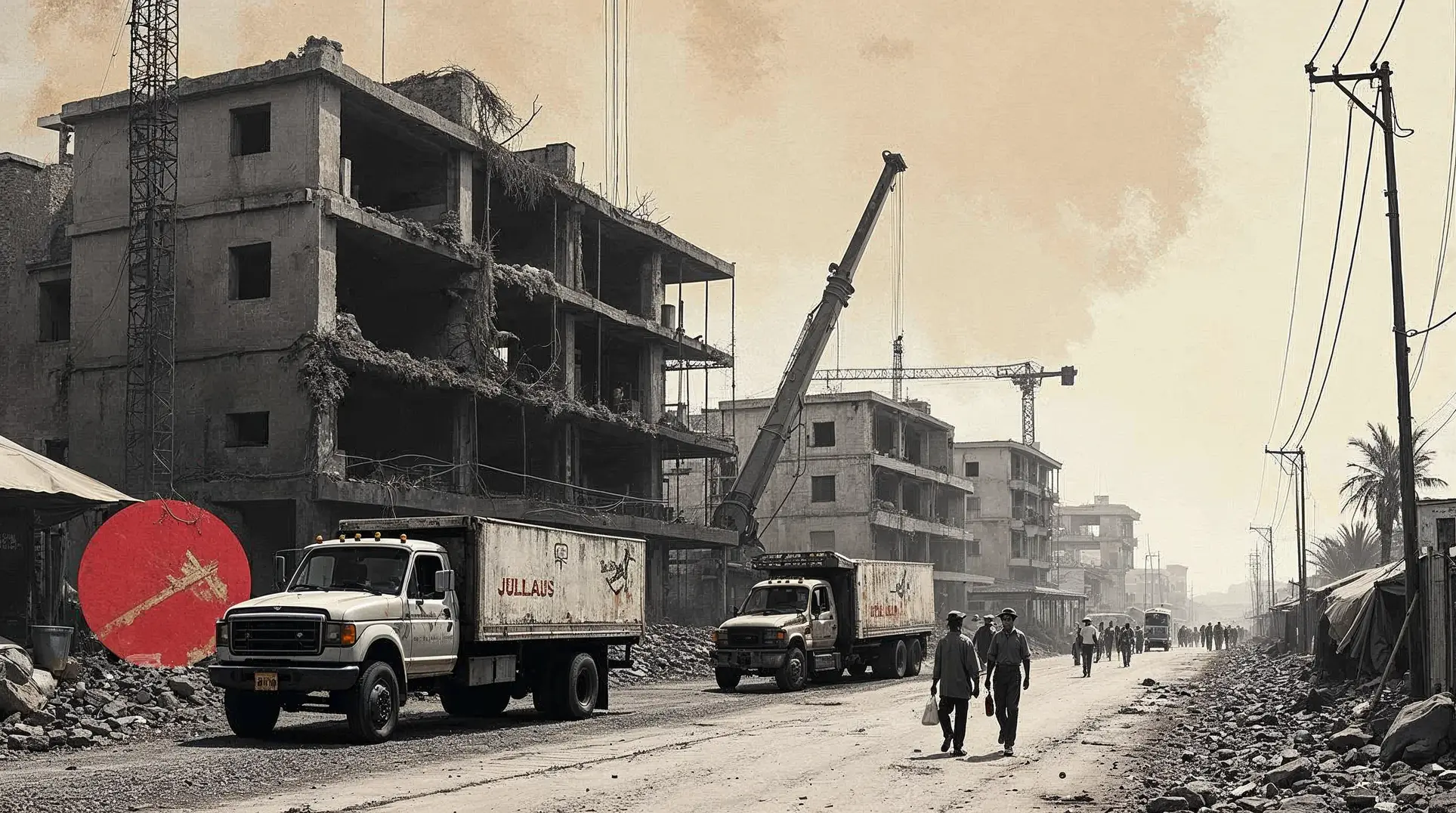
Members are reading: How reconstruction policies are weaponized to consolidate territorial division, creating permanent disparity between Israeli and Hamas zones.
The governance vacuum deepens
The political deadlock extends beyond reconstruction to governance structures themselves. Israel's opposition to Palestinian Authority involvement in Gaza administration eliminates the most obvious transitional arrangement, while international reluctance to deploy peacekeeping forces without clear mandates and host consent prevents external security guarantees. The envisioned multinational force remains a conceptual placeholder without committed troop contributions, operational parameters, or agreement on its relationship to either Israeli security requirements or Palestinian sovereignty aspirations.
This governance vacuum ensures that the current territorial division persists by default. Without agreed transitional authority to administer formerly Hamas-controlled areas, and without Israeli willingness to cede control of strategic zones to an uncertain political arrangement, the Yellow Line becomes the effective administrative boundary. Each side governs what it controls, with no mechanism to bridge the gap.
The humanitarian cost compounds daily. Restricted movement, frozen reconstruction in Hamas areas, and continuing political uncertainty create conditions where Gaza's population cannot rebuild lives or livelihoods. The estimated $53-70 billion reconstruction requirement becomes meaningless when political prerequisites for accessing these funds remain unmet. Palestinian aspirations for statehood—already fragile—face further erosion as territorial fragmentation becomes normalized rather than transitional.
The Trump administration's peace initiative contains structural vulnerabilities in its assumption that shared interest in ending violence would overcome fundamental disagreements about security, sovereignty, and statehood. Instead, those disagreements prove determinative. Without resolution of core political questions—Palestinian self-determination, Israeli security guarantees, Hamas's political future—tactical arrangements like ceasefires cannot transform into strategic settlements. They crystallize instead into enduring divisions that reflect power realities rather than peace frameworks
Subscribe to our free newsletter to unlock direct links to all sources used in this article.
We believe you deserve to verify everything we write. That's why we meticulously document every source.


