


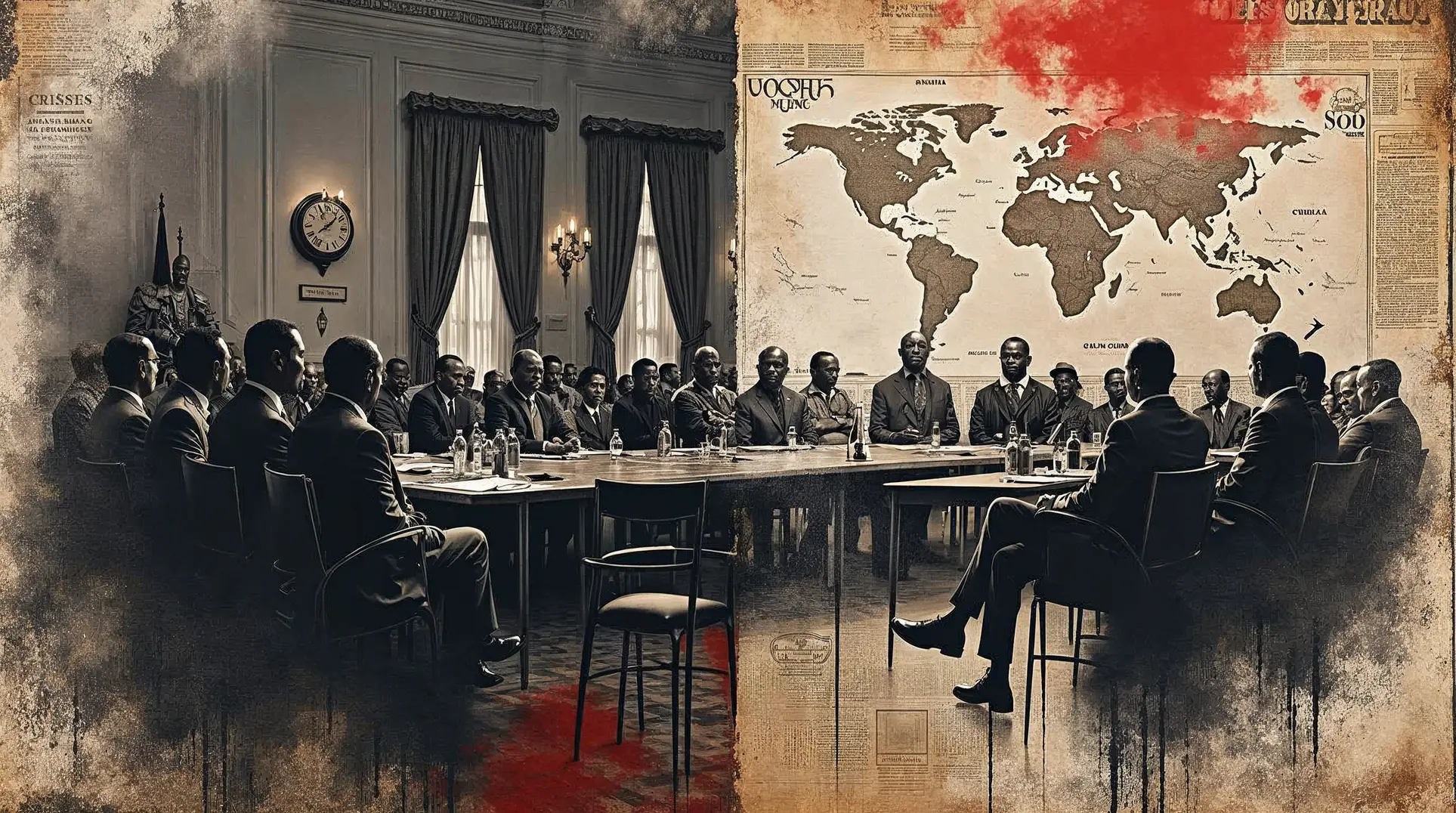
On December 4, 2025, President Donald Trump hosted the formal signing of the Washington Accords for Peace and Prosperity at the newly-renamed Donald J. Trump Institute of Peace. Presidents Paul Kagame of Rwanda and Félix Tshisekedi of the Democratic Republic of Congo put pen to paper, reaffirming a permanent ceasefire, disarmament of non-state armed groups, safe return of refugees and internally displaced persons, and a Regional Economic Integration Framework (REIF) aimed at critical minerals cooperation and prosperity. "We'll end a war that's been going on for decades," Trump declared. "I have a lot of confidence in both leaders."
Yet as the ceremony concluded in Washington, shelling echoed across eastern Congo. Congolese forces (FARDC) and the Rwanda-backed M23 rebels traded accusations of ceasefire violations in North and South Kivu. M23 was not in the room, is not bound by the bilateral accord, and continues separate negotiations with Kinshasa under Qatari mediation in Doha. This is the central tension: a state-to-state deal signed in Washington addresses a war fought by non-state actors on two tracks, with misaligned timelines and no proven enforcement mechanism. The question is not whether leaders can shake hands—it's whether the handshake changes behavior on the ground.
Two tracks, one war
The Washington Accords build on a June 27, 2025 U.S.-brokered agreement between DRC and Rwanda foreign ministers, and a November 7 initialing of the REIF alongside Joint Oversight Committee meetings on FDLR disbandment and Rwandan troop withdrawal. That state-to-state track runs parallel to a separate insurgency track: on July 19, the DRC and M23 signed a Qatar-mediated Declaration of Principles in Doha, followed by a November 15 framework agreement establishing ceasefire verification and an implementation pathway.
The Washington ceremony drew regional heavyweights—Presidents William Ruto of Kenya, João Lourenço of Angola, Évariste Ndayishimiye of Burundi, Faure Gnassingbé of Togo, and Uganda's Vice President Jessica Alupo, alongside U.S. Secretary of State Marco Rubio and ministers from Qatar and the UAE. The attendance signaled the stakes: eastern Congo's war is a Great Lakes security crisis, a minerals scramble, and a test case for U.S. critical minerals diplomacy. Kagame credited Trump's "new and effective dynamism." Tshisekedi called the deal a "turning point." Yet neither leader controls M23, and the Doha track remains the only mechanism with direct M23 participation and ceasefire monitors.
In the days surrounding the ceremony, clashes were reported around Kaziba, Katogota, and Lubarika in South Kivu. DRC government spokesperson Patrick Muyaya blamed M23 for the violations, calling them "proof that Rwanda doesn't want peace." Rwanda denies backing M23 and says any Rwandan Defense Forces (RDF) actions are defensive against the Democratic Forces for the Liberation of Rwanda (FDLR), a Hutu militia Kigali accuses Kinshasa of tolerating. A July 2025 UN Group of Experts report assessed that Rwanda exercises command-and-control over M23, a finding Kigali rejects.
Members are reading: Why front-loading minerals cooperation before security benchmarks risks rewarding territorial control by force.
What to watch in the next 72 hours
Peace processes fail slowly, then suddenly. The next week offers practical checkpoints. Does the ceasefire hold in the Kaziba–Katogota–Lubarika corridor and along the Goma–Bukavu axis? Do Doha's monitors issue joint, public verification notes, or do accusations fly without arbitration? Are there verifiable DRC operations against FDLR beyond messaging campaigns? Any evidence of phased RDF disengagement linked to those operations, such as withdrawal from contested areas in North Kivu? Do humanitarian access corridors open, allowing aid into zones currently cut off?
And crucially: do the mineral MOUs include conditionality tied to security benchmarks, or do they proceed independently? Washington's interest in critical minerals is explicit and strategic—diversifying supply chains away from China is a U.S. national security priority. But decoupling economic progress from security sequencing means the structural drivers that fuel the conflict—mineral rents, militia economies, foreign troop presence—remain intact even as new frameworks are signed.
This isn't a binary between peace and war; it's a question of whether two parallel processes can converge into one enforceable reality. Kagame and Tshisekedi are making calculated choices, Qatar and Angola have real leverage, and Washington's minerals agenda is transparent. The outcome depends on whether verification mechanisms can impose costs on violations, whether economic incentives are sequenced to reward disarmament rather than territorial control, and whether M23's absence from Washington becomes a fatal gap or a temporary sequencing issue resolved in Doha. The ceremony happened. The ceasefire has not.
Subscribe to our free newsletter to unlock direct links to all sources used in this article.
We believe you deserve to verify everything we write. That's why we meticulously document every source.


