


President Donald Trump announced Saturday that "the airspace above and surrounding Venezuela" is "closed in its entirety," addressing airlines, pilots, "drug dealers, and human traffickers" in a Truth Social post. The declaration follows a November 21 Federal Aviation Administration security advisory covering Venezuelan airspace and a cascade of international carrier suspensions that have severed most commercial air links to Caracas.
Trump's blanket "closure" is not a formal FAA prohibition but a presidential signal layered atop an existing hazard advisory for the Maiquetía Flight Information Region—which covers all Venezuelan airspace and portions of the southern Caribbean—warning of a "potentially hazardous situation" at all altitudes due to "worsening security and heightened military activity." The advisory, effective through February 19, 2026, set in motion operational and insurance decisions that have turned Venezuela's skies into a de facto no-go zone, even as political rhetoric outpaces regulatory authority.
Airlines exit, Caracas retaliates, connectivity collapses
Between November 24 and 25, six major carriers suspended Venezuelan service: TAP Air Portugal, LATAM, Avianca, Iberia, Gol Linhas Aéreas, and Turkish Airlines. The withdrawals reflected carrier risk assessments and insurer calculus rather than any U.S. government ban. Copa Airlines, Wingo, and select regional operators continued limited flights, according to airport sources, but the bulk of international connectivity evaporated within 48 hours of the FAA warning.
Caracas responded on November 27 by revoking operating permits for the six carriers that had suspended flights, framing the decision as a sovereign riposte to what Venezuelan officials called complicity in "state terrorism." The retaliatory cycle—airlines suspend because of safety risk; Venezuela withdraws permits in response—compounds civilian harm and strands travelers, while entrenching the very isolation that feeds governance failure and illicit economies.
This tit-for-tat unfolds against a military backdrop unprecedented in recent Caribbean history: the USS Gerald R. Ford carrier strike group and supporting vessels now operate in regional waters, the largest U.S. buildup in generations. Since early September, at least 21 strikes on suspected drug-smuggling vessels in the Caribbean and eastern Pacific have killed more than 80 people, according to compiled reporting. Meanwhile, the U.S. designated Venezuela's so-called Cartel de los Soles as a Foreign Terrorist Organization, a legal move Caracas rejects as pretense for intervention.
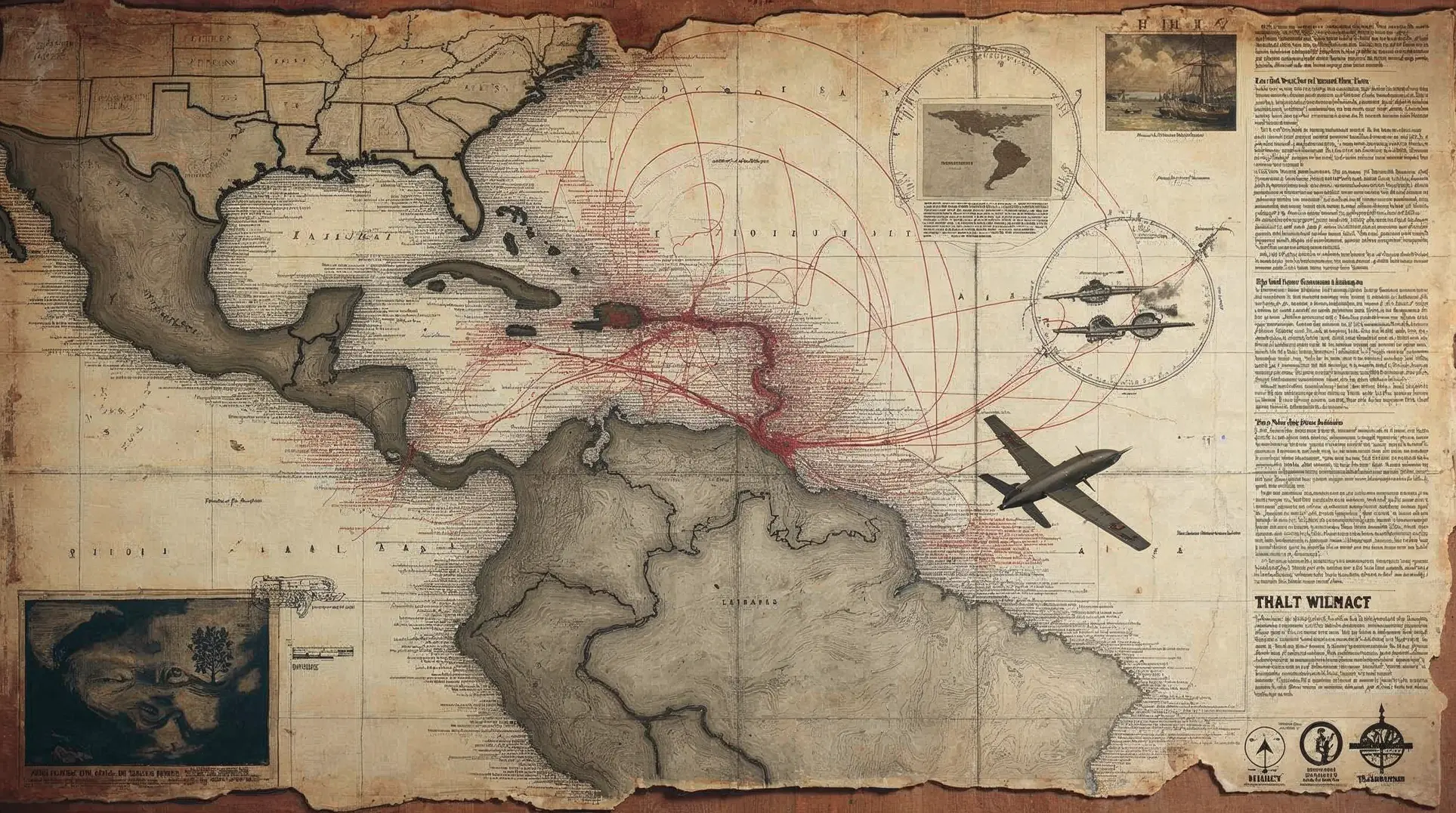
Members are reading: How presidential rhetoric and military buildups turn neutral airspace into a flashpoint for miscalculation at the civil-military interface.
Connectivity craters, humanitarian movement chokes
The practical fallout is immediate. Venezuela's remaining international links now depend on a handful of carriers willing to accept elevated risk and higher insurance premiums. Stranded travelers—including medical evacuees, diaspora families, and humanitarian workers—face lengthening waits or overland routes through Colombia and Brazil that expose them to border-zone hazards. Regional hubs in Panama City, Bogotá, and São Paulo absorb displaced traffic, but rerouting adds costs and delays that ripple through supply chains and remittance flows.
Even as Maduro signals openness to dialogue and Colombia's President Gustavo Petro calls for de-escalation and an end to military operations, the infrastructure logic works against talks. Each airline suspension, permit revocation, and carrier-group deployment entrenches positions and narrows off-ramps. Insurers rewrite coverage, flight planners avoid entire regions, and route maps redraw around the blank space where Venezuelan airspace used to sit.
For Latin America's broader connectivity, the Venezuelan airspace question previews a troubling pattern: when states use civil infrastructure as leverage in geopolitical contests, the costs accrue to populations least able to absorb them, while the governance failures that drive illicit economies and authoritarian consolidation deepen. The skies above Caracas are now a contested frontier, where safety margins compress under the weight of military signaling and political brinkmanship—and where the next misstep could involve a transponder code, not a missile boat.
Subscribe to our free newsletter to unlock direct links to all sources used in this article.
We believe you deserve to verify everything we write. That's why we meticulously document every source.


