


At 10:00 CET on Wednesday, September 17, 2026, judges of the Kosovo Specialist Chambers (KSC) in The Hague will read their first-instance verdict in the war crimes trial of Hashim Thaçi, Kosovo's first prime minister and later president, alongside three fellow former commanders of the Kosovo Liberation Army (KLA): Kadri Veseli, Rexhep Selimi and Jakup Krasniqi. All four face 10 counts including murder, torture, enforced disappearance and persecution, allegedly committed against Serbs, Roma and ethnic Albanian political opponents during and after the 1998-1999 war. All four have pleaded not guilty.
The KSC's official press briefing of September 10 confirms the verdict will stream with a 10-minute delay in Albanian, English and Serbian. What it will not confirm is whether the ruling will do anything to close the gap between the tribunal's legal mandate and its political legitimacy inside Kosovo, a gap that appears to have widened rather than narrowed as the verdict approaches. As Crisis.zone's April coverage of Kosovo's parliamentary dissolution documented, the country enters this moment already governing through its third snap election cycle in 14 months.
What prosecutors are asking for
Prosecutors are seeking 45-year prison sentences for each defendant on the war crimes counts. Thaçi faces additional, compounding jeopardy: closing arguments concluded on September 14 in a parallel obstruction-of-justice trial, where prosecutors allege he directed associates from inside the KSC's Detention Unit to instruct protected witnesses on what to say. They are seeking a six-year sentence, to run consecutively to any war crimes term. Defense counsel Sophie Menegon countered that "there is no allegation of a bribe, compulsion, or threat against witnesses" and that the prosecution is asking judges to imprison Thaçi "over conversations inside a detention unit that resulted in zero real-world impact." In his own closing statement in the main trial, Thaçi said "the only just decision would be my full acquittal."
Mobilization ahead of the ruling
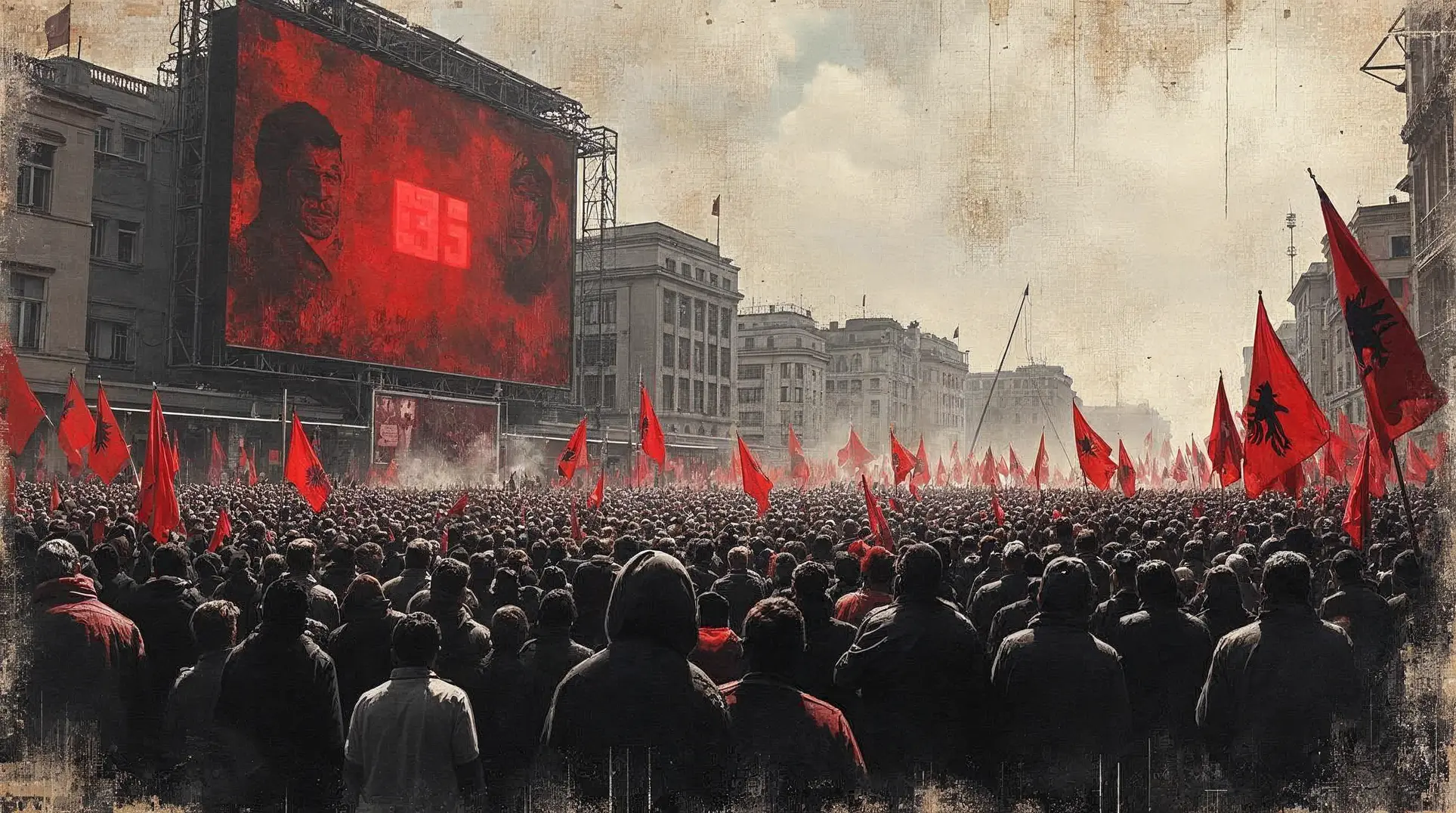
On Saturday, September 12, tens of thousands rallied in Pristina's central square in what organizers, the group Freedom Has A Name, called a "March for Freedom," demanding acquittal. Albanian flags and portraits of the four defendants filled the square alongside banners reading "Heroes of War and Peace." Digital countdown screens have appeared on roads and squares across Kosovo throughout September, according to AFP and AP reporting from the ground.
War veterans' leader Hysni Gucati told the crowd that "Kosovo's freedom was won through sacrifice. No courtroom will be able to erase this truth." Politician Bedri Hamza said "a just decision strengthens justice, while an unjust one destroys it." Albanian Prime Minister Edi Rama, writing on Facebook, called the proceedings a "farce" nearing its "final days," describing the defendants as "liberators." This is not marginal sentiment. It spans party lines and extends into the diaspora, whose voices AFP quoted at the rally expressing concern about potential "unrest" in Albanian-majority areas should the men not be released.
Observers are reading: how a conviction or acquittal would each reshape Kosovo's fragile coalition politics and the EU-facilitated Serbia dialogue.
Become an Observer — it's free. Get full access to all Crisis.Zone analysis, briefings and breaking coverage.
What the verdict will not settle
Whichever way the judges rule, the verdict will not resolve the underlying tension between two frameworks that Kosovo has never fully reconciled: individual criminal accountability under a court it created, and a founding narrative in which the KLA's armed struggle secured the nation's independence. A conviction will likely be read by much of Kosovo's ethnic Albanian public as confirmation that the court was built to punish liberators. An acquittal will likely be read by Serbian officials and international rights advocates as evidence the tribunal lacked teeth from the start.
Either outcome lands on a political system already destabilized, one that has cycled through three elections in little over a year, and it will feed directly into the EU-facilitated Kosovo-Serbia normalization dialogue that both capitals are expected to weaponize regardless of the ruling. The judges will read their decision at 10:00 CET. The countdown clocks in Pristina's squares will stop. The argument over what Kosovo's founding generation owes to law, and what the law owes to Kosovo's founding story, will not.
Become an Observer — it's free — to unlock direct links to all sources used in this article.
We believe you deserve to verify everything we write. That's why we meticulously document every source.


