


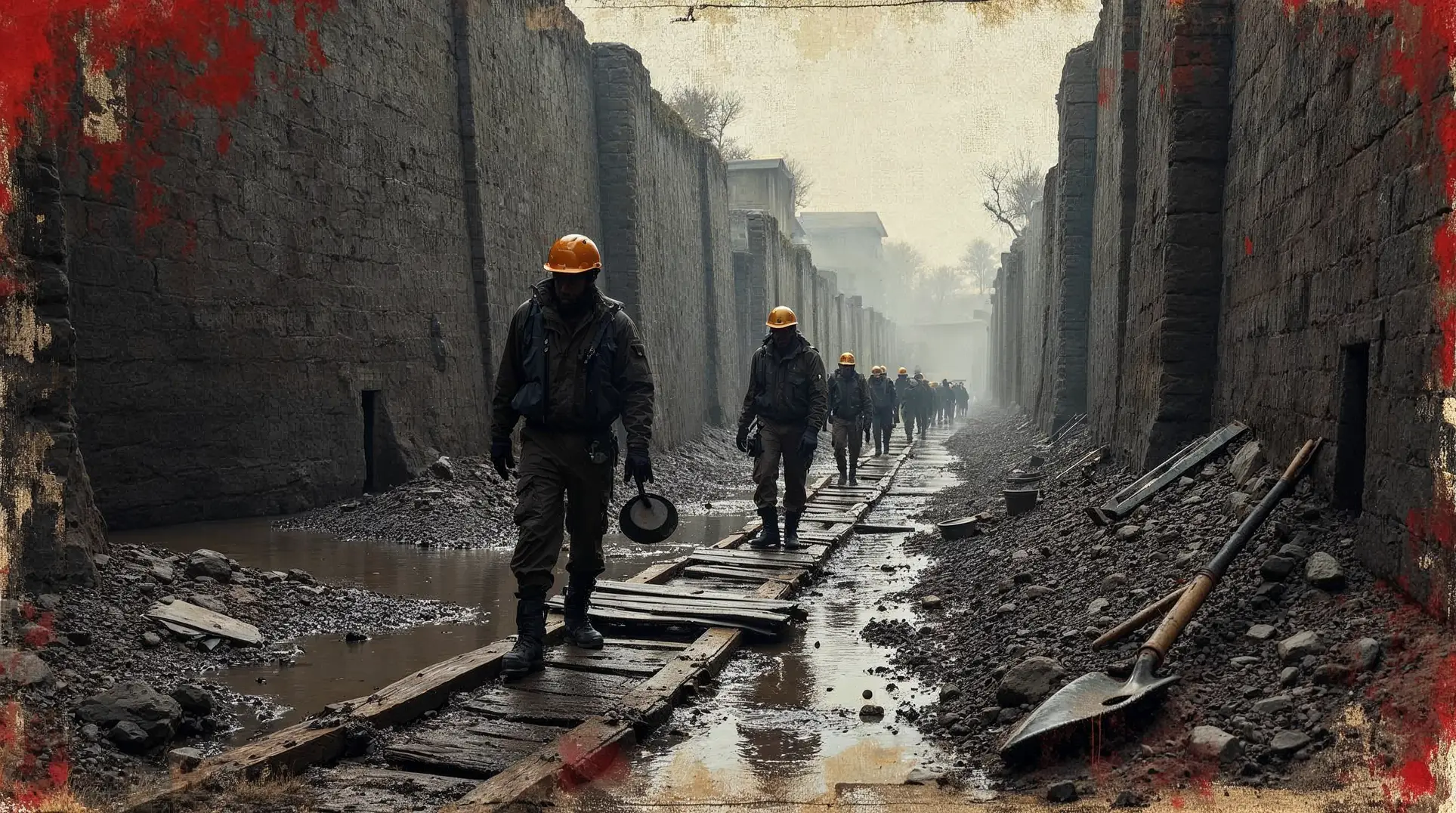
At least 32 artisanal miners died on Saturday when a makeshift bridge collapsed inside the Kalando cobalt mine, approximately 42 kilometers southeast of Kolwezi in Lualaba Province. Provincial Interior Minister Roy Kaumba Mayonde confirmed the death toll to reporters as recovery operations continued into Sunday, with additional victims feared missing beneath the rubble of a rain-flooded trench. Provincial authorities suspended operations at the site on November 16.
The collapse represents one of the deadliest single-site accidents in Lualaba's informal mining sector in recent years, underscoring persistent safety failures across a cobalt economy that powers global battery supply chains. The disaster occurred inside a contested space where artisanal miners, mining cooperatives, and legal operators—reportedly including Chinese-invested entities—compete for control, revenue, and access, leaving safety responsibilities diffuse and enforcement nearly impossible.
Panic and militarized crowd control
According to a report from SAEMAPE, the DRC's Artisanal and Small-Scale Mining Support and Guidance Service, the presence of soldiers at the site sparked panic among miners, sending crowds rushing across the bridge moments before it collapsed. The National Human Rights Commission's (CNDH) provincial office shared images showing bodies recovered from the trench and estimated that more than 10,000 wildcat miners operate at Kalando, working under conditions that blur subsistence labor, informal cooperatives, and outright trespass.
The mine had been under a formal access ban due to heavy rains and landslide risk, yet miners forced entry—a pattern repeated across Lualaba's artisanal sector where survival economics override official restrictions. The deployment of armed personnel, ostensibly to enforce the ban or maintain order, appears to have escalated rather than mitigated risk, transforming a crowd-management problem into a stampede.
Early reports circulating on social media referenced a deadly landslide at a site called "Kawama" near Kolwezi, with casualty figures ranging from 70 to 80. As of mid-November, major wire services and provincial authorities substantiate only the Kalando bridge collapse with a verified toll of at least 32 deaths. The higher figures and alternate site naming should be treated as unverified early reporting or misattribution; no authoritative confirmation exists for an 80-fatality landslide at Kawama on November 15.
Members are reading: Why bans and soldiers make artisanal cobalt sites more dangerous, not safer—and what traceability schemes miss.
What comes next
Lualaba provincial authorities have announced an investigation into the collapse, and SAEMAPE and CNDH have documented conditions at the site. Whether these investigations translate into enforceable safety standards, site formalization, or compensation for victims' families remains uncertain. The test will be whether recommendations move beyond paper into changes in how artisanal mining is governed: land tenure clarity, cooperative support, safety infrastructure, and an end to using armed force as the primary tool of crowd management.
For global buyers and battery manufacturers, the Kalando collapse poses a challenge to corporate responsibility frameworks that treat artisanal mining as a reputational risk to be avoided rather than a labor reality to be formalized. Traceability and due diligence that do not address the governance void at sites like Kalando will remain performative, unable to prevent the next disaster at the bottom of the supply chain.
The 32 confirmed dead at Kalando join a lengthening roster of artisanal miners killed in collapses, floods, and stampedes across the DRC's cobalt heartland. Until safety becomes inseparable from the economics and politics of extraction—rather than a footnote to peace processes or ceasefire monitors—the pattern will repeat.
Subscribe to our free newsletter to unlock direct links to all sources used in this article.
We believe you deserve to verify everything we write. That's why we meticulously document every source.


