


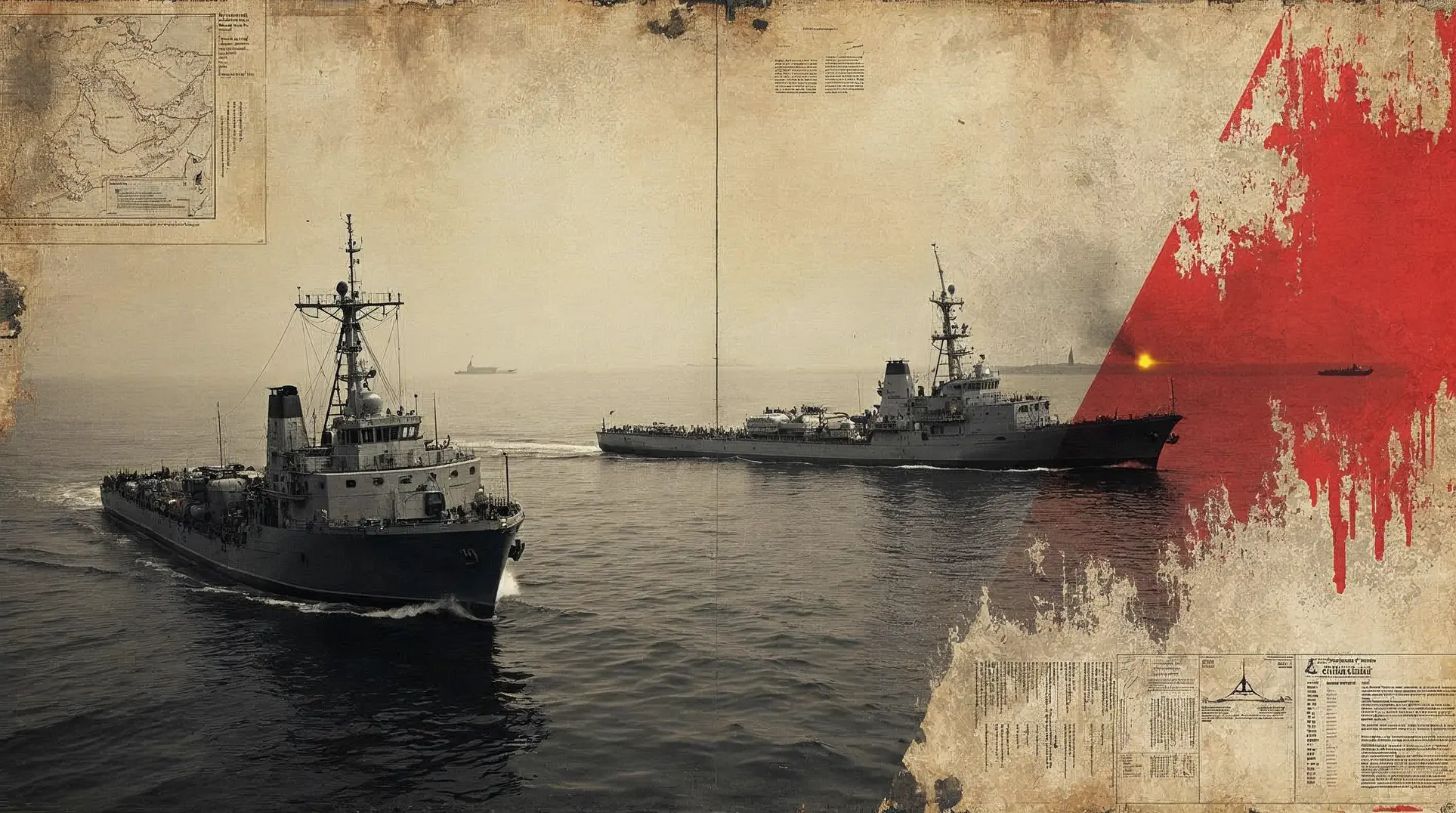
Iran's Islamic Revolutionary Guard Corps claimed Wednesday it attacked 10 vessels — two American ships and eight oil tankers — attempting to transit a newly declared "forbidden and unsafe" zone in the Strait of Hormuz, according to Iranian state media. The IRGC simultaneously fired 20 ballistic missiles at the al-Azraq airbase in Jordan, which hosts U.S. forces. Jordan's military said it intercepted 18 missiles; two fell in unpopulated areas. No casualties were reported.
The claimed attacks mark the largest single declared wave of maritime strikes by either side since the war began February 28, 2026. U.S. Central Command called the IRGC's claim of a successful strike on American warships "completely FALSE," stating no U.S. Navy vessel was hit and all attempted Iranian attacks failed. UKMTO, the neutral maritime monitoring body, confirmed only that "several merchant vessels" were on fire in the Northern Arabian Gulf and Gulf of Oman, describing the damage as "disabling fire as part of ongoing military activity in the region" — without attributing responsibility.
Retaliation cycle escalates after eight tankers destroyed
Wednesday's claimed attacks follow a direct sequence. CENTCOM confirmed destroying five Iranian tankers Tuesday — four in the Gulf of Oman, one near Kharg Island — as detailed in Crisis.Zone's coverage of the Kharg Island and Jask strikes. That action followed the September 5 destruction of three tankers, when CENTCOM commander Adm. Brad Cooper established what he called a doctrine: "two of yours for three of ours." Secretary of State Marco Rubio reinforced the policy Wednesday: "For every time they [attack] a U.S. naval ship... they're going to lose tankers."
The IRGC separately announced a unilateral maritime restricted zone extending from Chabahar into the Gulf of Oman and Arabian Sea, warning vessels entering without Iranian coordination would face sanctions and loss of insurance access. The IRGC Navy also warned tanker crews near Kuwait and Bahrain to evacuate immediately, claiming those vessels "will be targeted." IRGC spokesman Hossein Mohebi listed conditions for ending the campaign, including a $24 billion asset release and an Israeli withdrawal from Lebanon.
Observers are reading: How Iran's Kuwait and Bahrain threat could test the limits of the tanker-for-tanker doctrine.
Become an Observer — it's free. Get full access to all Crisis.Zone analysis, briefings and breaking coverage.
Oil markets register the disruption
Brent crude breached $100 per barrel Wednesday morning, its first move above that level since July 24, 2026, according to multiple wire services. Strait traffic has collapsed to six commodity vessels Tuesday, down from a 10-day average of roughly 12, with 42 tankers reported waiting to transit as of Monday. Collateral incidents multiplied Wednesday: the Panama-flagged tanker New Andros was struck by a drone in Iraqi territorial waters, with no casualties among its 22 crew; the tanker Hercules Star was reported listing off Dubai, with one crew member killed and one missing, according to charterer Peninsula. Further updates as verified information becomes available.
Become an Observer — it's free — to unlock direct links to all sources used in this article.
We believe you deserve to verify everything we write. That's why we meticulously document every source.


