


The Trump administration's intensifying military campaign in Venezuela has triggered a constitutional confrontation on Capitol Hill, with House Democrats formally invoking the War Powers Act to force a vote limiting presidential authority over military operations. The move comes as the USS Gerald R. Ford, the Navy's most advanced aircraft carrier, operates in Caribbean waters and the White House designates Venezuelan groups as foreign terrorist organizations—all without explicit congressional authorization.
The procedural maneuver highlights a deepening institutional conflict between the legislative and executive branches over war-making authority. While the Democratic resolution would expedite action to restrict operations against presidentially designated terrorist organizations in the Western Hemisphere, it faces long odds in the Republican-controlled House, where leadership is expected to deploy procedural obstacles to avoid forcing their members into a politically fraught vote.
The constitutional mechanism
The 1973 War Powers Resolution, passed over President Nixon's veto in the aftermath of Vietnam, was designed to reassert congressional control over military deployments. The statute requires the president to notify Congress within 48 hours of introducing armed forces into hostilities and limits such engagements to 60 days unless Congress authorizes an extension or declares war.
Democrats are leveraging the law's expedited procedures, which theoretically prevent the measure from being buried in committee. The proposed resolution would specifically bar military action against drug cartels in Venezuela without explicit congressional authorization—either through a formal declaration of war or an authorization for the use of military force. Democratic leaders frame this as fundamental constitutional oversight. "The framers deliberately placed war powers in Article I for a reason," noted Rep. Gregory Meeks, the ranking member of the House Foreign Affairs Committee. "We cannot allow any president to unilaterally launch military operations that could draw us into a broader conflict."
This constitutional argument has historical precedent. The military buildup around Venezuela has proceeded rapidly, with the Ford carrier strike group arrival marking a significant escalation. The Senate previously rejected a war powers resolution on the matter, but the House effort represents a renewed attempt to invoke legislative constraints.
The partisan calculation
The Republican-controlled House presents a structural obstacle that transcends simple party-line opposition. GOP leadership faces a delicate political calculation: allowing a vote risks either publicly defying President Trump or granting him extraordinarily broad military authority that even some Republican members privately question.
House procedural rules offer multiple avenues for blocking the measure. Leadership can refuse to schedule floor time, route it to hostile committees, or use rules governing privileged resolutions to delay action indefinitely. This approach shields rank-and-file Republicans from casting a recorded vote that could be politically weaponized in either direction—by primary challengers if they restrict Trump, or by general election opponents if they endorse unlimited executive war powers.
The administration's legal justification rests on the designation of Cartel de los Soles as a Foreign Terrorist Organization, which the White House argues provides sufficient statutory authority under existing counterterrorism and counternarcotics frameworks. While Operation Southern Spear is officially described as a counter-narcotics mission, analysts and foreign governments view the U.S. military deployment as a potential prelude to strikes on Venezuelan territory aimed at removing President Nicolas Maduro. The Trump administration has identified Venezuelan military installations allegedly linked to drug-trafficking networks as potential bombing targets and is exploring legal justifications for regime-change operations under existing anti-drug authorities, arguing that Maduro and his inner circle operate as key nodes in transnational narcotics networks. Secretary of War Pete Hegseth, in announcing Operation Southern Spear, was explicit in articulating the administration's regional vision: "The Western Hemisphere is America's neighborhood, and we will protect it." Elizabeth Dickinson, the International Crisis Group's senior analyst for the Andes region, emphasized that an aircraft carrier brings nothing useful for combating the drug trade and that the deployment is clearly a message geared towards pressuring Caracas.
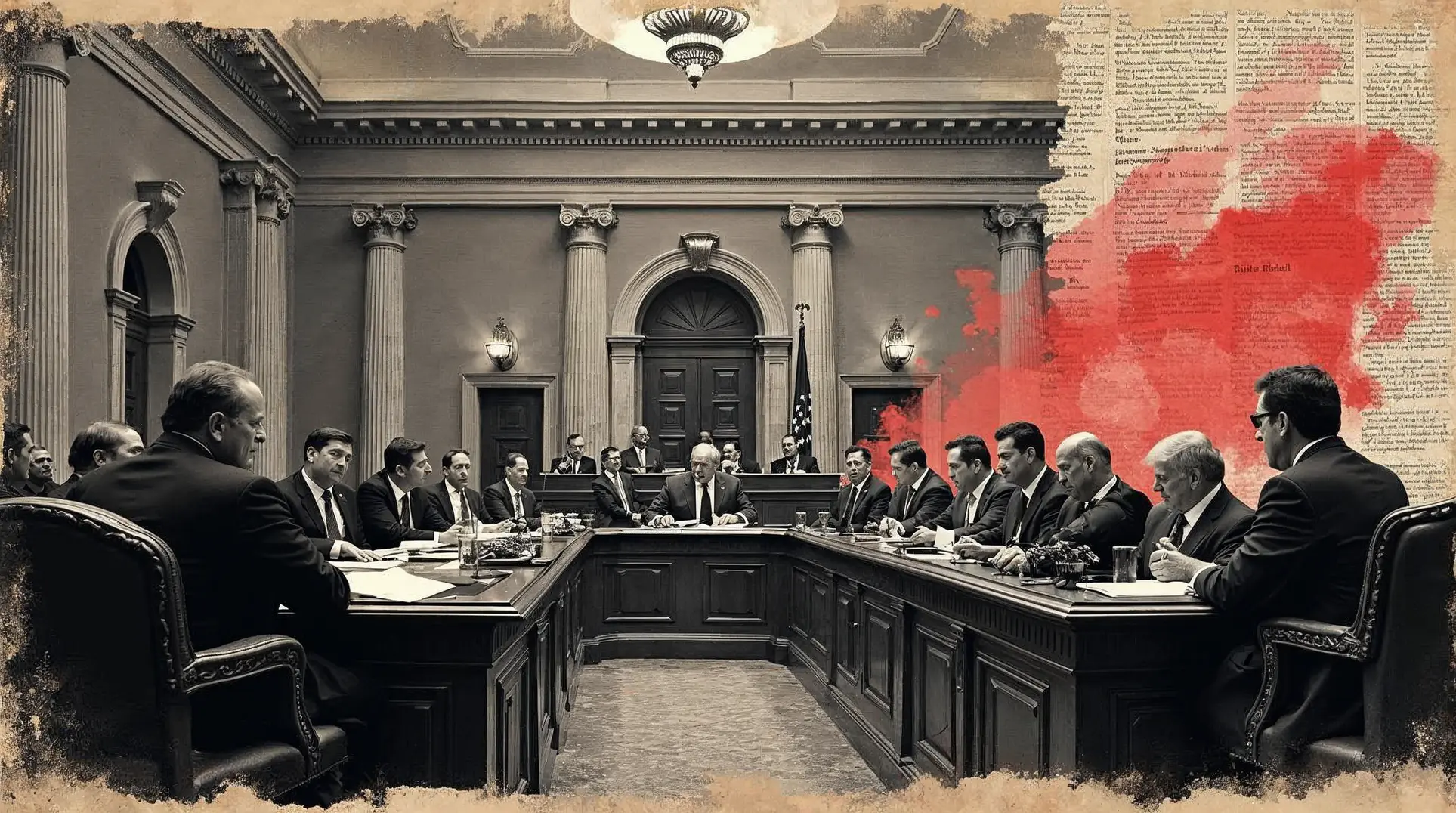
Members are reading: Analysis of how the Venezuela military campaign represents the latest erosion of congressional war powers and why partisan dynamics prevent institutional pushback.
Conclusion
The House Democratic resolution faces procedural realities that make passage unlikely, but its introduction serves a broader institutional purpose: establishing a legislative record of opposition to unilateral executive military action. Whether this sets a precedent for future congressional pushback or simply documents another failed attempt to reassert legislative authority remains to be seen.
The constitutional tension is unlikely to be resolved through this particular measure. Instead, the Venezuela campaign continues to operate in the expanding gray zone between presidential authority and congressional prerogative—a space where legal arguments about counterterrorism and drug interdiction increasingly substitute for traditional authorization frameworks. The outcome may ultimately be determined not in committee rooms but through the political consequences of the military operations themselves.
Subscribe to our free newsletter to unlock direct links to all sources used in this article.
We believe you deserve to verify everything we write. That's why we meticulously document every source.


