


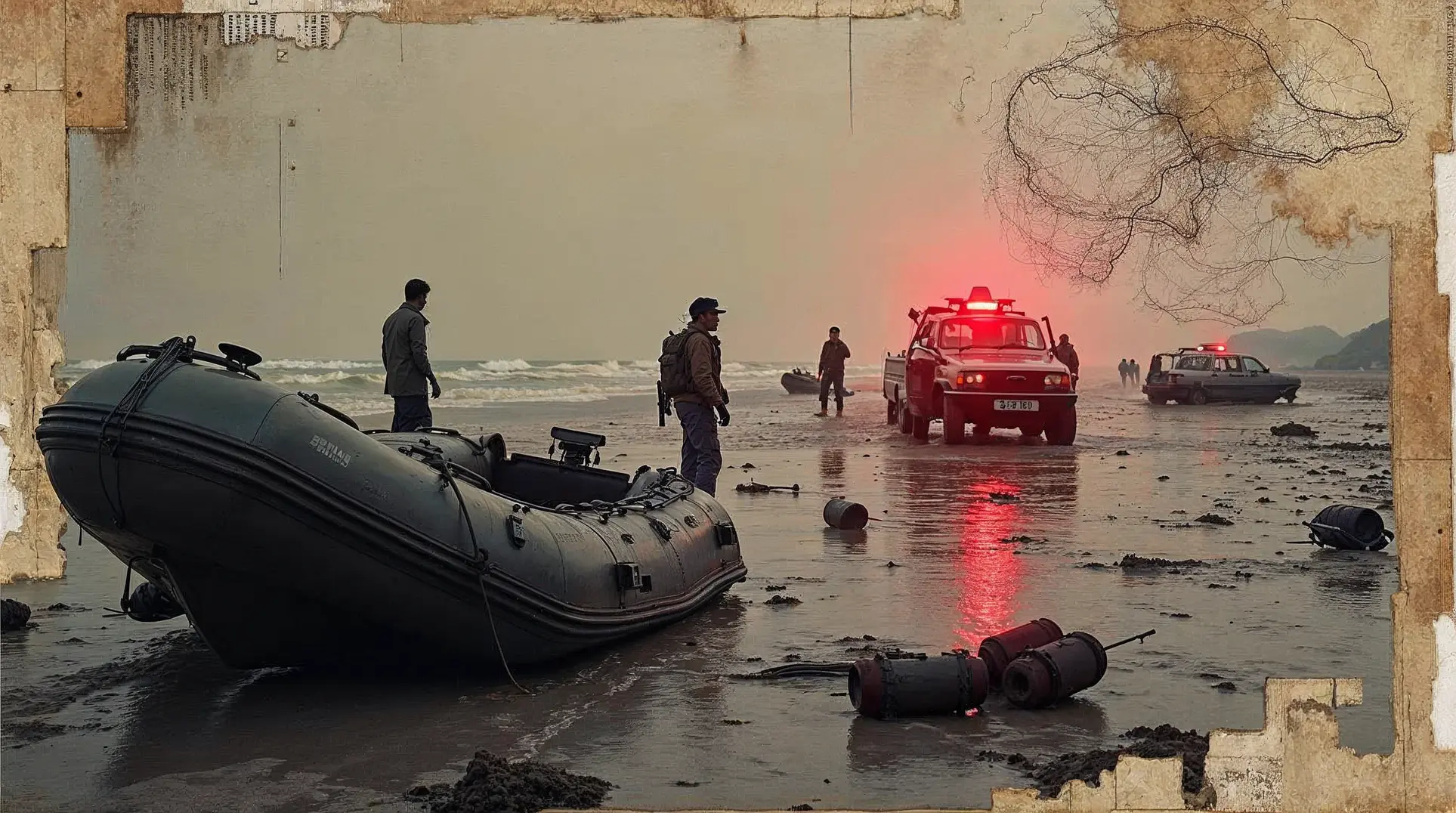
A small boat capsized off Boulogne-sur-Mer killing four migrants and prompting rescue operations that saved 63 others from freezing Channel waters. French maritime authorities coordinated the response, but the deaths—following two additional fatalities near Gravelines just nine days earlier—underscore persistent vulnerabilities in one of Europe's most scrutinized migration corridors despite reported declines in overall crossing numbers.
The April 9 incident occurred in conditions that exemplify the operational paradox facing UK and French enforcement agencies. Home Office data indicates an 18% decrease in small boat arrivals during Q1 2026 compared to the same period in 2025, attributed primarily to harsh winter weather rather than policy interventions. Yet the fatality rate per crossing has increased as smuggling networks adapt by deploying larger, more overcrowded vessels and shifting departure points to less monitored coastal areas. This combination of reduced crossings but elevated per-journey risk signals that current deterrence strategies may be reshaping rather than resolving the crisis.
Enforcement investment and operational limits
The UK and France extended their bilateral patrol agreement in 2025 with an additional £16.2 million in UK funding, building on the existing ~£476 million framework. This financial commitment translates to increased French police presence on departure beaches, enhanced coastal surveillance, and joint coordination protocols between British and French maritime authorities. UK Prime Minister Rishi Sunak characterized the April 9 deaths as a "tragic loss of human life," while Home Secretary Yvette Cooper focused attention on "criminal gangs making vast profit," framing the government's enforcement posture as targeting organized smuggling networks rather than migrants themselves.
However, the operational architecture reveals structural constraints. French police were observed on beaches during the March 31 incident near Gravelines, yet the boat still launched with approximately 30 people aboard. The presence of enforcement personnel does not consistently prevent departures—it frequently displaces them. Smuggling networks have demonstrated tactical flexibility by utilizing inland waterways and canals as departure points, moving operations beyond the traditional Calais-Dover corridor where surveillance is most concentrated. French maritime authorities possess legal authority to intercept "taxi boats" at sea, but jurisdictional complexities and the sheer volume of attempted crossings during favorable weather windows create gaps that organized networks systematically exploit.
The timing of the extended bilateral agreement also matters. Negotiations for a new UK-France deal commenced as overall crossing numbers declined, creating political space for both governments to claim progress. Yet the April fatalities demonstrate that reduced volume does not equate to reduced lethality. The average number of people per boat increased from 13 in 2020 to 62 in 2025, according to operational data cited by humanitarian organizations. This shift toward overcrowding directly correlates with heightened mortality risk, as vessels designed for far fewer passengers become dangerously unstable in Channel conditions.
Members are reading: How enforcement pressure drives smuggling network adaptation rather than deterrence, and why bilateral agreements operate at insufficient scale.
Environmental hazards and rescue coordination challenges
The English Channel's operational environment compounds policy challenges with physical danger. Freezing water temperatures during winter months reduce survival time dramatically, as Utopia 56 spokesman Nikolai Posner emphasized following the April 9 incident. Hypothermia becomes lethal within minutes for individuals in the water, and overcrowded boats offer no protection against exposure. The Channel's status as one of the world's busiest shipping lanes—over 600 commercial vessels transit daily—introduces collision risks that small, overloaded migrant boats cannot effectively navigate. Strong winds prevail 120 days annually, creating conditions where even experienced mariners exercise caution.
Rescue coordination between British and French maritime authorities functions through established protocols, but jurisdictional boundaries create response delays. Utopia 56 and similar NGOs frequently relay distress calls from migrants, serving as critical intermediaries when boats encounter trouble mid-crossing. The time lag between distress call, jurisdictional determination, and vessel deployment can prove fatal, particularly given the speed with which hypothermia and capsizing occur in Channel conditions.
The April 9 incident required coordinated French maritime response with British Coast Guard awareness, reflecting the operational reality that rescues often occur in contested or overlapping jurisdictional zones. Both nations maintain search-and-rescue obligations under international maritime law, but the political imperative to prevent arrivals creates tension with the legal duty to assist vessels in distress. This structural contradiction—enforcement versus rescue—produces operational hesitation that humanitarian organizations argue costs lives.
Post-Brexit asylum dynamics and comparative European context
The UK's departure from the Dublin Regulation eliminated the legal framework for returning asylum seekers to the first EU country of entry. While few individuals were actually returned under Dublin (the mechanism functioned more as legal architecture than operational reality), its absence is cited by migrants as removing a disincentive to claim asylum in the UK. Post-Brexit, the UK lacks formal agreements with EU member states for asylum cooperation, leaving bilateral arrangements like the France pilot scheme as the only available tools.
This institutional isolation contrasts with the UK's political rhetoric about "stopping the boats." Without EU-wide asylum coordination mechanisms, the UK must negotiate individual agreements that inevitably operate at limited scale. The Albania deal, the France pilot, and the now-cancelled Rwanda scheme all represent attempts to construct bilateral alternatives to the multilateral framework the UK exited. None has achieved the systemic effect that advocates envisioned, largely because they address symptoms (irregular Channel crossings) rather than causes (lack of safe legal pathways for asylum seekers fleeing conflict zones).
Comparative data reveals that the UK receives fewer asylum applications than major EU countries. Germany, Italy, Spain, and France all process higher total numbers, indicating that the Channel crisis—while politically salient in the UK—represents one component of a continent-wide challenge. Nearly 8,000 migrants died across multiple routes in 2025, though humanitarian monitoring capacity has declined due to funding cuts, obscuring the true toll of the broader European migration crisis. The English Channel's visibility stems from its geographic concentration and political symbolism rather than its proportional scale within European migration patterns.
Members are reading: How jurisdictional ambiguity shields enforcement policies from accountability, and what asylum grant rates reveal about Channel crossers' protection needs.
Nationalities, push factors, and the limits of bilateral enforcement
Iranian, Afghan, Iraqi, Albanian, Syrian, and Eritrean nationals constitute the primary nationalities attempting Channel crossings. The Afghanistan situation following the 2021 Taliban takeover, ongoing instability in Iraq, and the Syrian conflict's continued displacement effects create sustained outflows that no amount of Channel enforcement can prevent. These are populations fleeing conditions that meet international definitions of persecution and conflict—circumstances that historically generate refugee movements regardless of border security measures.
The Albanian case demonstrated that when a specific nationality group's migration is driven primarily by economic factors rather than protection needs, targeted policy interventions (expedited returns, origin country agreements) can reduce that particular flow. But this success is non-replicable for populations fleeing active conflict zones where return is not legally permissible under refugee law. The UK cannot return Afghans to Taliban-controlled territory or Syrians to active conflict zones, making deterrence-through-removal logistically and legally impossible for the majority of Channel crossers.
This creates the fundamental policy impasse. Enforcement measures that might work for economically motivated migration prove ineffective when applied to protection-driven movements. Yet UK policy continues to treat all small boat arrivals as a unified category subject to uniform deterrence strategies, rather than differentiating between populations with credible asylum claims and those without. This one-size-fits-all approach generates outcomes like the April 9 fatalities—deaths resulting from policies designed for one migration category being applied to another where they cannot logically succeed.
Members are reading: Why larger boats and displaced departure points create concentrated mortality risks that rescue capacity cannot adequately address.
The institutional and human cost calculus
The April 9 deaths arrive at a moment when both the UK and France face domestic political pressure to demonstrate border control effectiveness while simultaneously managing legal obligations to preserve life at sea. This dual mandate creates operational contradictions that frontline personnel navigate daily: prevent departures without violating rights, intercept vessels without endangering occupants, deter crossings without causing deaths. These contradictions are not resolvable through tactical adjustments—they are structural features of an enforcement-first policy framework applied to protection-driven migration.
For the 67 individuals aboard the boat that capsized on April 9, these policy debates were abstractions. Their immediate reality was freezing water, an overcrowded vessel unsuited for Channel conditions, and the absence of legal alternatives. Four did not survive. The 63 rescued now enter an asylum system that will evaluate their claims on protection grounds, potentially granting status to many if precedent holds. The journey they survived to reach that evaluation process is the policy failure, not the individuals' decision to undertake it.
UK Prime Minister Sunak's characterization of the deaths as "tragic" and Home Secretary Cooper's focus on criminal gangs both avoid the central question: whether the enforcement architecture jointly constructed by the UK and France creates conditions that elevate mortality risk without commensurately reducing migration pressure. The evidence from Q1 2026—fewer crossings but continued fatalities, larger boats, adaptive smuggling tactics—suggests that current policies reshape rather than resolve the crisis, distributing danger differently rather than eliminating it.
Subscribe to our free newsletter to unlock direct links to all sources used in this article.
We believe you deserve to verify everything we write. That's why we meticulously document every source.


