


China's announcement of "Justice Mission 2025" live-fire exercises around Taiwan on Monday represents more than another cycle of political theater. The deployment of troops, warships, fighter jets, and artillery from the People's Liberation Army's Eastern Theater Command signals a fundamental shift in Beijing's approach: the normalization of blockade rehearsals as standard military practice. For the first time, China explicitly framed its drills as preparation to deter "external military intervention," transforming the Taiwan Strait from a political pressure point into an active training ground for potential conflict.
This evolution demands recalibration of how we understand China's military posture. What was once a pattern of reactive demonstrations tied to specific provocations—presidential inaugurations, congressional visits, arms sales—has become a sustained operational campaign. The exercises are no longer primarily about sending messages; they are about building muscle memory for a naval quarantine that could sever Taiwan's economic lifelines and test the resolve of its security partners.
Anatomy of a blockade operation
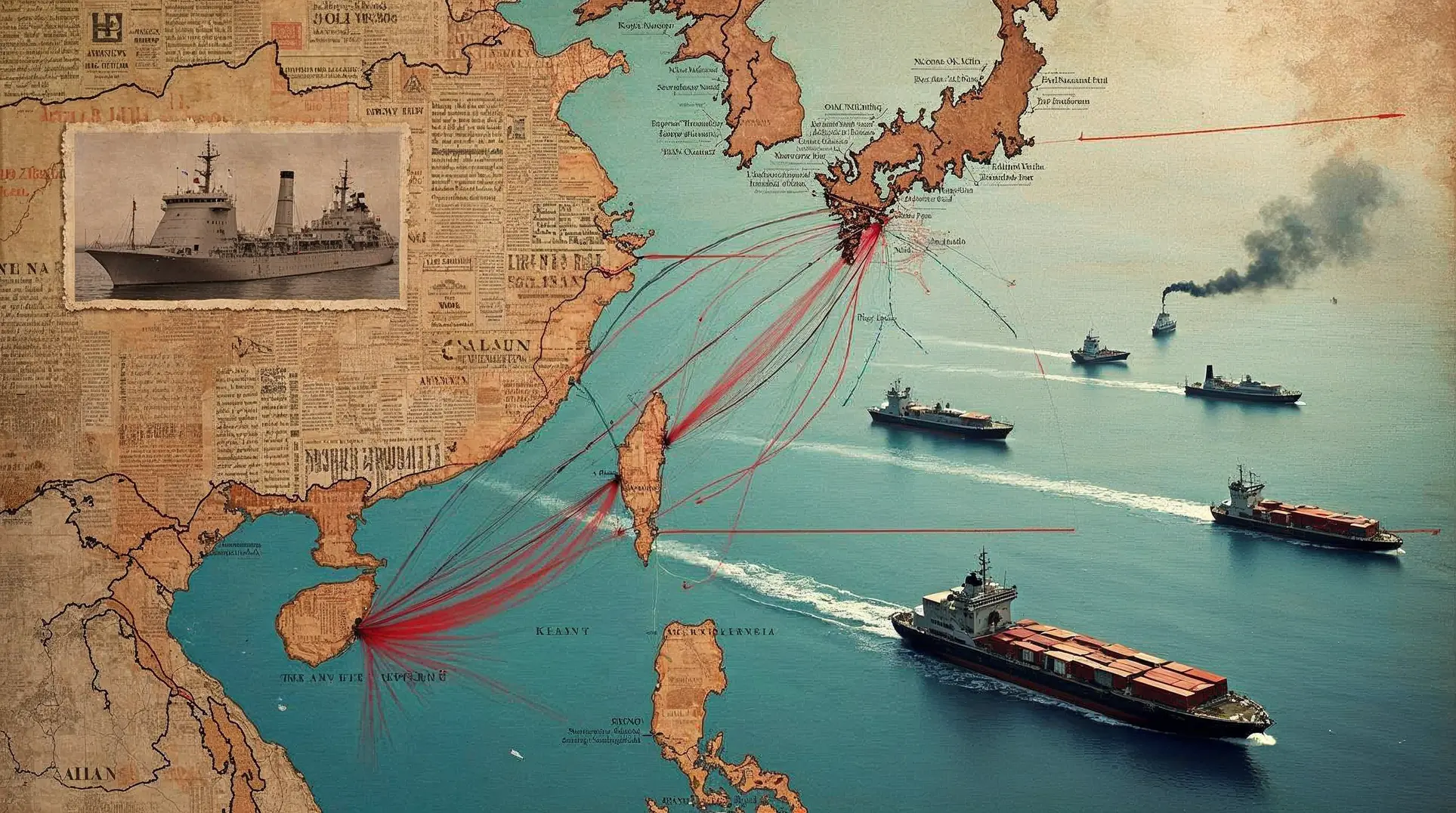
The specifics of "Justice Mission 2025" reveal its operational intent. The Eastern Theater Command coordinated joint forces across all domains—Army, Navy, Air Force, and Rocket Force—in simulated actions described as "joint seizure of comprehensive control." Most significantly, the drills explicitly rehearsed sealing off key ports including Keelung in the north and Kaohsiung in the south, the arteries through which Taiwan's export-oriented economy breathes.
This is not symbolic posturing. A blockade scenario represents the most militarily feasible and politically calibrated option in Beijing's toolkit—more sustainable than outright invasion, less overtly catastrophic than missile strikes, yet devastating in its economic impact. Taiwan imports roughly 60 percent of its food and nearly all its energy. Cutting these flows, even partially, would create immediate civilian pressure while presenting Washington and Tokyo with the most difficult decision in modern alliance management: whether to run a blockade to support a partner, risking direct confrontation with a nuclear-armed power.
Taiwan's response—scrambling troops and showcasing U.S.-made defensive systems—demonstrates awareness of the threat, but also highlights the asymmetry. Each Chinese drill forces Taiwan to expend finite resources, sortie aircraft, activate air defense systems, and maintain heightened readiness. This is strategic attrition by design, exhausting defensive capacity while the PLA gains operational experience.
Members are reading: How Beijing is using drill normalization to condition responses, compress warning times, and gather operational intelligence for actual blockade scenarios.
Multi-domain pressure campaign
The military exercises do not occur in isolation but form one component of coordinated coercion. Beijing launched an accompanying propaganda campaign featuring "Shields of Justice" posters and caricatures depicting Taiwanese President Lai Ching-te as a rat, reinforcing the dehumanization necessary to justify military action domestically. This mirrors patterns observed in joint China-Russia air patrols that combine military demonstration with information operations.
The timing capitalizes on recent developments that provide political cover: the $11.1 billion U.S. arms sale to Taiwan and Japanese Prime Minister Takaichi's statement that a Taiwan contingency would be a Japanese national emergency. Beijing frames its response as reactive, though the scale and coordination of "Justice Mission 2025" indicate planning began long before these specific triggers. The pretexts are interchangeable; the campaign was inevitable.
This approach reflects sophisticated understanding of alliance politics. By maintaining ambiguity about whether exercises could transition to actual operations, Beijing complicates pre-positioning of U.S. and Japanese forces. Moving assets closer to Taiwan risks appearing provocative; not moving them concedes initiative. This dilemma grows more acute as the baseline of Chinese military presence in the Taiwan Strait continues to rise.
The new calculus of miscalculation
The gravest consequence of normalizing blockade rehearsals is the erosion of clear thresholds. When exercises become indistinguishable from actual operation preparation, the margin for miscalculation compresses dangerously. Taiwan's military must make split-second judgments about whether detected movements constitute drill or attack. Allied intelligence must assess whether this iteration differs from the last dozen. Economic actors must decide whether to reroute shipping based on incomplete information.
Beijing is practicing the components of a potential invasion in plain sight, using the cover of "routine exercises" to refine tactics that could quickly transition to actual operations. The international community faces a choice between accepting this new normal—and the strategic erosion it represents—or establishing clear costs for continued escalation. The current trajectory suggests the former is winning by default, not by design.
The Taiwan Strait has become a laboratory for 21st-century coercion, where military pressure, economic leverage, and information operations combine to alter strategic realities without crossing formal thresholds for intervention. The next blockade rehearsal will surprise no one. That is precisely the point.
Subscribe to our free newsletter to unlock direct links to all sources used in this article.
We believe you deserve to verify everything we write. That's why we meticulously document every source.


