


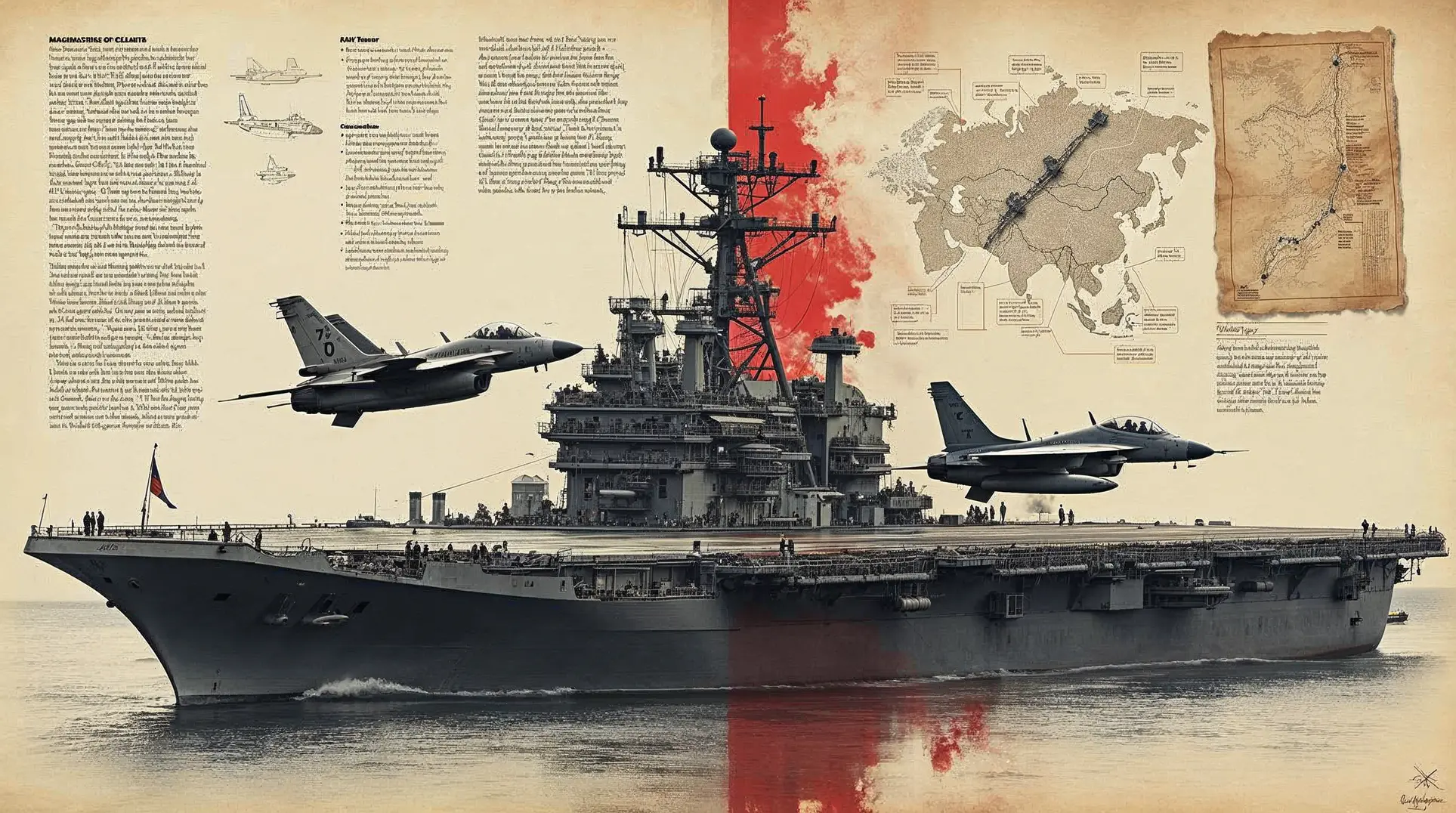
Late December satellite imagery showing China's newest aircraft carrier, Fujian, berthed alongside the veteran Liaoning at a Qingdao naval base has triggered fresh scrutiny of People's Liberation Army Navy carrier integration timelines. The co-location, coupled with a December 20 maritime safety notice from Dalian authorities announcing a week-long military activity zone in the Bohai Strait and northern Yellow Sea starting December 21, presents a pattern consistent with preparation for dual-carrier operations—yet stops short of confirming underway exercises.
The Fujian, commissioned only in November 2025, was observed transiting the Taiwan Strait earlier this month, its flight deck empty in surveillance photographs released by Taiwan's Ministry of National Defense. Taiwan's Defense Minister Wellington Koo speculated the ship might be returning to its Shanghai manufacturer to address technical issues, but subsequent imagery places the carrier at Qingdao's Yuchi naval complex, directly across the pier from Liaoning. The Dalian notice, covering waters near major PLAN training areas, prohibits commercial shipping from entering designated zones through December 28. Together, these data points suggest the PLAN is advancing carrier integration in northern waters, though the exact scope and timing of at-sea evolutions remain unannounced.
From ski-jump to catapults
Liaoning, China's first carrier, was commissioned in 2012 and transitioned from a training platform to an operational combat asset after 2018. Its ski-jump launch system, shared with the second carrier Shandong (Type 002), limits aircraft payload and sortie generation compared to catapult-equipped designs. Fujian represents a qualitative leap: as the PLAN's first Catapult Assisted Take-Off But Arrested Recovery (CATOBAR) carrier, it employs electromagnetic launch systems capable of launching heavier fixed-wing aircraft and airborne early warning platforms essential for sustained blue-water operations.
Earlier in 2025, Liaoning and Shandong conducted joint training beyond the first island chain, demonstrating growing institutional comfort with multi-carrier tasking. The addition of Fujian accelerates learning cycles around flight deck coordination, sortie generation, and command-and-control protocols. Co-berthing at Qingdao—Liaoning's home port since 2013—positions both carriers within easy reach of the Yellow Sea and Bohai training areas designated in the Dalian notice.
Members are reading: Analysis of what dual-carrier coordination would reveal about PLAN doctrine development and northern theater capability concentration timelines.
Signaling and regional context
The sequence—Taiwan Strait transit, northern berth convergence, restricted-water notice—unfolds within a broader December pattern of synchronized PLA maritime and air activity across the first island chain. The placement of Fujian in northern waters, weeks after commissioning, keeps attention on the carrier's integration trajectory while demonstrating mobility across theaters. The choice of the Yellow Sea and Bohai, rather than waters off Taiwan or the South China Sea, may reflect operational priorities: these are familiar training areas with established support infrastructure, reducing variables during early certification phases.
Regional surveillance actors—Japan's Maritime Self-Defense Force, South Korea's Navy, and Taiwan's MND—will adjust collection postures. The Dalian notice triggers commercial shipping advisories and routing adjustments, creating friction costs even absent direct confrontation. Concurrent tensions, including J-15 radar locks on Japanese fighters near Okinawa, underscore the role of carrier-based aviation in contested air-domain dynamics.
What to watch
Several indicators will clarify whether dual-carrier operations materialize. First, satellite or AIS evidence of both carriers getting underway into the Bohai or Yellow Sea during the December 21–28 window would confirm the exercise hypothesis. Second, presence or absence of aircraft on Fujian's deck in future imagery, particularly AEW or fixed-wing platforms consistent with CATOBAR trials, would signal readiness milestones. Third, additional NOTAMs, maritime safety notices, or public PLAN announcements naming specific drills would provide authoritative confirmation.
Fourth, regional responses—adjustments in Japanese and Korean surveillance posture, Taiwan MND reporting cadence, commercial shipping advisories—will reflect perceived threat levels and intelligence assessments. Finally, post-notice analysis of sortie rates, formation composition, and duration will distinguish between full dual-carrier integration drills and sequential, single-carrier certification events. Until underway operations are observed, the co-berthing and Dalian notice remain signals of intent rather than proof of execution—a reminder that China's carrier ambitions are advancing on institutional timelines that reward patient, multi-year capability development over immediate operational readiness.
Subscribe to our free newsletter to unlock direct links to all sources used in this article.
We believe you deserve to verify everything we write. That's why we meticulously document every source.


