


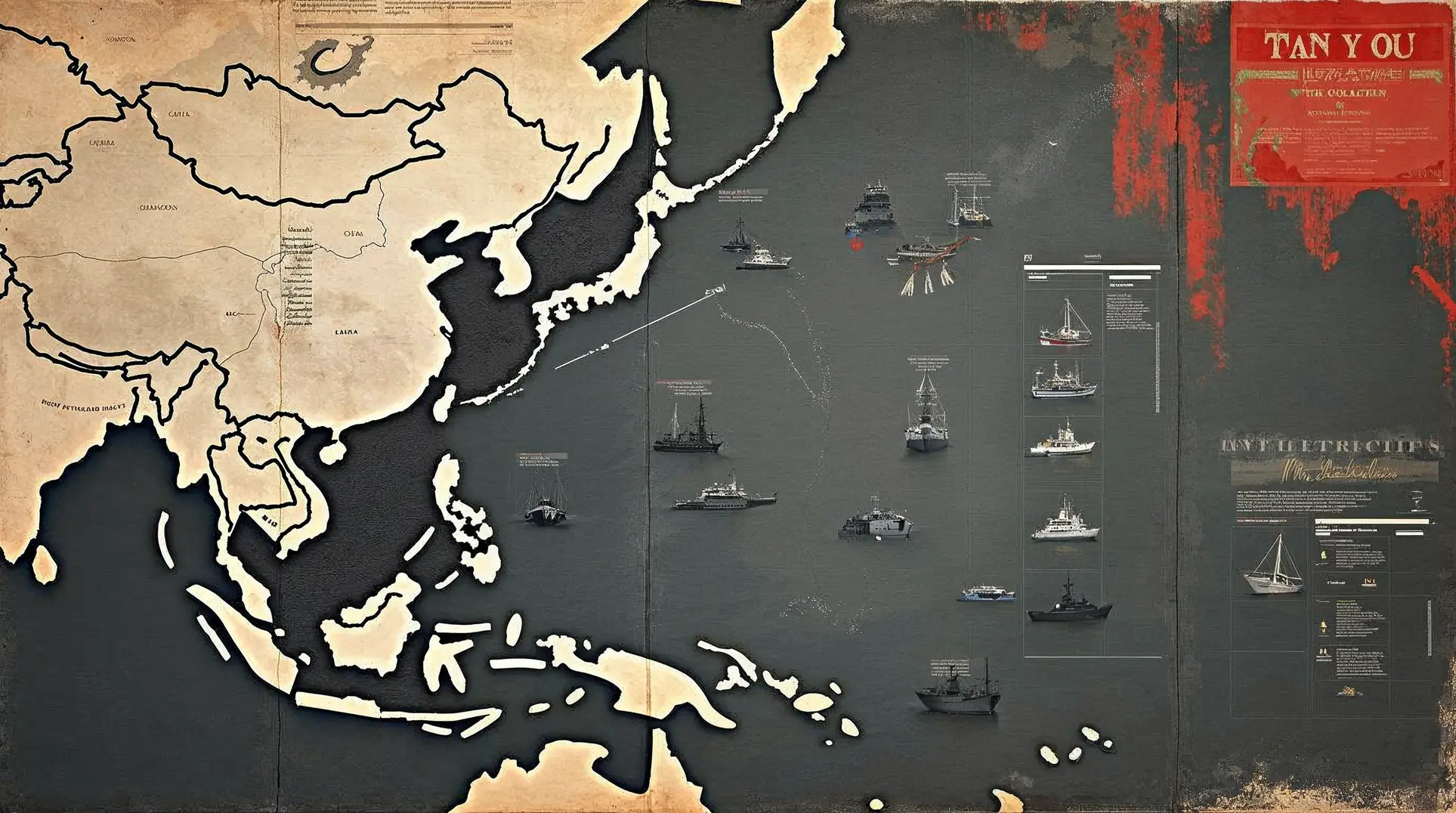
On December 4, 2025, Reuters reported that China had deployed more than 100 naval and coast guard vessels across East Asian waters—with over 90 still operating as of Thursday morning—in what represents Beijing's largest synchronized maritime operation to date. The deployment, which exceeded China's December 2024 mass mobilization that prompted Taiwan to raise its alert level, stretched from the southern Yellow Sea through the East China Sea, into the South China Sea, and out to the western Pacific, involving a mix of People's Liberation Army Navy warships and China Coast Guard vessels operating in coordinated formations.
Taiwan and Japan issued measured but pointed statements of concern. Presidential spokesperson Karen Kuo said the surge "poses a threat and impact to the Indo-Pacific and the whole region," called for restraint, and confirmed that President Lai Ching-te had ordered full situational awareness and close coordination with "friendly partners." Japanese Defence Minister Shinjiro Koizumi said Tokyo is monitoring Chinese military activities "with great attention" and intensifying intelligence gathering and surveillance, though he declined to comment on specific deployments.
A multi-theater rehearsal, not a Taiwan-only provocation
The operational significance of this surge lies in its geographic breadth and institutional coordination rather than its density around any single flashpoint. Intelligence documents reviewed by Reuters confirm four PLA naval formations were operating in the western Pacific as of December 3, while China Coast Guard units maintained simultaneous presence across the East China Sea—including waters near the disputed Senkaku/Diaoyu Islands—and the South China Sea. This represents a qualitative shift from prior drills that concentrated forces near Taiwan or within a single maritime theater.
Notably, Beijing did not announce any named large-scale exercises despite this being the traditional November-December period for heightened PLA activity. The absence of official branding signals a preference for flexible signaling and plausible deniability: China can normalize a higher operational tempo without formally declaring exercises that might trigger pre-planned regional responses or international censure. This approach blurs the line between routine patrols, gray-zone operations, and joint-force rehearsals, complicating the monitoring calculus for Taiwan, Japan, and allied intelligence architectures.
Reuters sources offered divergent assessments of intent. Some described vessels and aircraft conducting mock attacks on foreign ships and practicing anti-access/area-denial operations—suggesting combat rehearsal scenarios. Critically, intelligence indicated that the number of Chinese ships near Taiwan itself did not rise significantly, reinforcing the interpretation that this was a demonstration of synchronized capacity across multiple domains rather than imminent preparation for contingency operations around the island.
Members are reading: Why Beijing chose breadth over concentration, and what the surge reveals about command integration between navy and coast guard forces.
What to watch: duration, density, and institutional signals
China's naval modernization—particularly its expanding carrier fleet, Type 055 cruisers, and amphibious ready groups—has enabled the geographic distribution demonstrated this week. The question now is whether Beijing sustains this tempo or scales back after achieving its signaling objectives. Key indicators include whether ship density near Taiwan specifically increases in coming weeks; whether the PLA publicly names any forthcoming exercises, which would indicate a shift toward more overt deterrence messaging; and whether China Coast Guard patrols near the Senkaku Islands remain elevated, testing Japanese resolve amid the collective self-defense debate.
Equally important will be any emergent incident-management mechanisms. To date, no new hotline activations or working-level dialogues between Tokyo and Beijing, or Taipei and Beijing, have been reported. The absence of such channels raises the risk that a routine encounter—fishing vessel interdiction, close naval pass, or air intercept—escalates through miscalculation. The tone of official rhetoric in the days ahead will signal whether Beijing views this operation as a one-time demonstration or the opening phase of a sustained pressure campaign calibrated to both the Taiwan defense-spending cycle and Japan's ongoing debate over collective defense thresholds.
For now, the data points to a carefully orchestrated show of force designed to normalize higher operational presence, stress regional monitoring systems, and signal resolve without triggering crisis-level responses. The breadth of the deployment, rather than concentration at any single chokepoint, is the message: China's maritime forces can now operate coherently across the entire near seas simultaneously, and regional capitals must adjust their planning assumptions accordingly.
Subscribe to our free newsletter to unlock direct links to all sources used in this article.
We believe you deserve to verify everything we write. That's why we meticulously document every source.


