


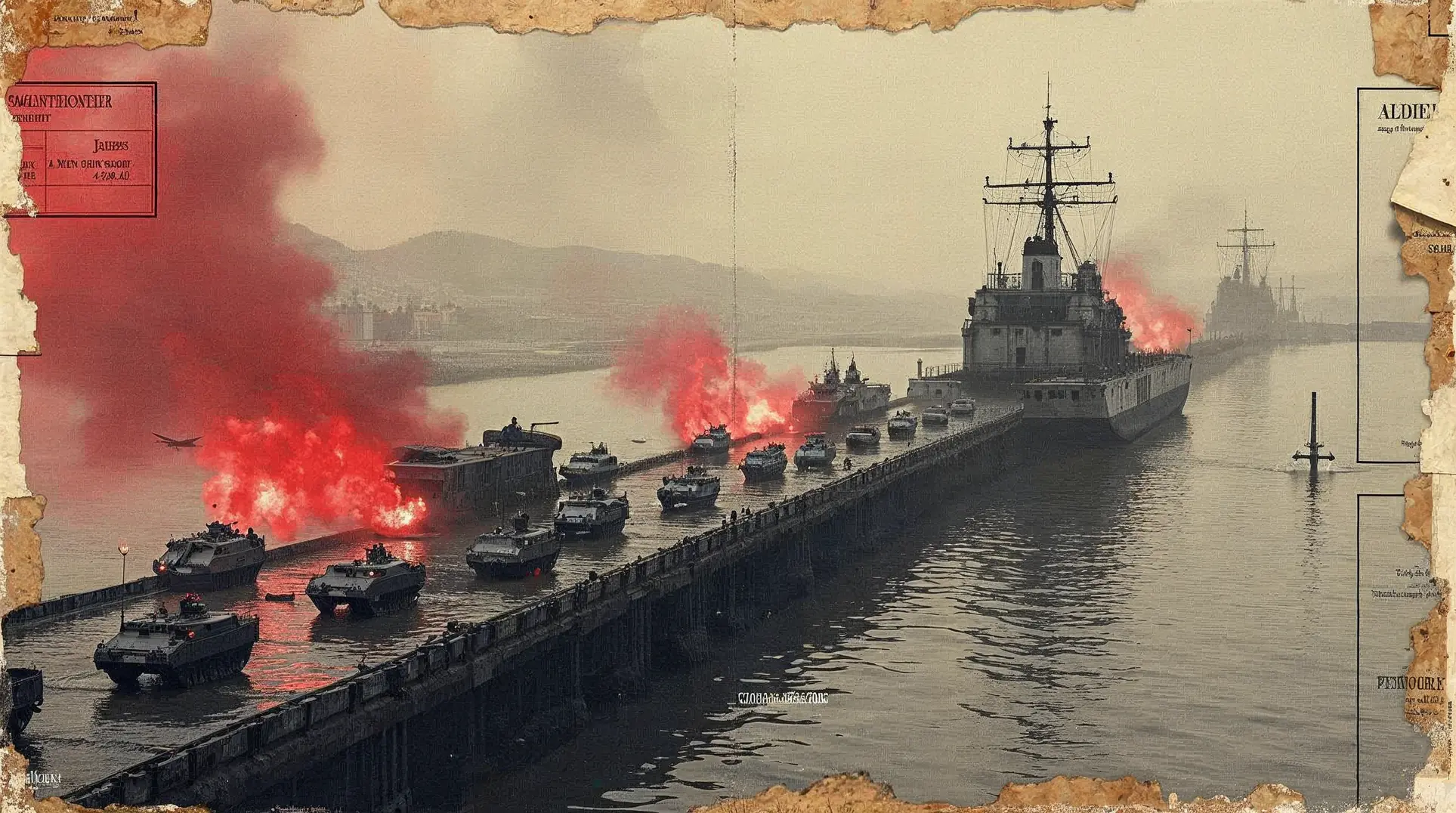
Between January 11 and 15, 2026, the People's Liberation Army Navy conducted sea trials of a second set of Shuiqiao-class amphibious landing barges off Nansan Island, confirming the operational development of a vessel type designed to fundamentally alter the logistical calculus of a Taiwan invasion. These self-propelled barges, which connect to form piers extending up to 820 meters, enable the PLA to offload heavy armor and artillery directly onto unimproved beaches, bypassing the need to capture a functioning port in the opening phase of an amphibious assault.
The deployment marks a tangible advancement in China's military preparations ahead of readiness goals established by President Xi Jinping for achieving full invasion capability. U.S. intelligence assessments indicate that Xi Jinping has directed the People's Liberation Army to be ready to invade Taiwan by 2027, though this represents a readiness benchmark rather than a definitive invasion timeline. Some U.S. officials have noted that China's military is not currently capable of carrying out a "short, sharp invasion" of Taiwan by 2027, citing gaps in sophisticated urban warfare and long-distance logistic capabilities. By solving one of the most enduring challenges in amphibious warfare—rapidly establishing supply lines without port infrastructure—the Shuiqiao-class vessels expand the number of viable landing sites along Taiwan's western coastline. This development forces Taipei to recalculate its defensive posture, spreading already limited resources across a significantly broader threat surface.
Bypassing the fortified port constraint
Taiwan's major ports—Kaohsiung, Taichung, and Keelung—have been identified as significant strategic objectives for any invading force. The Port of Kaohsiung ranks among the world's most efficient facilities, ranked 9th globally in the Container Port Performance Index, though Taichung Port's efficiency metrics are considerably lower. These facilities are among the most heavily defended positions on the island, fortified with anti-ship missile batteries, coastal artillery, and pre-positioned demolition charges designed to render docks unusable. PLA war planners have consistently identified port seizure as a critical vulnerability in invasion scenarios, creating what military analysts term a "operational dilemma": the sites most suitable for rapid logistics are also the most lethal to approach.
The Shuiqiao-class vessels represent a direct engineering solution to this constraint. Each barge measures approximately 90 meters in length and can be linked with others to create a modular causeway system. When deployed in conjunction with China's extensive fleet of civilian roll-on/roll-off ferries—vessels capable of carrying hundreds of armored vehicles but requiring pier infrastructure to offload—these mobile piers transform previously unsuitable coastline into functional landing zones. Beaches near Changhua County, the Tainan shoreline, and stretches of coast south of Taichung, all previously considered secondary targets due to lack of port facilities, now enter the operational planning matrix as viable first-wave objectives.
This capability integrates seamlessly with China's established pattern of military-civil fusion, leveraging its civilian maritime fleet for strategic military purposes. While China produces over 50 percent of global commercial tonnage, this shipbuilding capacity serves diverse purposes, with foreign companies purchasing 75 percent of ships built at China's dual-use shipyards. Chinese shipbuilders have systematically developed specialized military logistics platforms alongside their substantial commercial vessel production.
Members are reading: Detailed analysis of why these mobile piers become critical vulnerability zones and how Taiwan's asymmetric arsenal is optimized to exploit them.
Complicating the defensive equation
The primary strategic impact of the Shuiqiao-class barges lies not in guaranteeing invasion success, but in fundamentally complicating Taiwan's defensive calculations. Prior to their deployment, Taiwanese military planners could concentrate anti-landing resources around a limited number of high-probability beach zones adjacent to ports. The introduction of mobile pier capability forces a dispersion of defensive assets across hundreds of kilometers of coastline, diluting the concentration of force at any single point.
This dispersion effect aligns with broader PLA strategy evident in recent calculated escalations, which systematically test and probe defensive responses. Each new capability—whether maritime militia vessels, long-endurance drones, or now mobile logistics platforms—adds variables to Taiwan's defensive matrix, straining intelligence, surveillance, and reconnaissance resources while forcing difficult allocation decisions. The barges represent another tool in an expanding toolkit, increasing operational flexibility while simultaneously creating new targets that must be defended.
For Taiwan, the challenge extends beyond military hardware to strategic signaling. The assembly of Shuiqiao barges would constitute an unambiguous indicator of imminent invasion, yet responding with preemptive strikes risks escalation and international condemnation. This creates a narrow decision window in which Taipei must determine whether observed preparations represent genuine invasion intent or another iteration of the coercive exercises that have become routine in the strait.
The logistics arms race continues
The Shuiqiao-class deployment underscores the relentless pace of PLA capability development as China's military readiness benchmarks approach. These vessels exemplify China's industrial capacity to identify specific operational gaps and rapidly develop tailored solutions. Yet they also illustrate the enduring challenge of amphibious warfare: every logistical innovation creates new vulnerabilities that adversaries can exploit.
The mobile piers expand China's options while simultaneously presenting Taiwan with high-value targets whose destruction could cripple invasion logistics. This duality—enhanced capability paired with concentrated vulnerability—defines the escalating competition in the Taiwan Strait, where each new military development triggers countermeasures, and the space between deterrence and conflict continues to narrow. The Shuiqiao barges are both a solution and a problem, embodying the complex, high-stakes calculus that now characterizes cross-strait military balance.
Subscribe to our free newsletter to unlock direct links to all sources used in this article.
We believe you deserve to verify everything we write. That's why we meticulously document every source.


