


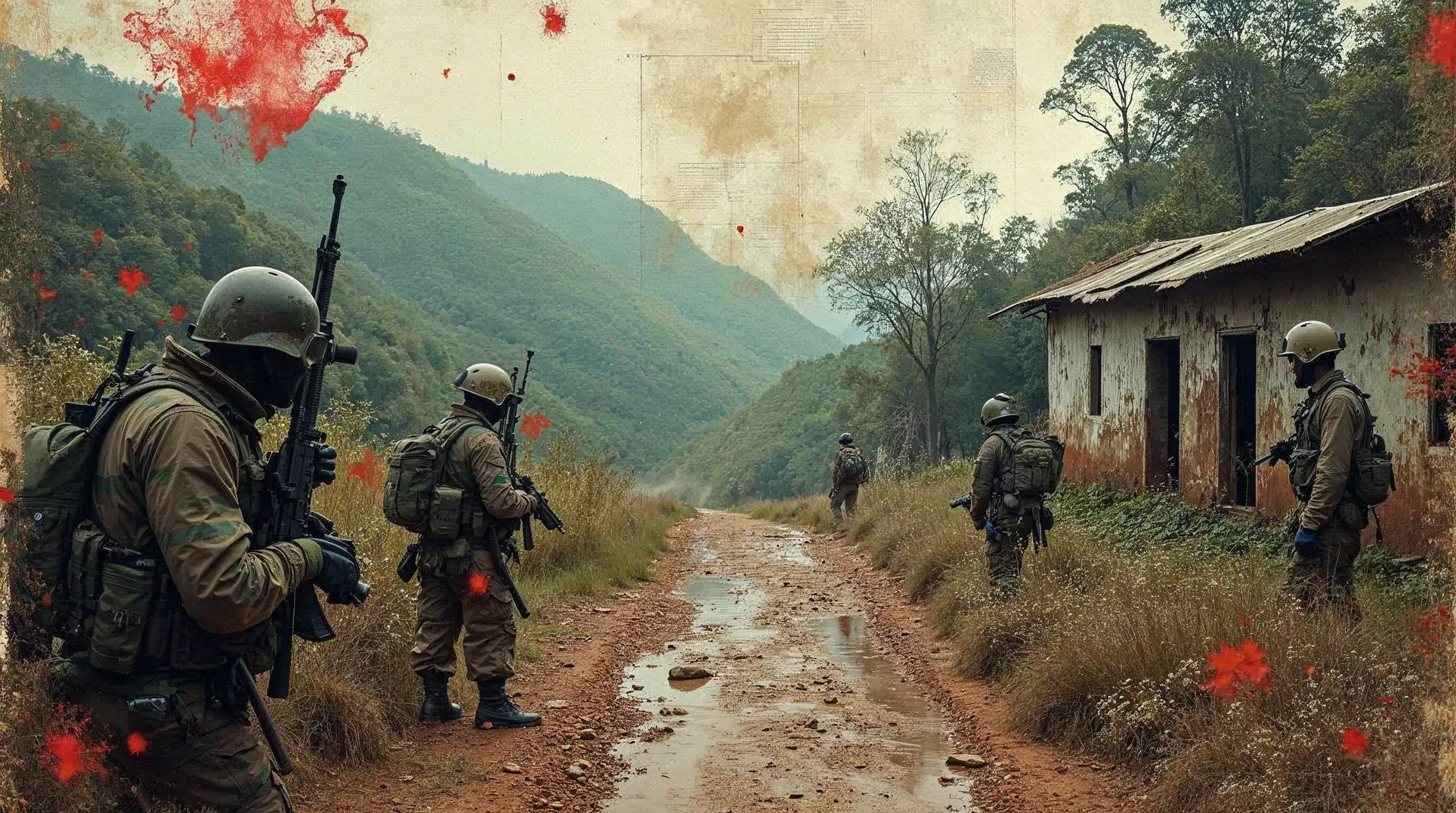
Hours before President Donald Trump was scheduled to host Rwanda's Paul Kagame and the Democratic Republic of Congo's Félix Tshisekedi at the White House on December 4, 2025, the ceasefire they were meant to formalize collapsed in gunfire. On December 2, Congolese armed forces (FARDC) and the Rwanda-backed M23 movement traded accusations of violations around Kaziba, Katogota, and Lubarika in South Kivu, each claiming the other had sabotaged both the US-brokered Washington track and the parallel Qatar-mediated Doha framework. Rwanda's Foreign Minister Olivier Nduhungirehe told Reuters in Washington that he hoped the accord "will be a step toward peace," yet in the same breath accused FARDC of using fighter jets and attack drones against M23 positions and civilians, violating earlier agreements. Kinshasa's government spokesperson Patrick Muyaya blamed M23 for the renewed fighting, calling it proof "Rwanda doesn't want peace," while expressing hope that Trump's personal involvement could translate paper commitments into ground-level progress.
This collision between diplomatic choreography and battlefield reality exposes the central fragility of the Washington Accords for Peace and Prosperity: two parallel tracks—one state-to-state, one engaging the actual belligerents—risk working at cross purposes unless sequencing, monitoring, and enforcement are tightly aligned. The gap between what can be signed in the White House and what can be verified in Kivu is where peace deals go to die.
Two tracks, one war
The architecture underpinning Thursday's ceremony is complex and layered. On June 27, 2025, DRC and Rwanda signed a preliminary peace agreement and economic pact under US auspices, establishing a Joint Security Coordination Mechanism and Joint Oversight Committee. Follow-up meetings in Washington on October 21-22 and November 7 saw the parties initial a Regional Economic Integration Framework (REIF), designed to pair security de-escalation with investment incentives around critical minerals—a strategic priority for Washington. The security concept of operations (CONOPS) envisioned neutralizing the Democratic Forces for the Liberation of Rwanda (FDLR), a Hutu militia Kigali considers an existential threat, and phasing out Rwanda's "defensive measures" inside DRC territory.
Parallel to this state-level diplomacy, the Doha framework signed on November 15 between DRC and M23—following a July 19 Declaration of Principles—committed both sides to ceasefire verification, troop disengagement, humanitarian corridors, and eventual reintegration or demobilization. Qatar, the United States, and the African Union are observers and facilitators. The Doha process acknowledges an uncomfortable truth Washington has been reluctant to foreground: M23, not Rwanda officially, controls territory and commands fighters on the ground. Any sustainable settlement must account for their interests, grievances, and political endgame.
The UN Security Council's February 21 Resolution 2773 condemned M23 offensives and called on the Rwanda Defence Force to cease support to M23 and withdraw from DRC, underscoring the international consensus Kigali has defied. Council members have floated MONUSCO involvement in ceasefire monitoring, but the mission remains under-resourced and politically constrained, with no clear mandate or timeline for a verification role.
Members are reading: Why Kinshasa, Kigali, and M23 each demand the other concede first, and how misaligned timelines risk unraveling both tracks.
What happens next
The next seventy-two hours will test whether the Washington ceremony is a turning point or a photo opportunity. Immediate indicators include whether fighting stops in the Kaziba-Katogota-Lubarika corridor, whether Doha's monitoring mechanism issues third-party verification reports, and whether the White House annexes specify concrete security benchmarks or remain vague. Short-term metrics include tangible DRC operations against the FDLR beyond awareness campaigns, verifiable signals of phased RDF disengagement tied to those operations, and humanitarian access corridors opening in contested zones.
Medium-term, watch for integration or demobilization arrangements for M23 fighters per Doha protocols, alignment between REIF economic incentives and security milestones, and Joint Oversight Committee communiqués indicating whether disputes are being resolved or papered over. Kinshasa's own policy contradictions around militia engagement complicate its ability to deliver on any pathway.
Ultimately, peace in eastern Congo will not be signed into existence in Washington or Doha. It will be built—or broken—by whether the parties accept mutual costs, whether verification can function amid spoiler violence, and whether economic incentives flow only when security conditions warrant. The gap between what Trump can host and what Kivu can sustain remains wide. The skirmishes on the eve of the ceremony are a reminder that ceasefires without enforcement are just pauses between rounds.
Subscribe to our free newsletter to unlock direct links to all sources used in this article.
We believe you deserve to verify everything we write. That's why we meticulously document every source.


