


The November 17, 2025 verdict against former Bangladesh Prime Minister Sheikh Hasina for crimes against humanity arrives not as legal conclusion but as inflection point—a moment when competing visions of justice, sovereignty, and regional order collide with consequences extending far beyond Dhaka's courtrooms. The trial, conducted in absentia against a defendant sheltered by India despite extradition requests, exposes the fundamental tensions between accountability mechanisms and geopolitical realities in South Asia's evolving security architecture.
Sheikh Hasina stands accused of orchestrating the systematic killing of at least 1400 protesters—52% of them students—during the July 2024 uprising that ended her 15-year rule. The prosecution's evidence portfolio includes surveillance footage, drone logs, hospital records documenting gunshot wounds, and leaked government communications allegedly authorizing "shoot-on-sight" orders against unarmed civilians. The International Crimes Tribunal, ironically established by Hasina's own administration to prosecute 1971 war crimes, now seeks her death penalty for crimes including deployment of military hardware against protesters, coordinated killings by security forces and Awami League-affiliated groups, and systematic destruction of evidence.
Unlock a Audio deep dive: Bangladesh at the Crossroads Sheikh Hasina Trial.
Yet the trial's legal architecture reveals deeper structural problems that transcend individual guilt or innocence. Hasina's denunciation of proceedings as a "kangaroo court" and refusal to return from Indian refuge creates a situation where accountability mechanisms operate in political vacuum, disconnected from enforcement capacity. Her appointed defense attorney works under potential conflict of interest, while India's protection transforms extradition from legal obligation into geopolitical bargaining chip. The interim government led by Muhammad Yunus pledges justice while managing political chaos including banned Awami League lockdown calls, petrol bomb attacks, and security crackdowns—conditions that raise questions about whether transitional justice can function within environments it seeks to transform.
For an Asia-Pacific analyst examining interconnected systems rather than binary great power competition, the Hasina trial represents something more complex than simple accountability versus impunity. It illuminates how domestic political transitions become enmeshed in regional economic networks, diplomatic relationships, and security calculations that either enable or obstruct justice mechanisms. The case tests whether Bangladesh can break cycles of authoritarian rule and violent political change, or whether structural factors—India's strategic calculations, institutional weaknesses, political polarization—predetermine outcomes regardless of legal proceedings. Most fundamentally: can transitional justice succeed when the accused remains beyond reach, protected by the very regional order that Bangladesh must navigate for economic survival and strategic stability?
The architecture of authoritarian control: Hasina's 15-year consolidation
Sheikh Hasina's tenure from 2009 to 2024 demonstrated how democratic institutions can be systematically hollowed out while maintaining electoral facades. The Awami League government employed overlapping control mechanisms—legal frameworks criminalizing dissent, security apparatus deployment against opposition, and strategic use of liberation war legacy for political legitimacy—that transformed Bangladesh from parliamentary democracy into personalized autocracy.
The legislative foundation for repression evolved through iterations designed to evade international criticism while expanding state power. The Digital Security Act, and its replacement the Cyber Security Act, created expansive definitions of prohibited speech that enabled prosecution of journalists, bloggers, and activists for "derogatory remarks" against Hasina or government officials. Amnesty International documented cases illustrating the law's reach: Pinaki Bhattacharya charged for Facebook posts, Selim Khan detained for social media criticism, journalist Rozina Islam arrested for reporting on government contracts. These prosecutions established chilling effects extending far beyond individual cases—public discourse constricted as citizens internalized that criticism carried criminal consequences.
The security apparatus operated through both official channels and informal networks that blurred state authority with party militia functions. Police, armed forces, and intelligence services conducted enforced disappearances that removed perceived threats without judicial process, creating fear through unpredictability. Simultaneously, Awami League-affiliated groups functioned as auxiliary enforcement mechanisms, attacking opposition rallies and intimidating dissidents with implicit state protection. This dual-track repression meant that citizens faced threats from both uniformed officers and party operatives, with accountability mechanisms deliberately obscured across both domains.
Economic policy under Hasina prioritized infrastructure development and poverty reduction that generated genuine improvements in living standards, creating political legitimacy beyond coercive capacity. Bangladesh's garment export growth, remittance flows, and development indicators provided material foundation for Awami League support among constituencies benefiting from economic expansion. Yet this growth model concentrated wealth and patronage networks around government-connected elites, creating economic dependencies that reinforced political control. Opposition to Hasina meant risking not just legal prosecution but economic marginalization within systems where government connections determined access to opportunity.
Members are reading: How India's economic leverage over Bangladesh shapes the strategic calculations that make extradition a geopolitical bargaining chip rather than legal obligation.
July uprising: The anatomy of mass killing
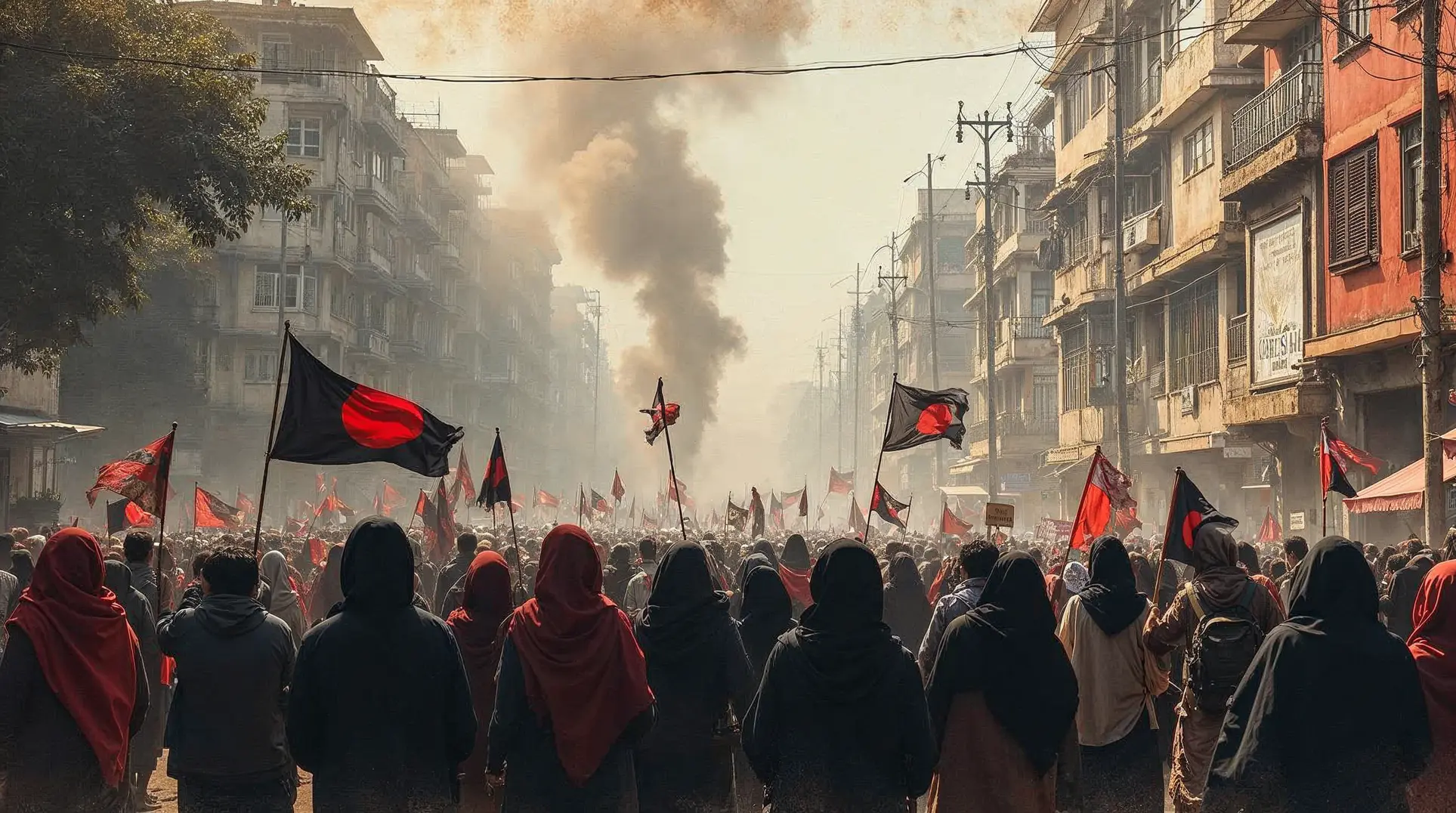
The student protests that erupted in July 2024 began with specific grievance—opposition to quota system reserving government jobs—before escalating into broader challenge to Hasina's authoritarian governance. The government's response demonstrated systematic deployment of lethal force against unarmed civilians, with coordination between security forces and party-affiliated groups creating kill zones in urban centers.
Human Rights Support Society documentation identified at least 875 deaths between July 16-August 5, with 52% being students and significant representation of women protesters. The United Nations reported potentially up to 1,400 deaths, though verification remained incomplete due to government obstruction of independent investigation during the violence. The death toll's concentration among students reflected both protest demographics and targeting patterns—security forces focused lethal response on university areas and youth-heavy demonstrations.
The prosecution's evidence reveals calculated escalation rather than spontaneous crowd control failure. Surveillance footage allegedly shows security personnel firing directly into crowds of unarmed protesters. Drone logs document aerial surveillance coordinating ground force deployment to protest locations. Hospital records catalog entry wounds consistent with aimed rifle fire rather than crowd dispersal weapons. Leaked communications allegedly include directives authorizing lethal force against demonstrators, though their authenticity remains subject to defense challenge.
Specific incidents illuminate the killing's systematic nature. Student leader Abu Sayed's death, captured on video showing security forces shooting him while unarmed, became symbolic of the crackdown's brutality. The prosecution charges Hasina with direct responsibility for his murder alongside broader crimes against humanity counts. The deployment of military hardware including helicopters and incendiary weapons against civilian protesters represented escalation beyond any legitimate crowd control framework, signaling intent to suppress dissent through terror rather than minimal necessary force.
The mass arrests compounded the lethal violence—10,000 protesters detained between July 17-29 according to human rights organizations. Detention facilities overflowed as security forces swept protest areas, arresting participants, bystanders, and suspected organizers. Reports emerged of torture, beatings, and denial of medical care for injured detainees. The internet blackouts during peak violence prevented real-time documentation and coordination, isolating protesters and enabling unconstrained security force operations.
Women and girls faced specific forms of violence beyond the general crackdown. Sexual assault reports, targeted harassment of female protesters, and gender-specific threats attempted to discourage women's participation through intimidation exploiting social vulnerabilities. Yet women remained central to the protest movement, demonstrating resilience against gendered repression tactics.
The trial's legal architecture and due process challenges
The International Crimes Tribunal's reconstitution by the interim government to prosecute Hasina created immediate legitimacy questions. The tribunal, originally established during Hasina's tenure for 1971 war crimes trials, faced criticism for procedural irregularities and political influence even before its repurposing. Its transformation into the mechanism prosecuting its creator intensifies concerns about whether institutional independence can exist when courts serve transitional government political objectives.
The charges enumerate five counts of crimes against humanity: orchestrating mass killings of protesters; deploying military hardware including helicopters, drones, and incendiary weapons against unarmed civilians; specific murder of student leader Abu Sayed and others; systematic destruction of evidence including deletion of surveillance footage and hospital records; and coordinated killings involving security forces and Awami League-affiliated groups. Each count requires proving not just individual acts but systematic, widespread attack against civilian population with knowledge of the broader context—the legal threshold for crimes against humanity under international law.
The trial in absentia raises fundamental fairness questions that extend beyond Hasina's individual case to implicate the proceedings' broader legitimacy. International human rights law permits trials in absentia under specific conditions: the defendant must have been properly notified, given opportunity to appear, and provided effective legal representation. Bangladesh's satisfaction of these requirements faces serious challenge.
Hasina's denunciation of the tribunal as "politically motivated" and her claim of being denied right to choose her counsel create defense foundation beyond mere procedural complaint. Her characterization of proceedings as "kangaroo court" attacks the tribunal's fundamental legitimacy rather than just specific procedural elements. The appointment of state-selected attorney to represent an absent defendant who rejects the court's authority creates inherent conflict—can counsel effectively defend someone who repudiates the entire judicial process and refuses participation?
British journalist and Bangladesh legal expert David Bergman's concerns about potential conflicts of interest in court-appointed representation highlight how structural factors compromise defense effectiveness. An attorney selected by the prosecuting government faces implicit pressures to avoid too-vigorous defense that might antagonize appointing authorities, particularly when defending against politically charged accusations. This creates appearance if not reality of defense counsel serving institutional legitimacy needs rather than zealous client representation.
The death penalty request compounds due process concerns. Seeking capital punishment in absentia trial creates scenario where defendant could be executed without ever having faced accusers, cross-examined witnesses, or presented defense in person. While Bangladesh's legal system permits death sentences and the crimes alleged carry utmost gravity, capital punishment in absentia tests the limits of what procedural fairness can accommodate even for serious offenses.
Members are reading: Why institutional reform proves far more difficult than regime change, as Bangladesh discovers that removing Hasina left authoritarian structures largely intact and operational.
Regional implications beyond bilateral India-Bangladesh tensions
The trial's regional reverberations extend beyond India-Bangladesh relationship strain to implicate broader South Asian security architecture and great power competition dynamics. China's careful positioning—neither defending Hasina nor criticizing India's protection—reflects Beijing's strategic patience in cultivating relationships with Bangladesh's interim government while avoiding antagonizing New Delhi unnecessarily. The United States' human rights rhetoric about trial fairness and due process provides diplomatic cover for interim government while maintaining Washington's traditional emphasis on procedural legitimacy over substantive justice demands.
Pakistan's Afghan border crisis creates parallel that illuminates regional pattern: when neighbors harbor individuals or groups that other states consider security threats or criminal fugitives, bilateral relationships deteriorate through sovereignty disputes that legal frameworks cannot resolve. Pakistan faces two-front crisis as Afghanistan refuses to act against TTP militants operating from its territory, just as India declines to extradite Hasina despite Bangladesh's legal requests. Both situations demonstrate how sovereignty and legal cooperation break down when states prioritize strategic calculations over neighboring countries' security concerns.
The cases diverge in India's relative power advantage over Bangladesh compared to Pakistan's challenged leverage over Afghanistan. Where Pakistan attempts coercion through border closures and military strikes that expose structural deadlocks, Bangladesh lacks equivalent options to pressure India. This asymmetry means Bangladesh must navigate India's non-cooperation through diplomatic accommodation rather than confrontation—accepting that Hasina's extradition depends on Indian strategic assessment rather than legal obligation.
Regional organizations offer minimal assistance in such sovereignty disputes. SAARC's weakness and dysfunction mean South Asian multilateral frameworks cannot mediate India-Bangladesh tensions or establish norms compelling fugitive transfer. The absence of effective regional mechanisms leaves bilateral negotiations as sole avenue for addressing extradition disputes, inevitably favoring more powerful party with greater leverage.
Societal impact: Trauma, polarization, and the search for closure
The July uprising's survivors and victims' families navigate profound trauma while seeking justice through proceedings that may never deliver meaningful accountability. Families who lost student children to security force bullets face impossible choice between participating in judicial process that might vindicate their losses or boycotting proceedings they view as inadequate theater. The trial's in absentia nature means families cannot confront Hasina directly, observe her defense, or see her face conviction—if conviction comes—in person. This abstract quality of justice when the accused remains absent creates emotional dissatisfaction even if legal requirements are technically met.
Survivors bearing physical and psychological scars from violence confront daily reminders while political debates treat their suffering as abstract legal questions or political pawns. Students who witnessed classmates shot dead navigate university returns to scenes of trauma. Women who faced gender-specific violence during protests manage social consequences and psychological impact with minimal support services in Bangladesh's under-resourced mental health system. The trial's focus on Hasina's culpability provides some validation that their suffering resulted from criminal acts rather than legitimate state response, yet legal proceedings cannot heal trauma or restore what violence destroyed.
The political polarization extends into families and communities, dividing those who supported Hasina's development achievements from those prioritizing democratic rights and protest movement. Social media amplifies divisions as competing narratives circulate with minimal common factual ground—Awami League supporters share content portraying Hasina as victim of conspiracy while opposition networks document July killings and celebrate her removal. These parallel information ecosystems prevent dialogue and reconciliation, with each side consuming content that confirms existing positions rather than engaging opposing perspectives.
Street-level political violence manifests the polarization's dangerous trajectory. The crude bomb explosions, petrol bomb attacks on public transportation, and arson targeting symbols of protest movement or interim government demonstrate how political contestation spills beyond institutional channels into physical confrontation. Each attack escalates tensions, hardens positions, and creates cycles of retaliation that undermine stability necessary for democratic transition. The interim government's security responses—deploying forces, imposing restrictions—risk replicating the very authoritarian patterns the uprising opposed.
International human rights scrutiny and selective accountability
International human rights organizations occupy ambiguous position regarding the Hasina trial—supporting accountability for July killings while expressing concerns about due process and trial fairness. Amnesty International's documentation of Hasina-era abuses including enforced disappearances, minority violence, and workers' rights violations provides evidentiary foundation for prosecution while the organization simultaneously advocates for trial procedures meeting international standards.
This positions human rights advocates in apparent contradiction: demanding justice for victims while criticizing the specific mechanisms pursuing that justice. Yet the contradiction reflects genuine dilemma—accountability must be achieved through processes that themselves respect rights and due process, otherwise justice becomes revenge disguised in judicial form. International law permits trials in absentia but requires procedural safeguards that Bangladesh's tribunal struggles to demonstrate. The death penalty's application in absentia particularly troubles human rights organizations given capital punishment's irreversibility and international trend toward abolition.
The selective accountability pattern across South Asia reveals how justice mechanisms apply to weak rather than powerful actors. India's protection of Hasina while Bangladesh prosecutes contrasts with impunity for Indian security force abuses in Kashmir, northeastern states, and elsewhere. Pakistan's prosecution of some militants while protecting others based on strategic calculations mirrors regional pattern where accountability follows political convenience rather than consistent legal principles. This selectivity undermines rule of law's credibility when citizens observe that justice depends on power and connections rather than conduct and evidence.
The international community's engagement focuses disproportionately on procedural rather than substantive questions—trial fairness receives more attention than whether accountability for mass killing occurs. This reflects both genuine commitment to due process and preference for technical legal discussions over politically fraught substantive judgments. Western governments particularly emphasize procedural legitimacy, enabling criticism of both authoritarian repression and transitional justice mechanisms without requiring clear positions on whether specific individuals should face conviction or what remedies victims deserve.

Members are reading: How great power competition transforms Bangladesh's transitional justice into geopolitical contest where victim justice becomes subordinate to regional power calculations.
The path forward: Can Bangladesh escape historical patterns?
Bangladesh confronts fundamental question as Hasina verdict approaches: whether this transition can break cycles of authoritarian rule and violent political change that have characterized its independence history, or whether structural factors predetermine return to familiar patterns under different leadership and party labels.
Historical precedent suggests pessimism. Previous regime transitions saw initial reform rhetoric give way to gradual accumulation of power, suppression of opposition, and eventual authoritarian consolidation by successor governments. The institutional weaknesses, political polarization, and economic pressures that enabled Hasina's authoritarianism persist largely unchanged despite her removal. Security forces retain operational capacity for repression, judicial system lacks genuine independence, political culture prioritizes power accumulation over rights protection, and economic development depends on centralized control that conflicts with democratic accountability.
Yet countervailing factors offer tentative optimism. The July uprising's scale and youth composition suggest generational shift in political consciousness that may sustain pressure for genuine democratic governance. International attention creates external constraints on backsliding even if not sufficient to prevent it entirely. Economic integration provides incentives for institutional development and rule of law that serve investor confidence and trade relationships. Civil society organizations emerging from protest movement offer potential accountability mechanisms beyond formal political institutions.
The Hasina trial's outcome will influence but not determine Bangladesh's trajectory. Conviction might provide accountability that begins breaking impunity cycle, or might fuel Awami League resistance that destabilizes transition. Acquittal might calm polarization through gestures toward procedural fairness, or might enrage protest movement and validate Awami League intransigence. Trial collapse through procedural irregularity might eliminate controversy, or might satisfy no constituency and undermine institutional legitimacy. None of these outcomes mechanically produces specific political development—much depends on how political forces respond and whether institutions can manage resulting tensions.
The India relationship looms as structural constraint regardless of trial outcome. Bangladesh's economic dependence and geopolitical position mean accommodation with New Delhi remains necessary for stability and development. India's protection of Hasina demonstrates that regional power considerations will sometimes override accountability mechanisms, creating limits on what justice processes can achieve when pursued defendants enjoy external protection. This reality may require pragmatic acceptance that full accountability—Hasina's physical presence in court—cannot be achieved through legal processes alone but depends on political negotiations addressing Indian strategic concerns.
The interim government's legitimacy window closes gradually as extended tenure without elections strains democratic justifications for holding power. The referendum proposal might extend this timeline through participatory constitutional process, but also risks becoming excuse for indefinite delay of elections that would test whether protest movement translates into durable political force. The balance between taking sufficient time for institutional reform versus returning to electoral politics before transition momentum dissipates requires political judgment that may prove incorrect regardless of choice.
Conclusion: The fragile machinery of justice in regional context
The Sheikh Hasina trial exposes profound tensions between accountability aspirations and enforcement realities when justice mechanisms operate within regional orders where sovereignty and legal cooperation remain contingent on power and strategic calculation. The proceedings may determine Hasina's legal guilt, but they cannot compel India to surrender her, transform Bangladesh's institutions, or reconcile politically polarized society. The trial represents necessary but insufficient component of Bangladesh's democratic transition, providing symbolic accountability and legal documentation of July atrocities while struggling to deliver justice's practical and emotional dimensions when the accused remains beyond reach.
For regional stability, the trial's implications extend beyond Bangladesh's borders. The India-Bangladesh relationship strain demonstrates how accountability demands conflict with strategic partnerships, forcing neighboring states to choose between legal cooperation and protection of allied leaders. The pattern replicates across South Asia where sovereignty disputes, fugitive harboring, and selective justice application undermine rule of law development and regional cooperation frameworks. Pakistan's experience with Afghanistan's refusal to act against TTP militants mirrors Bangladesh's frustration with India's Hasina protection—both situations reveal how regional powers prioritize strategic considerations over neighbors' security and justice concerns.
The economic interdependence that theoretically incentivizes cooperation becomes instead leverage tool enabling powerful states to resist legal obligations while dependent states absorb costs. Bangladesh's dependence for trade, energy, and investment creates structural constraints on how aggressively Dhaka can pursue extradition or criticize Indian protection of Hasina. This dynamic illustrates how regional economic integration affects justice mechanisms—either strengthening accountability through mutual dependencies in balanced relationships, or weakening it through asymmetric leverage that powerful parties exploit.
The broader implications for transitional justice are sobering. When accountability mechanisms operate in geopolitically contested environments, their effectiveness depends partially on factors beyond domestic control—external powers' strategic calculations, regional relationship dynamics, and great power competition for influence. Legal frameworks that assume state cooperation and enforcement capacity struggle in contexts where sovereignty operates differently for powerful and weak actors, where fugitive protection serves strategic interests, and where justice demands conflict with stability imperatives.
Bangladesh's challenge exemplifies the precarious position of states navigating democratic transitions within regional orders dominated by more powerful neighbors. The country must balance accountability demands from domestic constituencies with geopolitical realities that limit enforcement capacity, reform fragile institutions while managing economic pressures, and build rule of law frameworks while operating within regional environment where law remains subordinate to power. The Hasina verdict, regardless of its specific terms, cannot resolve these fundamental tensions—it can only illuminate them while Bangladeshis confront whether justice processes can transform political systems or merely document their failures.
The November 17 verdict will be rendered, documented, and debated. Hasina may be convicted in absentia and sentenced to death, creating legal accountability without physical custody. India will likely maintain its protection, transforming legal judgment into geopolitical standoff. Bangladesh will continue its fragile transition, with trial outcome influencing but not determining whether the country escapes authoritarian cycles or replicates them under new leadership. And the region will absorb another demonstration that sovereignty, justice, and accountability remain contingent concepts—powerful in rhetoric, fragile in practice, and ultimately subject to the same power calculations that shape all aspects of South Asian order.
The machinery of justice operates, but its gears grind against geopolitical friction that laws cannot dissolve and courts cannot adjudicate. For Bangladesh's students who died demanding democratic rights, for families seeking closure, for a society attempting to break free from authoritarian patterns, the trial provides partial justice at best—necessary recognition that mass killing constitutes crime, insufficient enforcement to ensure consequences reach those responsible. In regional context where economic dependencies constrain sovereignty and power determines which legal obligations states honor, perhaps this partial, incomplete accountability represents the maximum achievable rather than minimum acceptable. That reality may satisfy legal formalists while leaving justice's deeper demands unmet—a fitting metaphor for South Asia's evolving security architecture where institutions and norms develop slowly while power relations remain stubbornly persistent.
Subscribe to our free newsletter to unlock direct links to all sources used in this article.
We believe you deserve to verify everything we write. That's why we meticulously document every source.


