


On 17 November 2025, at the entrance to United Nations Headquarters in New York, a 12-year-old boy named Kerim helped cut the ribbon on a permanent memorial to the genocide his grandmother survived. Beside him stood Munira Subašić, President of the Association of the Mothers of Srebrenica and Žepa, whose son was among more than 8,000 Bosniak Muslim men and boys systematically murdered in July 1995 after Bosnian Serb forces overran the UN-declared "safe area." The monument—a marble flower with 11 white petals encircling a green center—is a gift from Bosnia and Herzegovina. It is also something rarer and more uncomfortable: an institution memorializing its own failure.
The 'Flower of Srebrenica' now stands a few steps from the Kwibuka flame commemorating Rwanda's genocide. Together, they form a nascent constellation of memory at the heart of the multilateral system, anchoring two of the gravest protection failures in UN history. But as Subašić herself declared at the unveiling, "This flower signifies that we are still here and there will be more of us." The question is whether the organization that failed to protect them in 1995 has learned enough to protect anyone in the future.
What the flower says
The symbolism is deliberate and dense. Eleven petals reference 11 July, the date in 1995 when the enclave fell. White evokes the innocence of victims; green echoes the Islamic funerary shroud and the possibility of new growth. Placed near the Kwibuka flame, the Flower inscribes Srebrenica into a dual narrative: genocide as historical fact, and the UN as both witness and actor in those histories. Deputy Secretary-General Amina Mohammed framed the installation as a bulwark against erasure: "Denial itself is an assault on humanity itself." Special Adviser on Genocide Prevention Chaloka Beyani called it "an act of love and remembrance… and a global commitment to preventing future genocides."
This is institutional acknowledgement at its starkest. The memorial does not merely honor victims; it roots survivor testimony—decades of advocacy by the Mothers of Srebrenica—inside the organization's physical and symbolic geography. It counters denial, distortion, and revisionism not with a resolution or a report, but with marble that cannot be edited or vetoed.
How it came to be
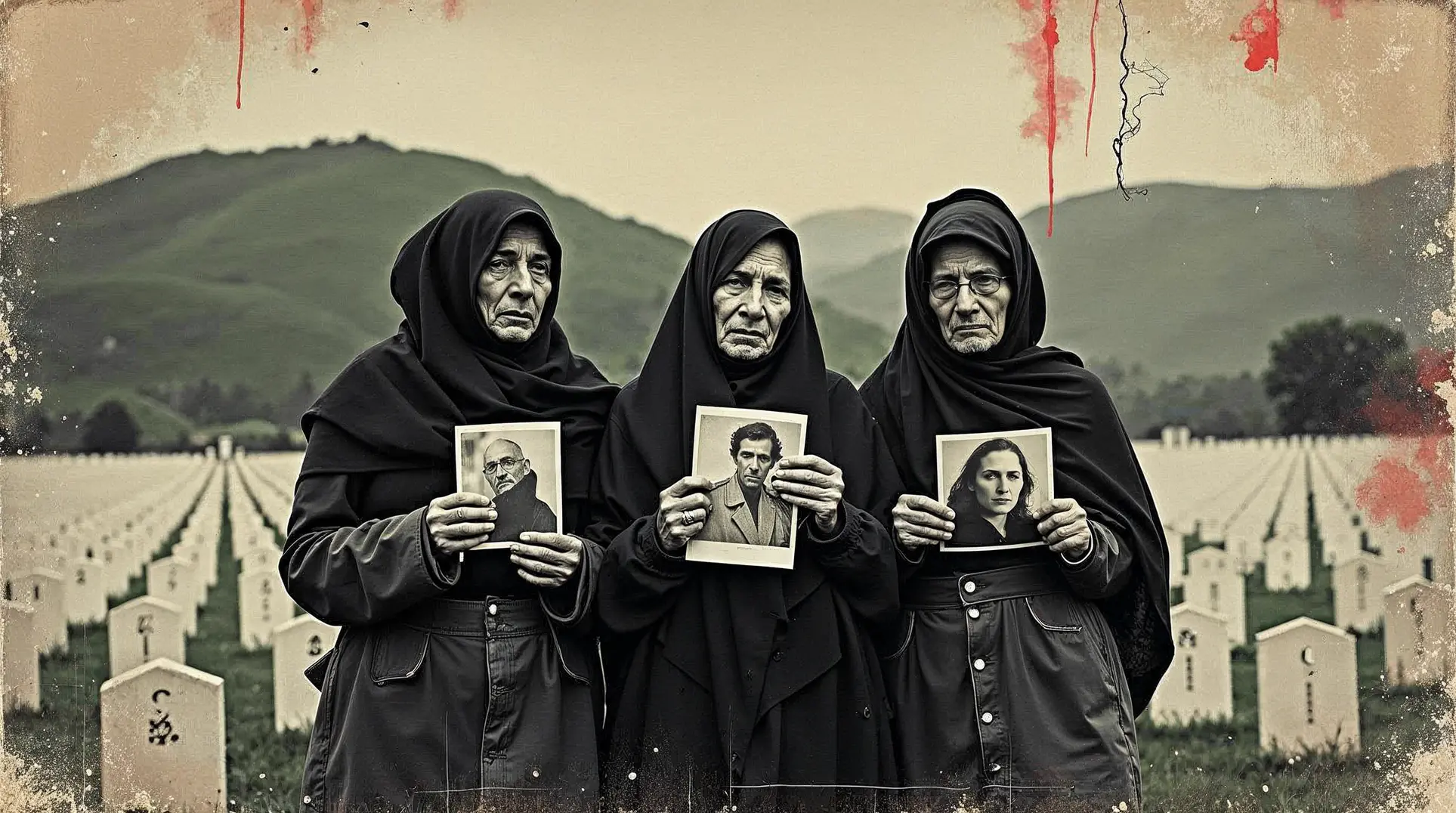
The Flower did not arrive by bureaucratic initiative. It is the product of relentless survivor pressure. The Mothers of Srebrenica organized for three decades, searching for the missing, fighting denial in courts and classrooms, and demanding accountability where institutions hesitated. They sued the Dutch government and Ministry of Defence for failing to protect Srebrenica's residents; Dutch courts acknowledged limited liability. In May 2024, the United Nations General Assembly designated 11 July as the International Day of Reflection and Commemoration of the 1995 Genocide in Srebrenica, a resolution sponsored by Germany and Rwanda. And they pressed the UN itself to reckon publicly with what Human Rights Watch documented in real time: mandate ambiguity, insufficient troops, delayed and denied air support, hostage-taking of peacekeepers, and operational paralysis as mass executions unfolded.
The International Criminal Tribunal for the former Yugoslavia and the International Court of Justice both recognized the killings as genocide. Yet as Crisis.Zone has explored in cases ranging from Joseph Kony to Roger Lumbala, international justice is selective, slow, and often symbolic. The Mothers understood that memory embedded in the UN's front yard might prove more durable than judgments that rely on enforcement the institution cannot guarantee. They converted grief into policy-adjacent outcomes: the UN Outreach Programme on Srebrenica, anti-denial language in senior leadership speeches, and now a permanent installation that cannot be removed by political expedience.
Members are reading: How the memorial should reshape UN doctrine on protection, anti-denial policy, and genocide prevention infrastructure.
The survivor's answer
Munira Subašić brought her grandson to the unveiling for a reason. She raised children, she said, "without vengeance, without hate." That restraint is not weakness; it is the foundation of a different kind of power—the power to reshape institutions through testimony and persistence. The Flower of Srebrenica is survivor-led accountability made visible. It is also a reminder that memory, however permanent, is not prevention. The marble will endure. Whether the UN has internalized the operational lessons it commemorates remains the harder question. The survivors are watching. So should we.
Subscribe to our free newsletter to unlock direct links to all sources used in this article.
We believe you deserve to verify everything we write. That's why we meticulously document every source.


