


The courtroom in Paris where Roger Lumbala went on trial Wednesday represents both a rare moment of accountability and a damning indictment of international justice's failures. Twenty years after the Effacer le tableau ("Erase the Board") operation unleashed systematic killings, mass rape, and looting across northeastern Democratic Republic of Congo, the former rebel leader finally faces charges of crimes against humanity. Yet as victims who traveled thousands of kilometers prepare to testify, the proceedings crystallize an uncomfortable truth: justice arrives late, selectively, and often at venues far removed from the communities that bore the violence.
This marks the first prosecution of a Congolese citizen in France under universal jurisdiction—a legal principle allowing states to try individuals for grave crimes regardless of where they occurred. The trial will examine Lumbala's leadership of the Rally of Congolese Democrats and Nationalists (RCD-N), a Uganda-backed armed group that sought control of Beni region in Ituri province during the Second Congo War. According to UN documentation from February 2003, the military offensive between October 2002 and January 2003 involved atrocities that met the legal threshold for crimes against humanity. The systematic nature of violence against civilians, not merely its brutality, defines these charges.
The Lumbala trial arrives amid renewed conflict in eastern Congo, where over 100 armed groups continue competing for territorial and resource control. M23 rebels advance on provincial capitals while government-backed Wazalendo militias resist disarmament, creating conditions eerily reminiscent of the Second Congo War era that Lumbala's forces helped define. Goma's population swells with displaced families fleeing violence that follows patterns established two decades ago—patterns for which accountability remains exceptional rather than systematic.
Can prosecuting one warlord two decades after the fact address Congo's structural crisis of impunity, or does this trial merely demonstrate how international justice operates: slowly, selectively, and primarily when perpetrators foolishly place themselves within European jurisdictions?
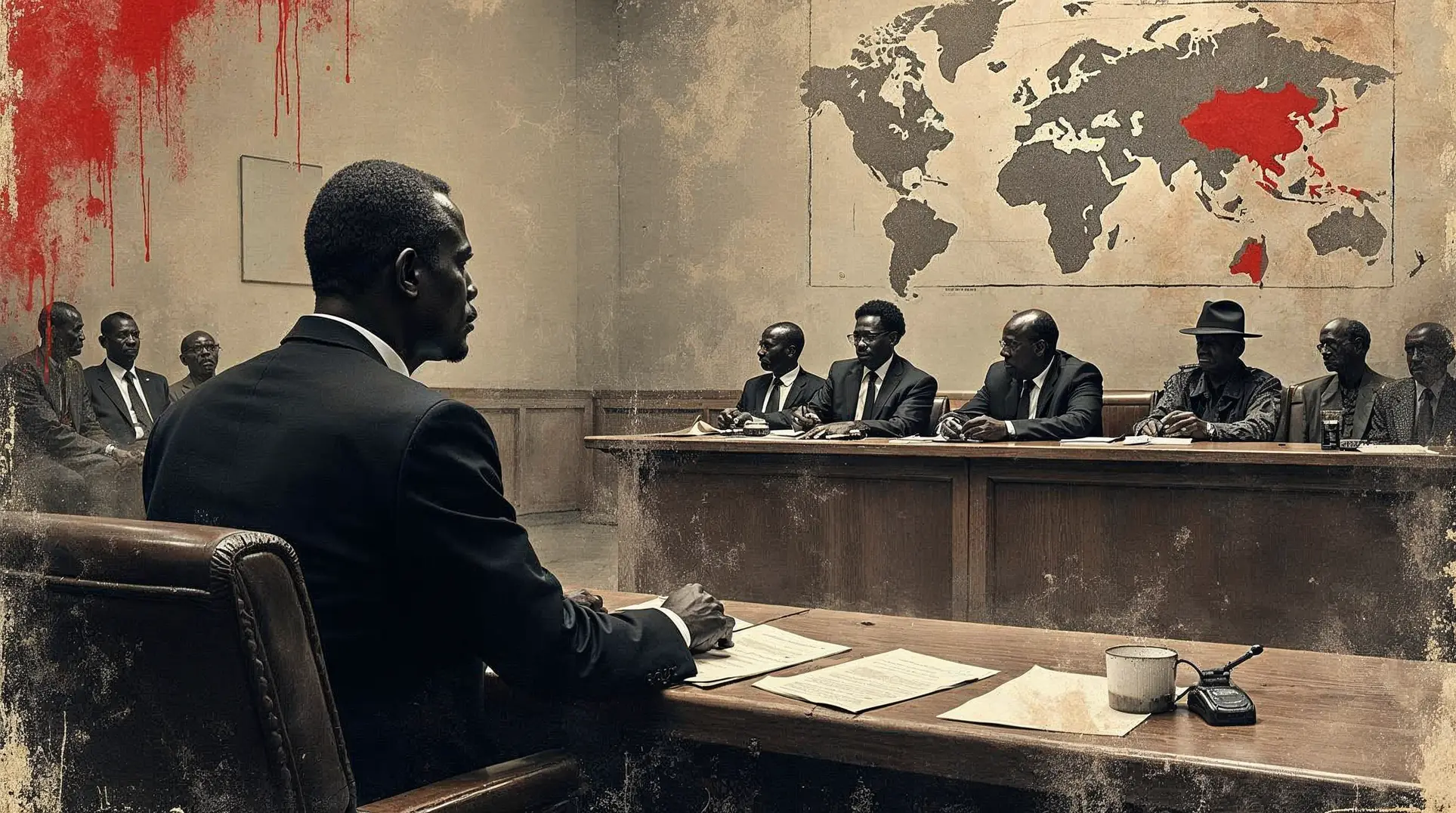
Unlock this in-depth audio analysis. This content is reserved for Front Line Members.
The military campaign that brings Lumbala to trial wasn't spontaneous eruption but calculated operation. Between October 2002 and January 2003, RCD-N forces executed a offensive designed to seize Beni region, a mineral-rich area whose control meant access to gold, timber, and strategic transit routes. The operation's name—"Erase the Board"—captured its eliminationist logic: clear territory of populations deemed hostile or inconvenient to establish complete control.
UN investigators documented systematic patterns that distinguished Effacer le tableau from ordinary military operations. Killings targeted civilians, not combatants. Sexual violence served strategic purposes of terrorizing communities and destroying social cohesion. Looting wasn't opportunistic but organized, stripping villages of resources to deny sustenance to populations and fund RCD-N operations. The systematic nature transformed individual atrocities into crimes against humanity—acts committed as part of widespread or systematic attack against civilian populations.
Ituri province's strategic importance made it a prize worth atrocity. The region's mineral wealth attracted armed groups, foreign backers, and commercial networks seeking resource access. Uganda's support for RCD-N reflected Kampala's broader intervention in eastern Congo, where official justifications about security threats masked commercial interests and proxy warfare against Rwandan-backed rivals. The complexity of alliances, counter-alliances, and shifting loyalties that characterized the Second Congo War found concentrated expression in Ituri's violence.
Members are reading: Why Lumbala's prosecution reveals how geography and political expediency determine who faces justice more than actual culpability.
Victims' testimony: The human cost of military campaigns
The trial's most significant dimension may be the platform it provides for victim testimony. Survivors who traveled to Paris to recount experiences from two decades ago represent countless others who remain in eastern Congo, their suffering unacknowledged by any legal process. Their presence in the courtroom transforms abstract allegations of crimes against humanity into human stories of specific violence against identifiable people.
Victim testimony serves multiple functions beyond establishing facts. It provides recognition that atrocities occurred, that perpetrators can be identified, that survivors' experiences matter sufficiently to merit international attention. For communities whose suffering often disappears into statistics—"thousands killed," "widespread sexual violence"—individual testimony asserts the specificity and humanity of each crime. The act of testifying, of being heard by official institutions, can carry weight independent of trial outcomes.
Yet testimony also raises difficult questions about representation and extraction. The victims who traveled to Paris necessarily represent small fraction of those affected by Effacer le tableau. Selection processes—who testifies, whose story gets told—involve choices about which experiences best serve prosecution strategy. Victims become witnesses, their narratives shaped by legal requirements for establishing specific elements of crimes against humanity. The translation of suffering into legally admissible evidence risks reducing complex human experiences to datapoints in prosecutorial arguments.
The Uganda factor: Foreign sponsorship and limited accountability
Lumbala's prosecution necessarily implicates Uganda's role, though Kampala faces no formal charges. RCD-N operated as Uganda-backed proxy, its military campaigns enabled by Ugandan weapons, training, and strategic support. The relationship between Lumbala's forces and their foreign sponsor exemplifies how proxy warfare allows external powers to pursue interests while maintaining plausible deniability about atrocities committed by forces they support.
Uganda's intervention in Congo during the Second Congo War combined stated security objectives with commercial interests and regional power projection. Official justifications emphasized threats from insurgent groups operating from Congolese territory. Yet investigations revealed systematic mineral exploitation, with Ugandan military officers and connected businessmen extracting resources from territories their forces controlled or enabled proxies to seize. Security rhetoric masked resource extraction and regional dominance pursuits.
The prosecution of Lumbala while Uganda remains unaccountable demonstrates international justice's limitations. Foreign sponsors who enable atrocities through weapons provision, training, intelligence support, and political backing bear responsibility, yet face minimal consequences compared to local commanders who execute operations. This disparity reflects power dynamics: prosecuting Congolese warlords proves politically feasible, while holding regional powers accountable for proxy warfare creates diplomatic complications that international institutions prefer to avoid.
Members are reading: How the structural conditions that enabled the Second Congo War remain unaddressed, ensuring cycles of violence persist despite prosecutions.
Universal jurisdiction: Promise and limitations
France's application of universal jurisdiction to prosecute Lumbala represents international law's most ambitious assertion: that some crimes so offend humanity that any state can prosecute regardless of where they occurred or perpetrators' nationality. The principle aims to close impunity gaps by ensuring perpetrators find no safe haven. Yet practical application reveals how legal theory confronts political reality.
Universal jurisdiction requires states willing to investigate, allocate prosecutorial resources, and accept diplomatic complications that may arise. European states, particularly Belgium, France, Spain, and Germany, have developed the most active universal jurisdiction practices, building specialized war crimes units and establishing legal frameworks for such prosecutions. These efforts reflect both genuine commitment to accountability and advantages of geographic distance—prosecuting Congolese warlords or Rwandan genocidaires generates less domestic political resistance than addressing crimes committed by one's own nationals or allies.
The geographic concentration of universal jurisdiction prosecutions creates patterns. Perpetrators from Africa, particularly Great Lakes region, face disproportionate attention compared to those from other regions. This reflects multiple factors: larger diaspora populations in Europe who can provide intelligence and advocacy, historical colonial connections that create jurisdiction hooks, and perhaps unconscious bias about which atrocities merit resource allocation. The result resembles ICC's patterns: African perpetrators face systematic prosecution while those from powerful states or their close allies largely escape scrutiny.
Lumbala's case demonstrates universal jurisdiction's dependence on fortunate circumstances. He resided in France, making arrest straightforward. French authorities accessed UN documentation and could locate willing witnesses. The political environment supported prosecution—no powerful interests demanded his protection. Remove any of these factors and prosecution becomes vastly more difficult. Universal jurisdiction's promise—accountability anywhere for grave crimes—confronts reality that prosecution requires favorable political and logistical conditions rarely present.
The trial's structure: Legal theater and historical documentation
The proceedings' expected month-long duration reflects both legal complexity and testimonial breadth required to prove crimes against humanity. Prosecutors must establish not merely that specific acts occurred, but that they formed part of systematic attack against civilian population—distinguishing criminal policy from isolated violations. The evidentiary standard demands documentation showing command responsibility, organizational capacity, and intentional targeting that meets legal definitions.
The trial serves purposes beyond determining Lumbala's individual guilt. It creates official record of Effacer le tableau, documenting events that might otherwise fade from memory or remain contested. Victim testimony, cross-examination, expert witnesses, and documentary evidence combine to produce authoritative historical account of specific military campaign. This documentation matters for communities whose suffering often goes unrecorded, for researchers attempting to understand conflict patterns, and for future accountability efforts that may reference established precedents.
Yet the theatrical dimension of trials—their performative nature as public rituals of accountability—can obscure limitations. The defendant sits in dock, victims testify, evidence is presented, judgment rendered. The drama of prosecution creates impression that justice functions, that accountability mechanisms work, that international law constrains violence. This reassurance may be the trial's most dangerous aspect if it obscures systemic failures that make such prosecutions exceptional rather than routine.
Members are reading: Why prosecuting individual commanders cannot dismantle the political economy that makes violence profitable in eastern Congo.
Precedent and prevention: What the trial establishes
Despite limitations, the Lumbala prosecution establishes important precedents. It demonstrates that universal jurisdiction can reach individuals who believed themselves beyond accountability. It shows that documentation from UN investigations and other sources can support prosecutions even decades after crimes occurred. It proves that victims' testimony remains legally powerful even after significant time has passed. These precedents may affect calculations of current perpetrators, though likely at margins rather than fundamentally altering behavior.
The trial also tests legal definitions of command responsibility and crimes against humanity in Congolese context. How courts establish links between commanders and subordinates' actions, prove systematic nature of attacks, and connect resource extraction to violence may influence future prosecutions. Legal precedents developed through this case could strengthen or limit subsequent accountability efforts depending on how judges interpret evidence and apply law.
For Congolese civil society organizations and victims' groups, the trial provides advocacy platform. International attention drawn to proceedings creates opportunities to highlight ongoing violence in eastern Congo, demand accountability for current crimes, and pressure international actors to move beyond symbolic gestures toward addressing conflict drivers. The trial's political utility may exceed its legal impact if advocates successfully leverage attention to demand systematic change.
Regional implications: Justice in Great Lakes context
The prosecution occurs against backdrop of renewed regional tensions. M23's advances create refugee flows into Uganda and Rwanda, strain relations between Kinshasa and Kigali, and risk wider regional conflict. In this environment, prosecuting a Ugandan-backed warlord from previous war sends subtle messages about accountability for proxy warfare—messages that may influence current calculations or may be ignored by powers confident in their continued impunity.
The trial also intersects with debates about African states' relationship with international justice institutions. Kenya, Uganda, and other states have criticized ICC for disproportionately focusing on African situations while avoiding prosecution of Western powers or their allies. France's prosecution of Lumbala under universal jurisdiction may face similar critiques: European states prosecuting African perpetrators while avoiding accountability for their own historical and ongoing roles in enabling African conflicts. This selective application undermines international justice's legitimacy even when individual prosecutions are legally sound.
Tanzania's recent democratic backsliding, electoral violence allegations, and internet shutdowns add further regional context. The pattern of impunity for state violence against opposition supporters contrasts with prosecution of non-state armed group leaders, demonstrating how accountability mechanisms consistently prove more effective against the politically weak than the powerful. Regional observers note these patterns, drawing lessons about which violence carries consequences and which operates with impunity.
The limits of legal solutions to political problems
Ultimately, the Lumbala trial illuminates international justice's fundamental constraint: legal mechanisms cannot solve political problems. Atrocities in eastern Congo stem from competition over resources, weak governance, regional interference, and international indifference—political conditions requiring political solutions. Prosecutions can address past crimes, establish records, provide victim recognition, and potentially deter some future violence. But they cannot substitute for political will to confront conflict drivers, challenge regional powers, dismantle commercial networks financing armed groups, or invest in genuine state building.
The trial may represent justice—deserved, necessary, important. But it does not represent solution. Hundreds of Congolese commanders who bear responsibility for atrocities continue operating with impunity. Regional sponsors who enable proxy warfare face no consequences. Commercial networks that profit from conflict minerals adapt to certification schemes without fundamentally changing business models. State weakness and corruption that create opportunities for armed groups persist. The structural conditions for violence remain.
This gap between individual accountability and systemic change defines international justice's tragedy. Courts can judge perpetrators, but cannot transform the conditions that produce them. Legal processes can establish truth about past atrocities, but cannot prevent future violence absent political commitment to address its drivers. Justice for yesterday's crimes, however important morally and legally, does not protect today's potential victims.
Conclusion
Roger Lumbala's trial in Paris represents both achievement and admission of failure. Achievement because a perpetrator of systematic violence finally faces justice in a courtroom, where evidence will be presented, victims heard, and judgment rendered according to law. Failure because this prosecution comes twenty years late, addresses crimes from a war that supposedly ended long ago, and changes nothing about conditions enabling continued violence in the regions where Effacer le tableau occurred.
The victims who traveled to Paris to testify deserve to see their perpetrator held accountable. The communities that suffered systematic killings, sexual violence, and looting deserve acknowledgment that these crimes occurred and that responsibility can be established. The principle of universal jurisdiction deserves vindication through cases that demonstrate no perpetrator of crimes against humanity can find safe haven. These are genuine accomplishments that merit recognition.
Yet as testimony proceeds in Paris, armed groups in North Kivu employ methods indistinguishable from those used during Effacer le tableau. Civilians face killings, rape, and looting as military strategy. Armed groups compete for mineral resources through violence against populations. Regional powers support proxies while maintaining plausible deniability. The political economy of violence persists because international responses focus on prosecuting selected perpetrators rather than dismantling systems that make atrocities profitable and routine.
The question is not whether Lumbala deserves prosecution—he manifestly does. The question is whether international justice can evolve beyond exceptional prosecutions of politically expendable actors toward systematic accountability that includes regional sponsors, commercial networks, and state officials whose actions enable mass atrocities. Until justice becomes routine rather than exceptional, comprehensive rather than selective, and preventive rather than merely retrospective, trials like Lumbala's will remain important symbolic gestures that change little about conditions enabling the violence they purport to address.
For eastern Congo's populations, the trial offers cold comfort: recognition that crimes against them matter enough to merit prosecution, combined with awareness that nothing about this proceeding will protect them from armed groups operating today using identical methods. That gap between justice achieved and security denied captures international intervention's fundamental limitation—the ability to judge yesterday's perpetrators while proving unable or unwilling to prevent tomorrow's atrocities.
Subscribe to our free newsletter to unlock direct links to all sources used in this article.
We believe you deserve to verify everything we write. That's why we meticulously document every source.


