


U.S. Energy Secretary Chris Wright arrived in Caracas this week, marking the highest-level American official visit to Venezuela in decades. The trip, which included meetings with interim President Delcy Rodriguez, comes weeks after U.S. forces captured Nicolás Maduro in January. Wright announced that Washington considers its oil embargo "essentially over" and pledged to help "dramatically increase" Venezuelan crude production. The visit represents a stark recalibration of U.S.-Venezuela relations, centered on securing access to the hemisphere's largest proven oil reserves.
The timing is no coincidence. Rodriguez's interim government recently pushed through legislation reversing two decades of Chavista oil policy, opening the sector to private investment and ending state monopoly control. Yet in an NBC News interview released Thursday—simultaneous with Wright's Caracas visit—Rodriguez maintained that Maduro remains Venezuela's "legitimate president" even as she confirmed accepting an invitation to visit the United States. This contradiction reveals the essential tension of Venezuela's post-intervention reality: a government facilitating American strategic objectives while performing rhetorical loyalty to the system it is dismantling.
The architecture of managed sovereignty
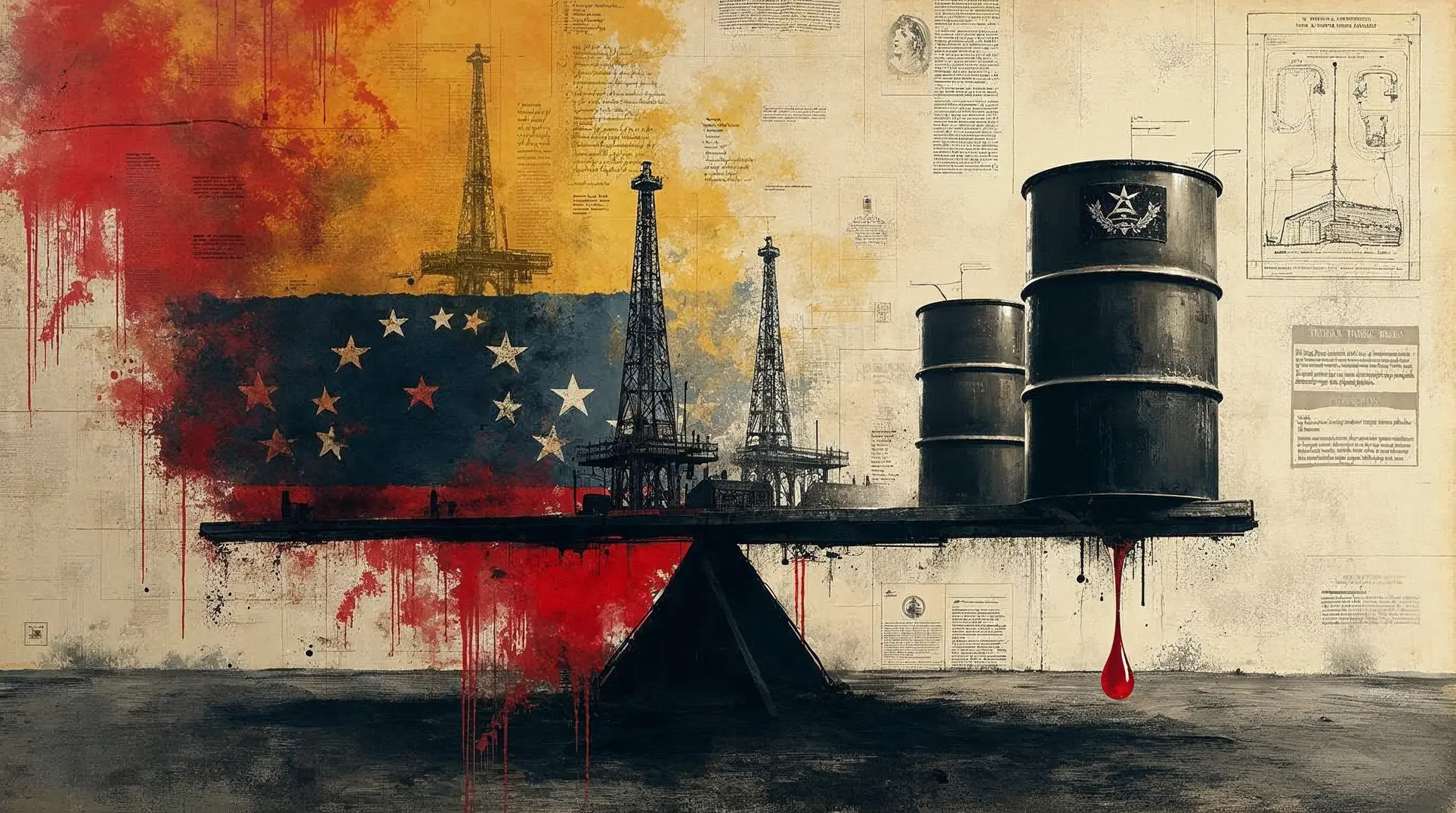
The new oil law represents the structural foundation of this arrangement. By ending PDVSA's monopoly and permitting disputes to be resolved through independent arbitration rather than Venezuelan courts, the legislation effectively removes the country's primary economic asset from domestic political control. This is not deregulation in service of market efficiency—it is the transfer of decision-making authority over national resources to external actors.
Wright's language during the visit was revealing. He framed increased production as aligned with "American energy dominance," the Trump administration's explicit policy of reshaping global markets through control of strategic reserves. Venezuela's estimated 300 billion barrels become, in this framework, an instrument of U.S. geopolitical competition with Russia and China, not a sovereign nation's patrimony to be managed according to its own development priorities.
Rodriguez's government functions within parameters established in Washington. Oil revenue flows are conditional on compliance with the new investment framework. The reopening of the U.S. embassy in Caracas provides institutional architecture for oversight. Sovereignty persists in formal terms—Venezuela has a government, issues laws, conducts diplomacy—but substantive autonomy over the core economic sector has been ceded as the price of survival.
Members are reading: Why Rodriguez's balancing act between Washington and Chavista hardliners reveals a sovereignty crisis with no stable resolution.
A Monroe Doctrine for the energy transition
The broader pattern is unmistakable. Wright's Caracas visit follows a distinct logic of U.S. engagement in Latin America: strategic resources justify intervention, compliant governments receive recognition, and institutional sovereignty is preserved as long as it does not interfere with extraction. Venezuela's oil becomes American energy security, just as lithium deposits across the Southern Cone are increasingly framed as critical to U.S. industrial policy rather than national assets of host countries.
The Trump administration has been explicit about this framework. Energy dominance is not a market condition but a geopolitical objective, requiring control over supply chains and production centers. Venezuela's reserves—larger than Saudi Arabia's—represent the single most significant prize in the Western Hemisphere. Rodriguez's interim government, whatever its internal contradictions, delivers that prize without the costs of direct occupation or the diplomatic complications of recognizing a straightforwardly authoritarian successor.
The oil flows, the embassy reopens, and American officials visit Caracas with the confidence of power brokers rather than diplomatic supplicants. Meanwhile, the deposed president sits in custody, the interim leader speaks of his legitimacy, and the legal architecture of national resource control is transferred to international arbitration panels. This is not partnership; it is the managed dependency of a client state whose compliance is secured through economic necessity and military defeat. The arrangement works as long as Venezuela's governing class accepts the terms. Whether that acceptance can be sustained as the material consequences of oil sector restructuring reach deeper into Venezuelan society remains the central unresolved question of this post-intervention order.
Subscribe to our free newsletter to unlock direct links to all sources used in this article.
We believe you deserve to verify everything we write. That's why we meticulously document every source.


