


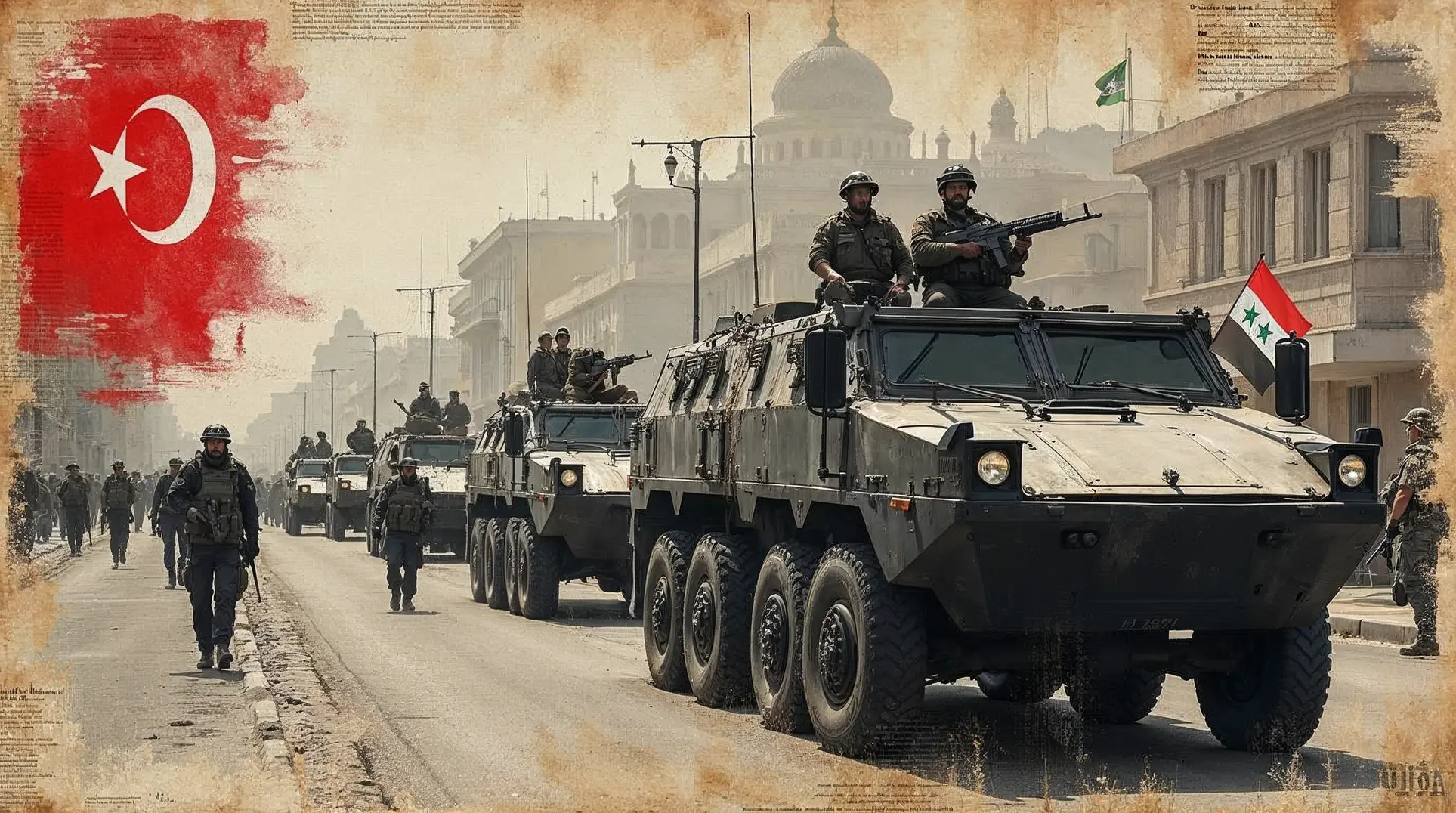
Multiple credible sources report fresh Turkish military deployments to northern Syrian towns under Ankara's control, including Afrin, Serêkaniyê, and Manbij. Footage published by Turkish media shows convoys with logistics elements and armored vehicles moving toward opposition-held areas, with some repositioning reported near the Manbij frontline. The reinforcements come days after Turkey's Chief of General Staff Selcuk Bayraktaroglu met Syria's interim President Ahmed al-Sharaa in Damascus on December 5–6, 2025. No details of that meeting have been disclosed.
The deployments coincide with the first anniversary of Syria's liberation from Bashar al-Assad's regime and arrive against a backdrop of stalled negotiations over integrating the Kurdish-led Syrian Democratic Forces into state structures. Yet both Turkish-backed factions and SDF leadership have publicly downplayed the prospect of imminent combat, framing the movements as routine rather than preparation for a new offensive. The pattern suggests a calibrated show of force designed to shape the integration process and consolidate Turkish influence over Syria's transition, not a near-term green light for major ground operations.
Convoys and mixed signals
Reports describe Turkish military vehicles entering multiple towns in northern Syria from different directions. The presence of logistics support and armored units points to sustained reinforcement rather than simple rotation. Some accounts indicate forward positioning around Manbij, a flashpoint on the edge of SDF-held territory that has seen repeated ceasefires and skirmishes since late 2024.
Despite the visible movement, senior SDF commanders have characterized recent media coverage as exaggerated, designed to stoke anxiety rather than reflect operational reality. One commander stated there is no serious threat to the Kurdish-led force at present. Turkish and Syrian opposition officials have similarly avoided inflammatory rhetoric, instead emphasizing the need to unify armed groups under a single national army framework to prevent post-transition chaos.
This deliberate tonal restraint on both sides suggests the deployments function primarily as leverage—a reminder to Damascus, the SDF, and external stakeholders that Ankara retains the capacity to surge assets rapidly if integration talks collapse or Kurdish autonomy trajectories harden.
The unresolved integration file
The current friction traces directly to the March 10, 2025 framework agreement, backed by Washington, that envisioned SDF integration into Syrian state structures. Implementation has been halting at best. Turkey insists that SDF personnel integrate as individuals, not as cohesive formations, and has drawn a public red line against YPG commanders receiving Syrian army officer commissions. The SDF, in turn, accuses Damascus and its Turkish backers of obstruction and demands guarantees that protect Kurdish political and security arrangements.
Sporadic clashes in late 2025—near Dayr Hafir, around Tishreen Dam, and in Deir ez-Zor—underscore the fragility of local ceasefires and the absence of enforceable sequencing mechanisms. Turkish press reports, citing officials, have suggested that if integration talks fail, Damascus could authorize operations against SDF-held areas with Turkish backing. This framing positions Turkey not as an external aggressor but as a partner helping Syria's interim government consolidate sovereignty—a narrative Ankara seeks to institutionalize.
The December meeting between Bayraktaroglu and al-Sharaa likely addressed these timelines and redlines, though the absence of public readouts leaves key questions unanswered: Did the two sides agree on sequencing steps, rules of engagement, or thresholds for escalation? The silence itself may be deliberate, preserving operational ambiguity while diplomatic channels remain open.
Members are reading: How Turkey's embedded role in Syria's transition architecture reshapes leverage dynamics and narrows Washington's options on Kurdish integration.
What to watch
Several indicators would signal a shift from leverage-building to preparation for offensive operations: deployment of Turkish engineer units or bridging assets toward the Tishreen or Manbij corridors; rapid emplacement of artillery batteries; sustained UAV strike tempo targeting SDF logistics nodes; or cross-line armor massing with forward staging. Equally important, formal deadlines publicly tied to the March framework or explicit ultimatums from Damascus would mark escalation beyond the current managed ambiguity.
Conversely, de-escalation would manifest through joint statements on integration sequencing, unit-level joint patrols involving SDF and Syrian transitional forces, or visible steps toward demobilizing and merging Ankara-backed factions under a unified "national army" label. None of these are currently evident.
For now, the pattern resembles coercive signaling calibrated to avoid triggering U.S. red lines or fracturing Ankara's relationship with Damascus, while keeping the SDF under structural pressure. The convoys are a message written in logistics: Turkey is not waiting for integration talks to conclude before shaping the terrain those talks will address. How Damascus and Washington respond—or fail to—will determine whether this buildup remains leverage or becomes a prelude.
Subscribe to our free newsletter to unlock direct links to all sources used in this article.
We believe you deserve to verify everything we write. That's why we meticulously document every source.


