


President Donald Trump's directive ordering military preparations for potential intervention in Nigeria represents a particularly brazen exercise in what might charitably be called selective humanitarianism—or more accurately, strategic opportunism dressed in the language of religious protection. The administration's characterization of Nigeria as perpetrating an "existential threat" to Christians, followed by Defense Secretary Pete Hegseth's confirmation that the Department of War stands ready for action, marks a significant escalation in rhetoric that warrants ruthless analytical scrutiny rather than reflexive acceptance.
The timing and framing of this intervention threat reveal more about American domestic politics and the contested nature of global influence than any genuine crisis requiring immediate military action. Trump's re-designation of Nigeria as a "Country of Particular Concern" for religious freedom violations—a status initially applied during his first term, then removed by Biden, now restored—follows a well-worn pattern of policy reversals that suggests strategic positioning rather than evidence-based assessment.
The fundamental question is not whether Christians in Nigeria face violence—they demonstrably do—but whether this particular crisis necessitates American military intervention, who truly benefits from such action, and what strategic calculations lie beneath the humanitarian veneer. In the unsentimental calculus of international relations, stated intentions rarely align with operational motives.
The narrative divergence: Genocide claims versus ground realities
Trump's assertion of a targeted "mass slaughter" of Christians by Islamist militants confronts an inconvenient empirical problem: the data doesn't support the genocide narrative being constructed in Washington. Independent monitoring organizations, including the Armed Conflict Location and Event Data Project (Acled), consistently document that Muslims constitute the majority of victims in Nigeria's predominantly Muslim northern regions where Boko Haram and affiliated groups operate.
This isn't to minimize Christian suffering—violence against religious communities demands serious attention regardless of comparative victim counts. Rather, it exposes the deliberate oversimplification of a complex security environment for political consumption. Nigeria faces multifaceted conflicts driven by resource competition, ethnic tensions, farmer-herder disputes, and yes, religious extremism—but framing these as a singular Christian persecution narrative serves specific American political interests rather than analytical accuracy.
Senator Ted Cruz's characterization of "radical Islamic terrorists slaughtering Christians" reflects a worldview more attuned to evangelical voter mobilization than counterterrorism strategy. When Nigerian officials emphasize that their constitutional framework protects all faiths and that violence affects both Christians and Muslims, they're not denying problems—they're challenging the reductionist framing that treats Nigeria as a monolithic persecutor rather than a sovereign state grappling with genuine insurgent threats.
The strategic question becomes: why does the Trump administration insist on a narrative contradicted by its own intelligence agencies more nuanced assessments? The answer likely lies in the intersection of domestic political calculation and the desire to assert American prerogatives in a region where influence increasingly competes with other powers.
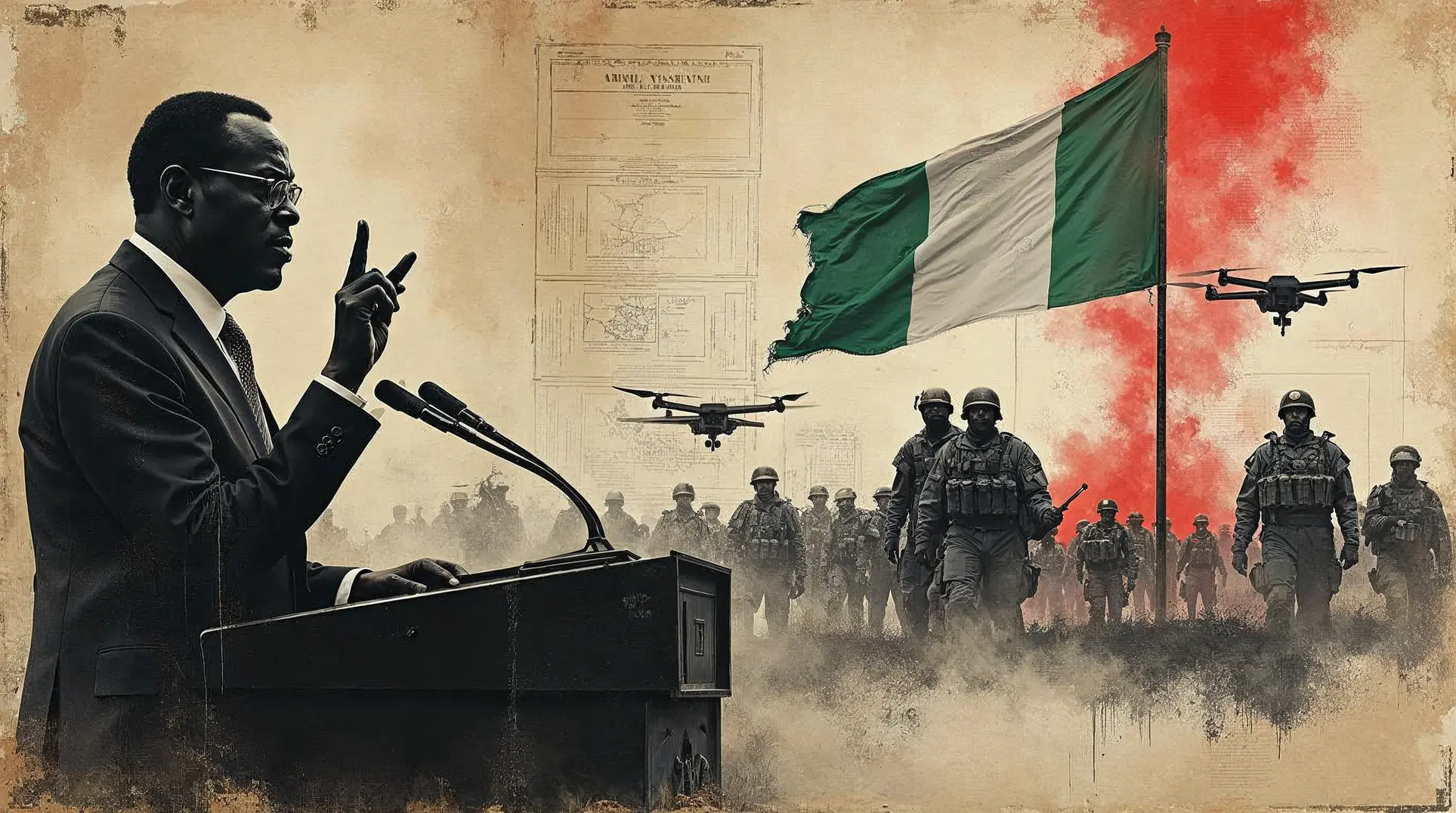
Members are reading: Why Nigeria's careful response to intervention threats reveals the sovereignty paradox in contemporary security partnerships and Washington's selective application of humanitarian principles.
Domestic politics driving foreign policy: The evangelical constituency factor
The domestic political dimensions of Trump's Nigeria directive deserve explicit acknowledgment rather than polite omission. Evangelical Christian organizations have lobbied aggressively for American intervention on behalf of Nigerian Christians, creating political pressure that intersects conveniently with Trump's electoral coalition maintenance. Republican lawmakers like Ted Cruz have championed this cause, framing it in civilizational terms that resonate with specific voter demographics.
This represents foreign policy formation through constituency service rather than strategic assessment—a pattern not unique to Trump or Republicans, but particularly pronounced in this instance. When domestic political imperatives drive intervention decisions, the resulting policies tend to prioritize symbolic action over effective outcomes. Military intervention that demonstrably worsens security conditions becomes defensible if it satisfies the political constituency demanding action.
The broader pattern is concerning: American foreign policy increasingly reflects the preferences of mobilized domestic factions rather than coherent grand strategy. Whether progressive activists demanding intervention in humanitarian crises or conservative evangelicals seeking protection of co-religionists abroad, the result is reactive, inconsistent policy vulnerable to the next advocacy campaign's pressure.
Members are reading: How Trump's intervention threats in Nigeria intersect with broader great power competition in West Africa, where American military predominance confronts new challenges to influence.
The operational question: What would intervention actually accomplish?
Beyond strategic considerations, the practical question of operational effectiveness deserves examination. What precisely would American military action in Nigeria achieve that the 135,000-strong Nigerian military, with extensive local knowledge and established operational networks, cannot accomplish? The implied answer—that American forces possess superior capability to identify and neutralize threats to Christians—rests on assumptions contradicted by recent military interventions' track records.
Afghanistan, Iraq, Libya, Syria: the pattern of American military intervention achieving tactical objectives while generating strategic complications and unintended consequences is well-established. Nigeria presents similar challenges at potentially greater scale. The country's size, population density, ethnic diversity, and complex religious geography create an environment where external military intervention faces structural disadvantages relative to indigenous forces, however imperfect their current performance.
The counterterrorism operations that Trump's directive ostensibly addresses require intelligence networks, cultural understanding, language capabilities, and political legitimacy that foreign forces inherently lack. Boko Haram's resilience stems partly from its ability to exploit local grievances, embed within communities, and present itself as resistance against external interference. American military intervention provides precisely the narrative opportunity such groups seek.
Moreover, the assumption that military force can resolve what are fundamentally political, economic, and social conflicts reflects the persistent militarization of American foreign policy thinking. Even if American forces could eliminate current Boko Haram leadership—itself a significant operational challenge—the underlying conditions producing violent extremism would remain unaddressed. New groups would emerge, potentially with enhanced legitimacy derived from resisting foreign intervention.
Strategic assessment: Interest versus ideology
The coldly analytical question Viktor Petersen's perspective demands is simple: does military intervention in Nigeria serve identifiable American national interests sufficiently compelling to justify the costs, risks, and complications? The humanitarian rhetoric surrounding Christian protection, while emotionally resonant for specific constituencies, does not constitute a strategic interest in the realist framework that actually governs great power behavior.
American interests in Nigeria might include: maintaining influence in a strategically significant region, ensuring stability for economic relationships including oil trade, preventing terrorist groups from establishing safe havens threatening American personnel or assets, and demonstrating commitment to security partnerships. None of these interests obviously require or particularly benefit from unilateral military intervention framed as protecting Christians from existential threat.
Indeed, such intervention likely undermines several genuine interests: it strains relationships with a key regional partner, generates nationalist opposition that complicates future cooperation, provides propaganda opportunities for extremist groups, and demonstrates American willingness to violate sovereignty in ways that concern other nations regarding their own territorial integrity.
The alternative approach—robust security cooperation, intelligence sharing, targeted assistance for Nigerian counterterrorism efforts, and economic engagement addressing underlying instabilities—serves American interests more effectively without the complications of intervention. That such approaches lack the dramatic appeal of "guns-a-blazing" rhetoric explains their political disadvantage while simultaneously highlighting their strategic advantages.
Conclusion: When power politics masquerades as humanitarian concern
Trump's directive regarding Nigeria illuminates enduring tensions in American foreign policy between stated values and operational interests, between domestic political imperatives and strategic coherence, and between military capability and effective influence. The humanitarian framing—protecting Christians from existential threat—provides politically acceptable justification for asserting American prerogatives in a region where influence faces genuine competition.
The realist assessment cuts through humanitarian rhetoric to examine underlying power dynamics and strategic calculations. Nigeria's significance derives from its regional weight, economic importance, and position in contested West African geopolitics—not from any unique crisis of Christian persecution requiring immediate military intervention. The intervention threat serves multiple purposes: satisfying domestic evangelical constituencies, asserting American willingness to act unilaterally, and signaling to other nations the consequences of insufficient deference to American preferences.
Yet this approach confronts practical limitations increasingly apparent in contemporary international relations. Military superiority does not automatically translate into political influence when intervention generates nationalist backlash, violates sovereignty norms that even American allies value, and competes against alternative partnerships offering respect for formal equality between nations. The gap between American capability to conduct military operations and American ability to achieve sustainable political outcomes through such operations continues widening.
Nigeria's careful response—welcoming assistance while rejecting intervention framed as correcting governmental failures—represents the emerging norm in international relations where even developing nations assert agency rather than accepting subordinate status. Whether American foreign policy adapts to this reality or persists in assuming prerogatives increasingly contested will determine its effectiveness in an international system no longer characterized by unquestioned hegemony.
The ultimate question is whether the United States seeks genuine partnership in addressing shared security challenges or prefers demonstrative assertions of superior moral authority backed by military threat. The answer will shape not only American-Nigerian relations but the broader architecture of international order in an era of intensifying great power competition and resurgent sovereignty claims.
Subscribe to our free newsletter to unlock direct links to all sources used in this article.
We believe you deserve to verify everything we write. That's why we meticulously document every source.


