


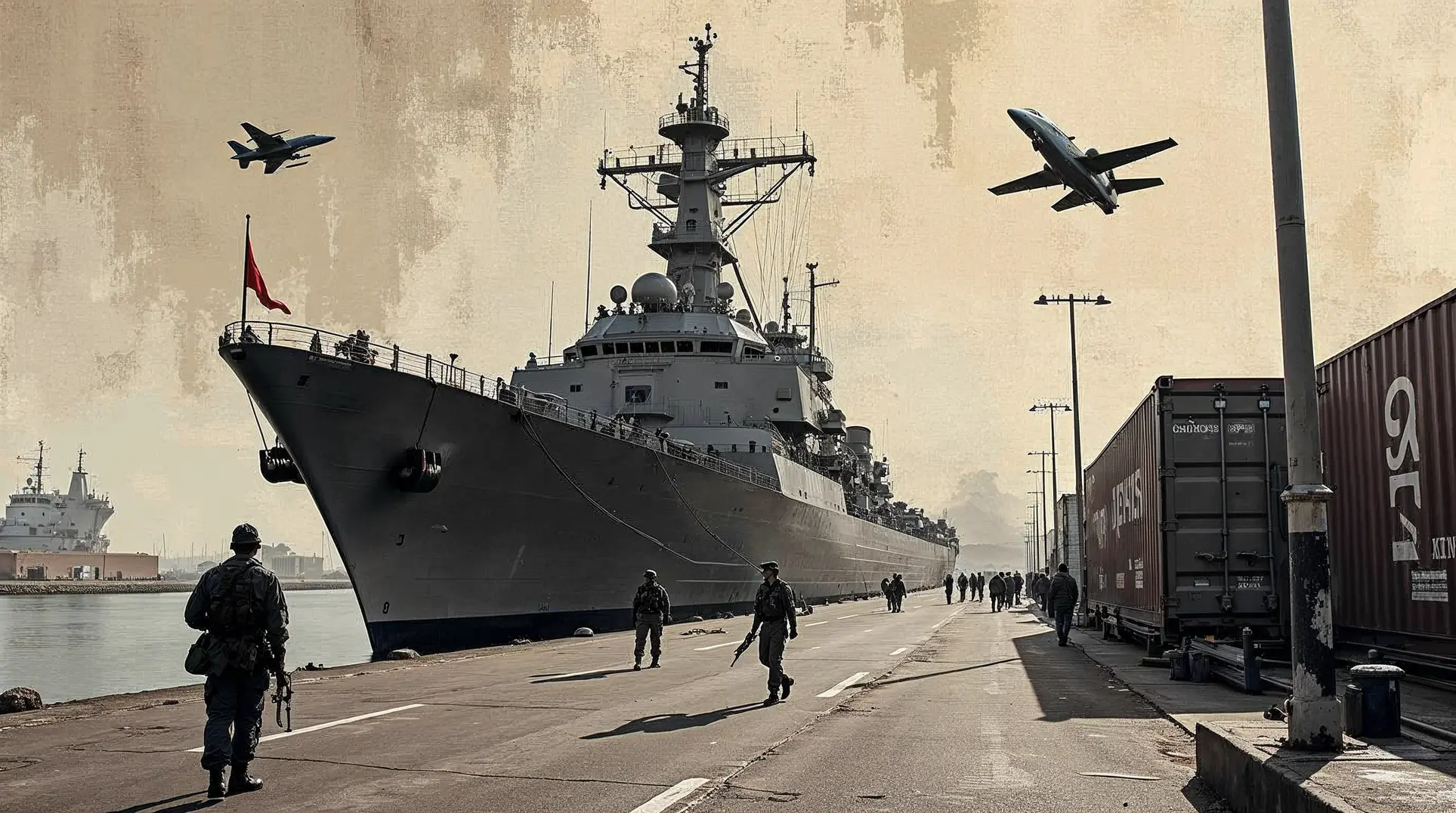
On December 2, 2025, Sudan's embattled military government formally offered Russia a 25-year agreement to establish a naval base in Port Sudan, potentially delivering Moscow its first permanent naval facility in Africa and an unprecedented foothold on the Red Sea. The proposal, confirmed by Sudanese officials, would grant operational rights for up to 300 Russian military personnel with diplomatic immunity and capacity to host four warships simultaneously, including nuclear-powered vessels—alongside reportedly permissive terms for mineral extraction inside the country.
This is not another covert supply line. It is a wartime survival bargain: Sudan's junta, locked in a brutal civil war with the Rapid Support Forces since April 2023, is trading long-term strategic access on one of the world's most contested waterways for immediate military aid that could shift the battlefield. From covert arms flows to a formal Russian naval flag on the quay, Sudan's war has just pulled the Red Sea into the center frame.
The terms: access for armaments
The base proposal, formalized in December 2025, arrives amid renewed negotiations as of late November 2025 over advanced Russian fighter jets—specifically the Su-30 and Su-35 platforms—and sophisticated air defense systems. Sudanese Armed Forces (SAF) urgently need both: the RSF has demonstrated strike capability against Port Sudan itself, launching drone attacks on the city on May 5, 2025, and continues offensive operations across the country. Just one day before the naval base offer was finalized, on December 1, 2025, the RSF claimed seizure of SAF's 22nd Infantry Division headquarters in Babanusa, West Kordofan, despite a self-declared truce.
The timeline underscores the proposal's wartime logic. In February 2025, Sudanese Foreign Minister Ali Youssef Ahmed al-Sharif confirmed Russia's agreement in principle to establish a facility in Port Sudan. By later in 2025, Russia—alongside Iran—had already delivered weapons, jet components, fuel, and drones to the Sudanese government, materially aiding SAF's partial recapture of Khartoan. The December offer formalizes what was already becoming a patron-client military relationship, elevating it to the level of strategic infrastructure.
For Moscow, the stakes are global. A Red Sea facility would solve persistent logistics challenges for Russian naval operations bridging the Mediterranean and Indian Ocean, provide a resupply and repair node for vessels operating off East Africa, and position Russian forces astride one of the world's most critical trade chokepoints. For Washington, which has sought to prevent Russian and Chinese control over African ports, the proposal represents both a geopolitical setback and a potential threat to freedom of navigation through the Bab el-Mandeb strait.
Members are reading: How Sudan's base-for-weapons bargain formalizes the war's externalization and what it costs Khartoum beyond the battlefield.
Red Sea risks and humanitarian exposure
Yet the bargain carries compound risks. Port Sudan is not merely a strategic prize; it functions as the Sudanese government's primary humanitarian artery, the main conduit for aid entering areas under SAF control. Formalizing a Russian military presence at the port internationalizes the site's threat profile, potentially making it a more attractive target for RSF operations or complicating humanitarian access if international actors view the facility as militarized infrastructure. The May drone attack demonstrated the port's vulnerability; a permanent foreign naval base could heighten that exposure.
For regional stability, the precedent is troubling. If the deal proceeds, it signals to other conflict-affected governments that strategic assets—ports, airspace, mineral rights—can be leveraged for immediate military advantage, regardless of long-term sovereignty costs. It also places a Russian military installation within the increasingly contested Red Sea theater, where Houthi attacks on commercial shipping, regional naval deployments, and great power competition already intersect.
The sovereignty equation
Khartoum's military rulers face a grim ledger. On one side: advanced weaponry, air defense capabilities, and external backing that could stabilize frontlines and sustain the regime's war effort. On the other: a quarter-century of foreign military presence on Sudan's coast, extractive concessions that may outlast the current government, and the internationalization of a civil war that has already displaced millions and generated what the UN terms one of the world's worst humanitarian catastrophes.
The Port Sudan proposal is less a strategic masterstroke than a distress signal—evidence that Sudan's junta believes it cannot win, or even survive, without trading future sovereignty for present-tense firepower. Whether Moscow's weapons prove decisive on the battlefield remains uncertain. What is clear is that Sudan's war, already a magnet for regional and international interference, has now opened a formal door on the Red Sea. The currents flowing through it will shape the Horn of Africa, great power competition, and Sudan's own trajectory long after the guns fall silent.
Subscribe to our free newsletter to unlock direct links to all sources used in this article.
We believe you deserve to verify everything we write. That's why we meticulously document every source.


