


- 300,000 South Sudanese fled in 2025 as Kiir-Machar conflict escalates toward full civil war
- Treason charges against VP Machar eliminate negotiation pathways, mobilize ethnic militias for total war
- Millions face catastrophic famine as corruption, Sudan spillover, and elite predation devastate the nation
As political tensions between President Salva Kiir and suspended First Vice President Riek Machar threaten to reignite civil war, the world's youngest nation faces a humanitarian catastrophe that demands urgent international intervention
The world's youngest nation is hemorrhaging its people. Approximately 300,000 South Sudanese have fled the country in 2025 alone, according to the United Nations Commission on Human Rights, as escalating armed conflict and political instability push the nation toward the brink of full-scale civil war. The mass exodus—driven by renewed clashes between forces loyal to President Salva Kiir and suspended First Vice President Riek Machar—marks a dramatic deterioration in a crisis that has plagued South Sudan since its independence in 2011.
The displacement represents just the latest chapter in South Sudan's troubled history. Since March 2025, political violence has escalated dramatically, including aerial bombardments in parts of the country and a 59 percent increase in civilian casualties compared to 2024. Internal displacement figures paint a dire picture, with hundreds of thousands of people forced from their homes by conflict this year, while regional countries now host more than 2.5 million South Sudanese refugees—a staggering figure that continues to climb as the security situation deteriorates.
As South Sudan teeters on the edge of renewed catastrophe, one question looms: Can the international community prevent the world's newest state from sliding back into the abyss of full-scale civil war?
The current crisis has its roots in the collapse of the 2018 Revitalized Agreement on the Resolution of the Conflict in South Sudan, which ended a devastating five-year civil war that killed an estimated 400,000 people. That fragile peace deal, which created a unity government with Kiir as president and Machar as first vice president, has been unraveling for months amid deepening mistrust between the two leaders.
The breaking point came in March 2025, when fighting erupted between the South Sudan People's Defence Forces (SSPDF) and an armed militia affiliated with Machar's Sudan People's Liberation Movement-in-Opposition (SPLM/A-IO). On March 4, the militia overran an army base in Nasir, a major town near the Ethiopian border in Upper Nile state. In response, Kiir arrested several opposition leaders and placed Machar under house arrest, effectively suspending him from his position as first vice president.
"The political stalemate between the various parties in South Sudan must be resolved before it is too late," warned George Owinow, President of the Reconstituted Joint Monitoring and Evaluation Commission (RJMEC), the body responsible for monitoring implementation of the peace agreements. "The RJMEC calls on regional and international guarantors to urgently use their diplomatic influence to resolve the political and security stalemate."
The violence has intensified dramatically since those initial clashes. The permanent ceasefire established under the peace agreement is "continually and repeatedly violated by signatory parties," according to international partners who convened in Juba to address the deteriorating situation. Humanitarian workers face increasing restrictions, with 70 access incidents reported in a single month in 2025—double the previous year's figure.
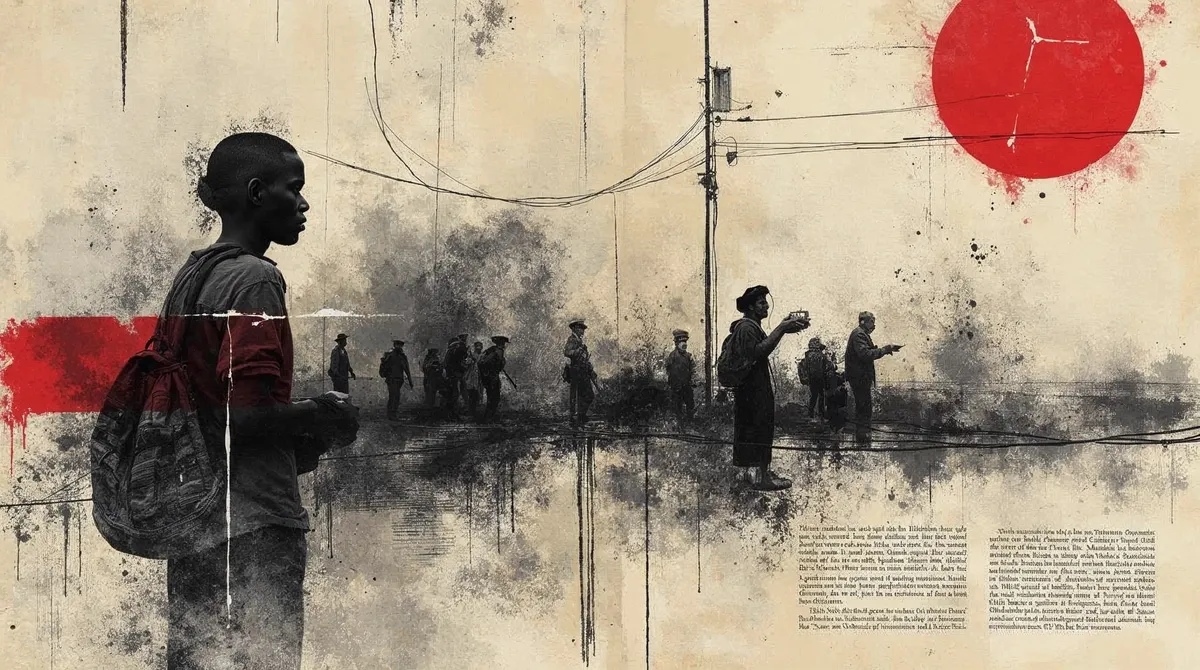
Discover the shocking web of corruption that's bleeding South Sudan dry—where billions in oil money vanish while children are recruited for war and women face systematic violence. The elite predation machine exposed.
Regional spillover and the Sudan connection
South Sudan's crisis cannot be separated from the devastating civil war raging in neighboring Sudan, where fighting between the Sudanese Armed Forces (SAF) and the Rapid Support Forces (RSF) has created the world's largest displacement crisis. The conflicts are increasingly intertwined, with potentially catastrophic implications for regional stability.
The rupture of South Sudan's oil pipeline in Sudan in February 2024 was the first major economic shock linking the two crises. This pipeline, which runs through territory contested by SAF and RSF forces, carried virtually all of South Sudan's oil exports to Port Sudan on the Red Sea. Its breakdown eliminated two-thirds of government revenue overnight, triggering the fiscal crisis that has undermined Kiir's ability to maintain his patronage networks.
But the connections run deeper than economics. South Sudanese militia groups have allied with forces on both sides of Sudan's war. The SPLM-North, a Juba-aligned Sudanese rebel group, has formed a political alliance with the RSF, bringing it into indirect conflict with forces loyal to Kiir. Meanwhile, many observers suspect that the Sudanese Armed Forces have reactivated decades-old ties to Nuer militias in Upper Nile state, potentially providing the weapons and supplies that enabled the March offensive against government positions.
"Amid a deteriorating security environment, fighting in Sudan could spill over into South Sudan, with the Sudanese army particularly interested in establishing itself in the Upper Nile region to prevent the Rapid Support Forces from pushing further eastward," according to analysis from the International Crisis Group. This would transform Upper Nile into a proxy battlefield, with South Sudanese communities caught between competing Sudanese factions and their local allies.
The humanitarian consequences of this regional instability are already severe. Nearly 850,000 people fled Sudan to seek refuge in South Sudan following the outbreak of conflict in April 2023, with approximately 940 people crossing the border daily between July and September 2024. Among the arrivals, one quarter are Sudanese citizens seeking asylum, while the rest are South Sudanese returnees, many of whom lived in Sudan for decades.
These new arrivals have overwhelmed South Sudan's already strained resources. The government and aid organizations lack the capacity to meet basic humanitarian needs in reception areas along the border. Violent clashes and hunger have afflicted overcrowded camps, while flooding—which displaced 350,000 people and affected 1.4 million as of October 2024—has further complicated relief efforts.
A nation on the brink of famine
The convergence of conflict, economic collapse, and climate shocks has pushed South Sudan to the edge of catastrophic food insecurity. Millions of people—more than half the population—face high levels of food insecurity, with approximately 1.4 million people experiencing catastrophic levels of acute food insecurity approaching famine conditions. This represents the worst hunger crisis in the country's history, surpassing even the peak of the previous civil war.
The 2024 floods devastated farms and livestock, disrupting access to essential services and destroying the agricultural base that many communities depend on for survival. The aftermath will worsen food insecurity well into 2025, as families who lost their crops and animals have no means to plant or rebuild. Tight domestic food supplies, sharp currency depreciation, and disruption of trade with Sudan have driven food prices to catastrophic levels, with severe inflation making basic necessities unaffordable for the majority of the population.
Malnutrition has reached critically high levels. In 2025, over 2.4 million children under age five are expected to suffer from acute malnutrition, with hundreds of thousands potentially lacking access to life-saving treatment. Pregnant and lactating women face rising rates of malnutrition, with numbers increasing significantly in crisis-affected areas—a 25 percent increase in malnutrition among this vulnerable group across conflict zones.
"The challenges facing the peace agreement are man-made, fundamentally political, and only resolvable through inclusive dialogue," said Anita Kiki Gbeho, Officer in Charge and Special Representative of the UN Secretary-General. "The time for action is now. The people of South Sudan deserve peace, a unified commitment to their safety, security, and stability."
Yet humanitarian funding remains woefully inadequate. As of late 2024, the 2025 Humanitarian Response Plan stood at only 28.5 percent funded, seriously undermining the delivery of crucial emergency aid and services. The UN and humanitarian partners will need $1.7 billion to target 5.4 million people—40 percent of South Sudan's population—with assistance in 2025, but donor fatigue and competing global crises threaten to leave this appeal underfunded.
Why one man's treason trial could ignite total war: Inside the prosecution that's holding Machar hostage, mobilizing ethnic militias, and destroying the last hope for negotiation. Uganda's military gambit revealed.
The international response: Too little, too late?
The international community's response to South Sudan's deepening crisis has been marked by urgent rhetoric but limited concrete action. The UN Commission on Human Rights, meeting in Addis Ababa, urged both the African Union Peace and Security Council and the UN Security Council to "take decisive and coordinated action to address South Sudan's escalating crisis."
The Commission called for justice and accountability—including the prompt establishment of the Hybrid Court for South Sudan—to be placed at the center of deliberations, recognizing that "impunity and corruption remain the principal obstacles to peace, stability, and human rights in South Sudan." It underlined that "only an inclusive and credible political transition, supported by the AU, IGAD, the United Nations, and guarantors of the peace agreement, working in tandem with the international community, can prevent further deterioration and violations."
Yet these calls have not been matched by the kind of sustained diplomatic pressure or resource commitment that the crisis demands. The AU Peace and Security Council has issued statements but taken no concrete measures to compel the parties to negotiate. The UN Security Council passed a resolution in May 2025 renewing the arms embargo on South Sudan, but enforcement remains weak, with weapons continuing to flow to both sides.
Regional actors face their own constraints. Kenya, Ethiopia, South Africa, and Tanzania—all of which have influence in South Sudan—are dealing with their own domestic challenges and limited bandwidth for intensive mediation. Uganda's military intervention on behalf of Kiir has complicated regional diplomacy, as it signals that at least one major player has chosen sides rather than serving as an honest broker.
The United States, which played a key role in South Sudan's independence and previous peace processes, has maintained a lower profile. The U.S. Embassy in Juba has condemned specific incidents, such as the military's looting of a World Food Programme boat, calling it "part of a worsening pattern of attacks on humanitarian aid." However, there has been no indication of a major new diplomatic initiative or willingness to deploy significant leverage to push the parties toward negotiations.
Yasmin Sooka, chairman of the UN Commission on Human Rights, placed responsibility squarely on South Sudan's leaders, saying they have "put their interests above those of their people." This assessment reflects a broader frustration among international actors that South Sudan's political class has repeatedly prioritized personal power and enrichment over the welfare of citizens.
What happens next?
South Sudan stands at a critical juncture. The country faces three possible trajectories, each with profound implications for its people and the wider region.
The first scenario is a return to full-scale civil war. If fighting continues to escalate and spreads beyond Upper Nile state, South Sudan could see a repeat of the 2013-2018 conflict, with its devastating toll of hundreds of thousands of deaths and millions displaced. Given the current levels of food insecurity and humanitarian need, such a war would likely trigger famine on a massive scale, potentially killing more people through starvation and disease than through direct violence.
The second scenario is a fragile, violent stalemate. The government might succeed in containing opposition forces through military pressure and Ugandan support, but without achieving decisive victory or addressing underlying grievances. This would leave the country in a state of chronic instability, with periodic flare-ups of violence, continued displacement, and no prospect of the political transition needed for elections in December 2026.
The third scenario—and the least likely without major international intervention—is a negotiated de-escalation that preserves some version of the power-sharing arrangement. This would require Kiir to release detained opposition figures, allow Machar to resume his role (or negotiate his departure under conditions acceptable to his supporters), and recommit to implementing the 2018 peace agreement. It would also require opposition forces to cease hostilities and return to the political process.
For any of these scenarios to unfold without catastrophic humanitarian consequences, several things must happen urgently. First, all parties must allow unimpeded humanitarian access to populations in need. The restrictions on aid workers and attacks on humanitarian convoys must end immediately if famine is to be prevented.
Second, regional and international actors must mount a coordinated diplomatic effort to bring the parties to negotiations. This will require sustained pressure from the AU, IGAD, the UN, and key bilateral partners, as well as a willingness to impose consequences on spoilers who continue to pursue military solutions.
Third, the international community must fully fund humanitarian appeals. The $1.7 billion requested for 2025 is not optional—it represents the minimum needed to prevent mass starvation and disease outbreaks. Donor nations cannot allow South Sudan to become a forgotten crisis while attention focuses elsewhere.
Finally, there must be a genuine commitment to accountability. The establishment of the Hybrid Court and other transitional justice mechanisms cannot be postponed indefinitely. Without consequences for those who commit atrocities and loot state resources, the cycle of violence and corruption will continue.
"Unless there is immediate, sustained and coordinated political engagement by the region, South Sudan risks sliding back into full-scale conflict with unimaginable human rights consequences for its people and the wider region," warned Commissioner Barney Afako. His words carry particular weight given that armed clashes are now occurring "on a scale not seen since the cessation of hostilities in 2017."
The people of South Sudan have endured more than a decade of violence, displacement, and deprivation since independence. They deserve better than a return to civil war driven by elite power struggles and enabled by international neglect. The next few months will determine whether the world's youngest nation gets another chance at peace—or descends into an abyss from which recovery may take generations.


