


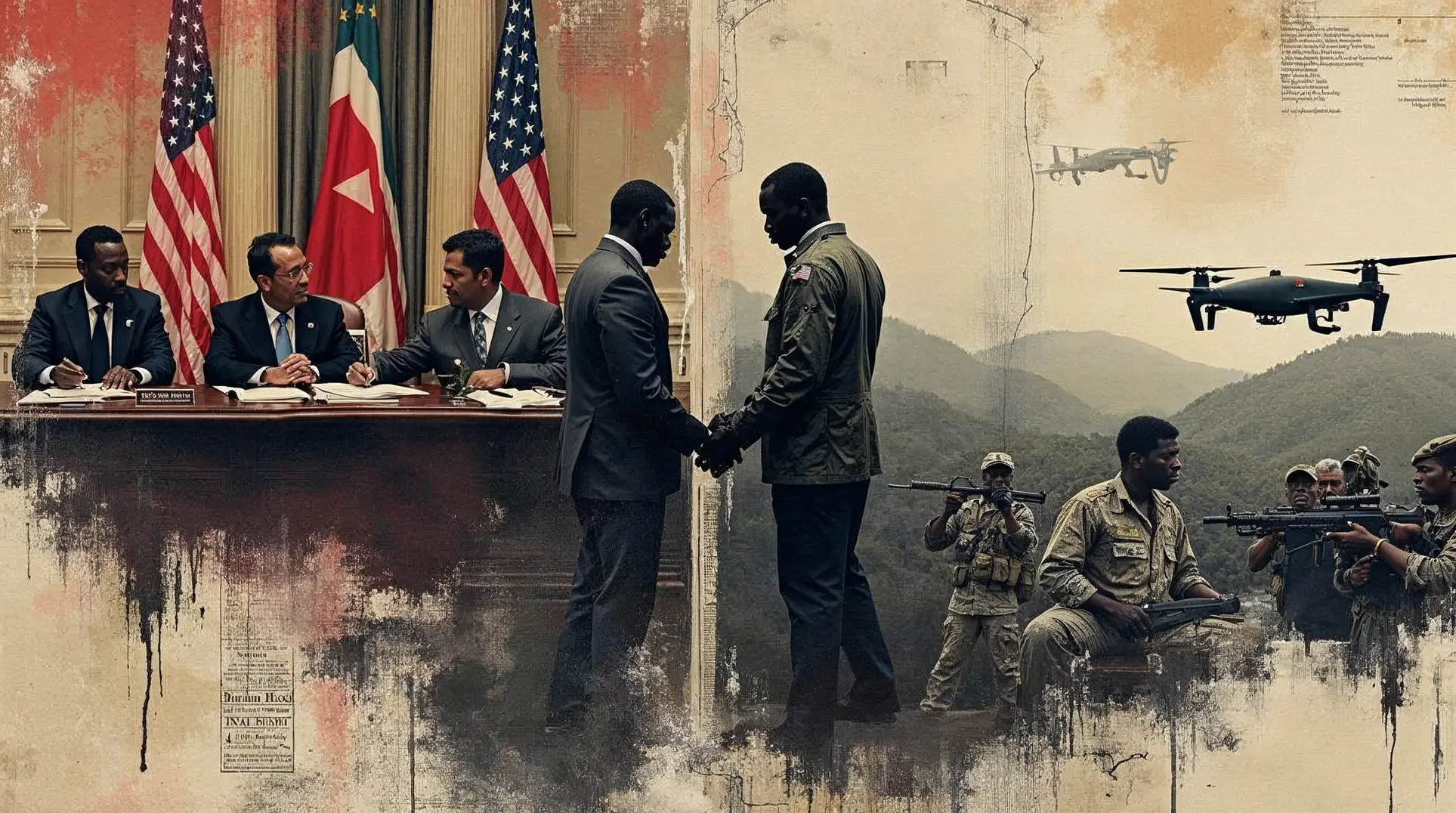
Just six days after shaking hands at the White House, the presidents of Rwanda and the Democratic Republic of Congo watched their December 4 Washington Accords dissolve into artillery smoke over South Kivu. On December 10, the Rwanda-backed M23 rebel group seized Uvira, the province's second-largest city, in a rapid offensive that employed attack drones, heavy artillery, and what Human Rights Watch identifies as direct participation by Rwandan Defense Forces. The capture displaced over 200,000 civilians since early December—more than 30,000 of whom fled across the border into Burundi—and has drawn sharp rebukes from Washington and Brussels. Yet the gap between diplomatic ceremony and battlefield reality has never been wider.
M23 released images of captured Burundian army (FDNB) soldiers during the operation, a development that transforms the conflict's regional geometry. Burundian forces withdrew from Uvira and surrounding areas; multiple sources describe ongoing negotiations and contested efforts to repatriate stranded troops via the Gatumba crossing, with some reports suggesting up to 2,500 FDNB personnel remain isolated in South Kivu's highlands. Burundi's ambassador to the DRC denied authorizing a formal corridor, but the reality on the ground speaks to a humiliating drawdown that gives M23 leverage and removes a key counterweight on the Uvira-Bujumbura axis.
The offensive: speed, firepower, and civilian cost
M23's December push followed a methodical advance down the RN5 corridor. After capturing Luvungi, Mutarule, and Sange in early December, the group entered Uvira late on December 9 and consolidated control the following day, seizing the strategic Kalundu port and the governor's office. Human Rights Watch documents Rwandan forces participating directly, deploying sophisticated weaponry that has come to define this phase of the conflict: attack drones and artillery systems far beyond the capabilities of a rebel militia.
The civilian toll has been catastrophic. HRW verified at least 74 deaths and 83 wounded tied to drone strikes and artillery barrages during the approach to Uvira, including a series of explosions in Sange that killed at least 36 people. The LA Times and Associated Press, citing local health officials and humanitarian sources, report more than 400 killed across the broader offensive. Shells fell across the border in Burundi's Rugombo commune, a spillover that underscores the conflict's widening radius.
Hospitals in Uvira are overwhelmed. The World Food Programme suspended assistance across South Kivu amid funding shortfalls and access constraints, leaving tens of thousands without emergency relief at the moment they need it most. The displacement wave—200,000 people in less than two weeks—adds to an internal displacement crisis that stood at 5.7 million before M23's latest gains.
Members are reading: How the Burundian troop capture shifts regional leverage, why two-track diplomacy is failing, and what credible enforcement would require.
Abuses during and after the takeover
Beyond the immediate combat toll, Human Rights Watch has verified that M23 fighters executed civilians and suspected members of the Wazalendo self-defense militias in Uvira's Kasenga and Kavimvira neighborhoods between December 10 and 12. These killings fit a wider 2025 pattern documented by HRW and Amnesty: summary executions, hospital raids and abductions of wounded fighters in Goma and Bukavu, forced recruitment of men and boys, and sexual violence against women and girls in areas under M23 control.
Accountability advocates stress that naming these abuses is not a both-sides exercise but a recognition that impunity by any armed actor—rebel, state, or militia—entrenches the logic that drives the conflict. Amnesty's March 2025 report on post-Goma abuses included survivor testimonies describing torture, forced labor, and rape, crimes potentially rising to war crimes and crimes against humanity. The UN Fact-Finding Mission has echoed these findings, yet prosecutions remain vanishingly rare and political will to impose costs on perpetrators remains absent.
The path forward: accountability or entrenchment
Uvira's capture is not simply another town changing hands; it is a test of whether external actors are willing to move from statements to consequences. If territorial gains are tacitly rewarded through negotiations that freeze the map in M23's favor, the incentive structure for future offensives remains intact. Conversely, ignoring insurgent control and insisting on full restoration of sovereignty without addressing underlying grievances or governance failures produces paper agreements that collapse at first contact with reality.
Credible enforcement would require several steps: targeted sanctions on Rwandan and DRC officials enabling military support and human rights violations; unfettered humanitarian access to Uvira and surrounding displacement sites; support for independent investigations and prosecutions; and review of economic partnerships—especially minerals trade—to block conflict financing. The International Contact Group's December call to halt operations must be backed by clear benchmarks and timeline for verifiable withdrawals, with consequences for non-compliance spelled out in advance rather than improvised after the next offensive.
The alternative is predictable: more ceremonies in distant capitals, more civilians displaced, and more evidence that the gap between diplomacy and deterrence has become unbridgeable. Eastern Congo's cycle will continue until the international community decides that accountability and enforcement matter as much as photo opportunities in Washington.
Subscribe to our free newsletter to unlock direct links to all sources used in this article.
We believe you deserve to verify everything we write. That's why we meticulously document every source.


