


The violence enveloping Sudan's Kordofan region is following a grimly familiar script. On 4 December 2025, UN High Commissioner for Human Rights Volker Türk issued his starkest warning yet on the country's expanding civil war, drawing a direct line between the atrocities that consumed El Fasher and the pattern now unfolding across North, South, and West Kordofan. "We must not allow Kordofan to become another El Fasher," Türk declared, cataloguing bombardments, blockades, mass displacement, and what he called "a despicable disregard for civilian lives." The question is whether the international community will act on his call for an arms embargo and ICC referral before Kordofan crosses the same threshold that turned El Fasher into a byword for siege warfare and engineered starvation.
The warning comes as Kordofan's towns record casualties and displacement at a scale that evokes Darfur's darkest chapters. At least 269 civilians have been killed in Bara, North Kordofan, since late October through aerial strikes, artillery barrages, and summary executions, according to the UN human rights office. The true toll is likely higher; telecommunications blackouts across much of the region have severed the flow of information that might enable families to flee or aid agencies to respond. In the town of Kauda, South Kordofan, a Sudanese Armed Forces aerial strike on 29 November killed at least 48 civilians. And famine—the endpoint of siege logic—has already arrived: the UN confirmed famine conditions in Kadugli, South Kordofan's largest city, with Dilling now at acute risk.
A geography of siege and starvation
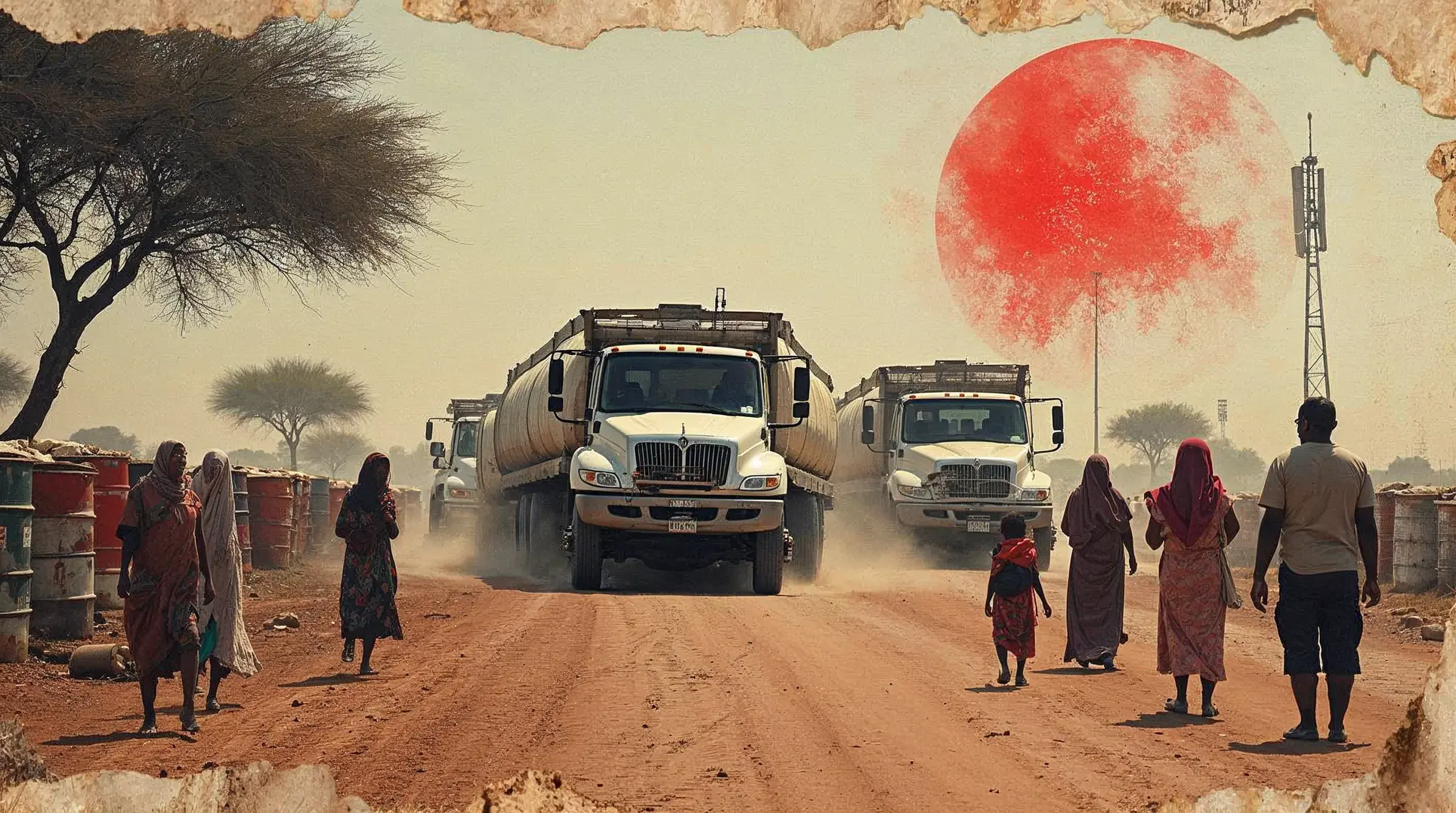
What distinguishes Kordofan from earlier phases of Sudan's war is its role as a chokepoint. The three Kordofan states form the central corridor linking Darfur to the Nile heartland, and the roads that once carried grain, medicine, and fuel now lie severed by frontlines and administrative obstruction. Aid convoys destined for El Obeid, An Nuhud, Al Khawai, Dilling, and Kadugli are stranded or turned back. In South Kordofan, Sudan's Humanitarian Aid Commission has suspended multiple NGOs, compounding access collapse at precisely the moment when the October 2025–January 2026 famine timeline projected by the Integrated Food Security Phase Classification is becoming reality. Over 45,000 people have fled Kordofan since the latest escalation began, according to the International Organization for Migration, joining the 14 million Sudanese already displaced since April 2023.
The violence is not indiscriminate in its origins, even when its effects are. On 3 November, a Rapid Support Forces drone strike on El Obeid killed 45 people, mostly women gathered under a tent. In Kalogi, South Kordofan, reports diverge sharply—Sudanese authorities claim 79 civilians, including 43 children, were killed in RSF drone attacks on a kindergarten and other facilities, while other accounts cite at least nine dead, including four children and two women. The discrepancy itself is a marker of information collapse, a deliberate byproduct of telecom shutdowns that Türk urged states to reverse immediately to facilitate evacuations and humanitarian response.
The RSF's claim to have captured the Sudanese Armed Forces' 22nd Infantry Division headquarters in Babanusa, West Kordofan's largest town, remains unverified—the Associated Press notes it cannot independently confirm the assertion, and the SAF has stayed silent. Yet the battle for Babanusa matters beyond tactical symbolism. The town sits astride corridors linking Darfur to central Sudan and near oil infrastructure tied to South Sudan's export pipelines. Its encirclement or fall would deepen the humanitarian blockade across West Kordofan, cutting off populations already beyond the reach of cross-border aid from Chad, which remains only partially feasible. In South Kordofan, the presence of the Sudan People's Liberation Movement-North alongside RSF forces has intensified sieges around Kadugli and Dilling, multiplying the armed actors with an interest in controlling—and therefore denying—access.
Members are reading: How El Fasher's siege blueprint is being replicated in Kordofan, and why the ICC referral Türk demands faces the same geopolitical blockade.
The threshold question
Türk's formulation—"all the signs are there: bombardments; blockades; people forced from their homes"—is both an alarm and an indictment. The signs are there because the international architecture designed to prevent mass atrocities has proven unable or unwilling to act on them. Since April 2023, an estimated 40,000 Sudanese have been killed and roughly 30 million are in need of humanitarian assistance, according to UN figures. Sudan's war has become the world's worst humanitarian crisis, yet it unfolds in a near-total information void, sustained by the same telecom blackouts and access denials that Türk now begs states to reverse.
Kordofan's trajectory is not inevitable. Aid routes can be reopened; telecommunications can be restored; arms flows can be halted; investigations can be launched. What is required is a departure from the pattern of response that allowed El Fasher to burn for 500 days before falling into silence. Whether that departure materializes will determine not only Kordofan's fate, but the credibility of the international legal and humanitarian order that claims to protect civilians in war. The threshold is visible. The question is whether it will be crossed before anyone acts.
Subscribe to our free newsletter to unlock direct links to all sources used in this article.
We believe you deserve to verify everything we write. That's why we meticulously document every source.


