


Militants from the al-Qaeda-linked Jama'at Nusrat al-Islam wal-Muslimin killed at least 10 Nigerien soldiers on November 19 near Garbougna, a village in western Niger's Tillaberi region close to the Mali and Burkina Faso frontiers. Security sources confirmed the ambush the following day, and al-Qaeda's Sahel media wing, Al-Zallaqa, claimed the attack alongside simultaneous operations in Mali and Burkina Faso, according to monitoring groups.
The tri-border Liptako-Gourma zone has long served as a permissive hub for both JNIM and Islamic State affiliates. But the ambush is only one axis of JNIM's current offensive. Since early September 2025, the group has mounted a fuel blockade targeting Mali's supply corridors—banning imports from Senegal, Guinea, Côte d'Ivoire, and Mauritania, torching tanker convoys, and strangling deliveries to Bamako itself. The blockade represents a strategic escalation: JNIM is weaponizing scarcity to undermine the military junta's legitimacy and expose the limits of its promise to restore security.
Blockade turns fuel into a weapon
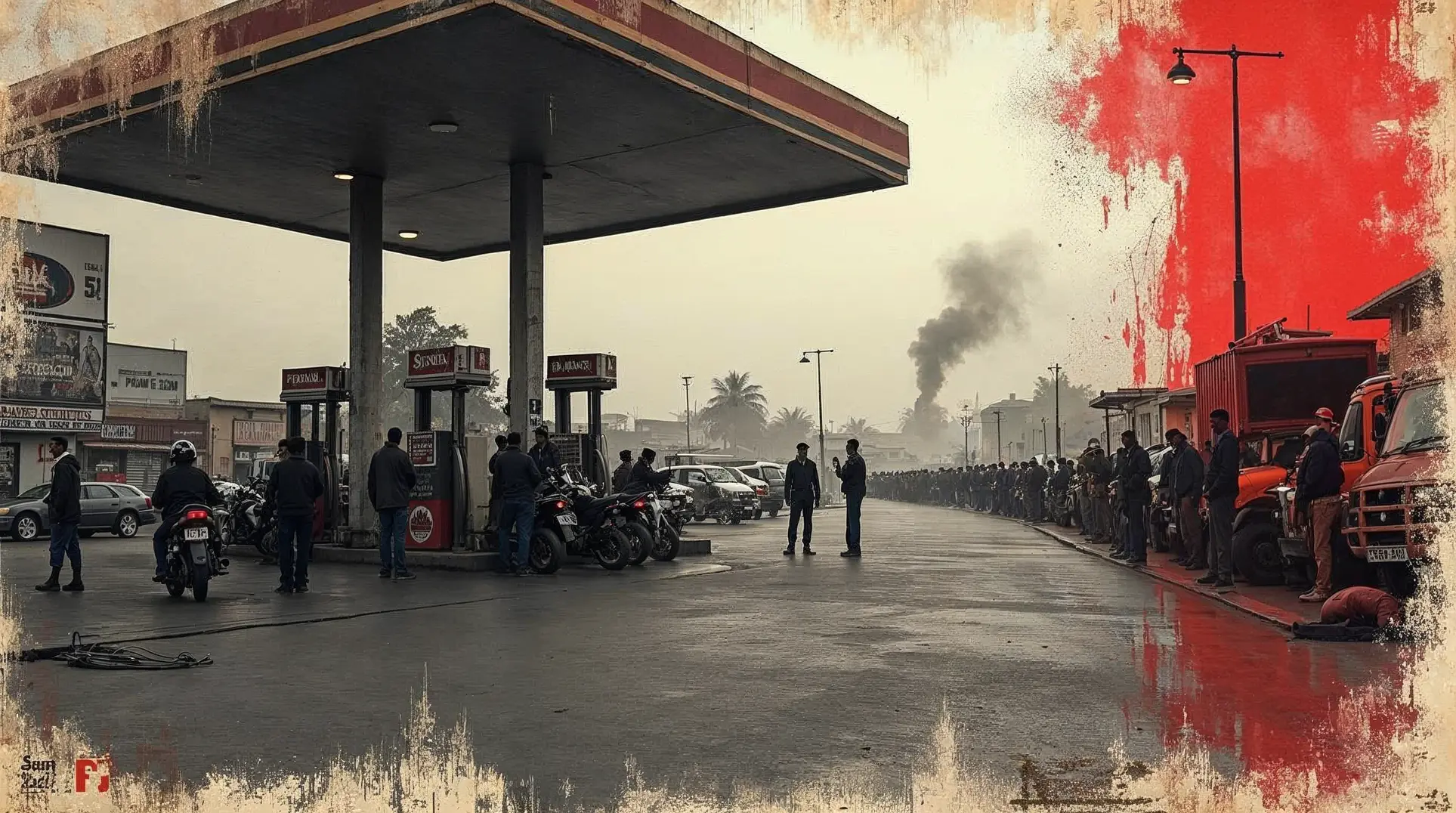
JNIM formally declared blockades in Kayes and Nioro, southwest Mali, in September and has enforced them with lethal discipline. Fighters ambushed and burned trucks near Torodo; tankers now move only under armed military escort, raising costs and slowing supply. The Malian army has reassigned units to convoy duty, thinning coverage elsewhere. Bamako, a capital of nearly three million, has experienced sporadic shortages at filling stations, and transport fares have climbed sharply.
The group's edict banning fuel imports from neighboring countries aims to choke both state revenue and civilian confidence. In Mopti region, local leaders have reportedly held talks with JNIM representatives—under intelligence auspices—to negotiate partial relief. Those negotiations, if confirmed, signal that the jihadists are positioning themselves as arbiters of access, a function typically reserved for governments. In communities where state protection has collapsed, JNIM's offer of predictable passage in exchange for compliance becomes a form of rudimentary governance.
The Alliance of Sahel States—Mali, Burkina Faso, and Niger—formed after military coups promised citizens a clean break with French and ECOWAS oversight, framing sovereignty and Russian-backed security cooperation as the path forward. The Bamako fuel squeeze now tests that promise at the pump, exposing the junta's inability to secure critical infrastructure despite the presence of Wagner Group successors and Africa Corps contractors.
Members are reading: Why JNIM's shift from guerrilla raids to economic siege reveals a proto-state strategy that no military can counter alone.
Regional coordination collapse amplifies risk
The military governments that now control Mali, Burkina Faso, and Niger justified their seizures of power with promises of decisive action against jihadist groups. They expelled French forces, ended the UN peacekeeping mission MINUSMA in Mali, and turned to Russian contractors. Yet JNIM's tempo has only increased. UN Secretary-General monitoring reports warn that the Sahel now accounts for a significant share of global terrorist attacks and casualties, with lethality and frequency climbing.
By mid-2025, nearly four million people were displaced across the three AES countries. More than 14,800 schools and 900 health facilities had closed, gutting the social infrastructure that might anchor communities against insurgent encroachment. Humanitarian access has contracted sharply, with aid workers detained and operations suspended amid junta suspicion of foreign agendas. The resulting vacuum leaves civilians dependent on whoever controls the roads—increasingly, that means JNIM or Islamic State Sahel.
ECOWAS and the African Union have struggled to craft practical security coordination with the AES despite shared threat assessments. Political estrangement has frozen intelligence exchange and joint-border patrols at precisely the moment JNIM is demonstrating transnational reach. The Tillaberi ambush, Bamako blockade, and expansion into Benin and Nigeria form a single, integrated campaign that no single junta can contain in isolation.
What comes next
The immediate question is whether talks between Malian intermediaries and JNIM yield any easing of the blockade, and at what political cost. Negotiated relief may stabilize fuel supply temporarily, but it would also validate JNIM's claim to veto authority over commerce and movement. If the blockade persists or tightens, analysts warn of siege conditions hardening around Bamako itself—a scenario that would represent both a humanitarian catastrophe and a decisive blow to junta credibility.
For regional actors, the challenge is whether coordination can be rebuilt across the ECOWAS-AES divide before capitals face the same encirclement logic already choking secondary cities. The tri-border ambush shows how JNIM sustains the war. The fuel blockade shows how it tries to win it.
Subscribe to our free newsletter to unlock direct links to all sources used in this article.
We believe you deserve to verify everything we write. That's why we meticulously document every source.


