


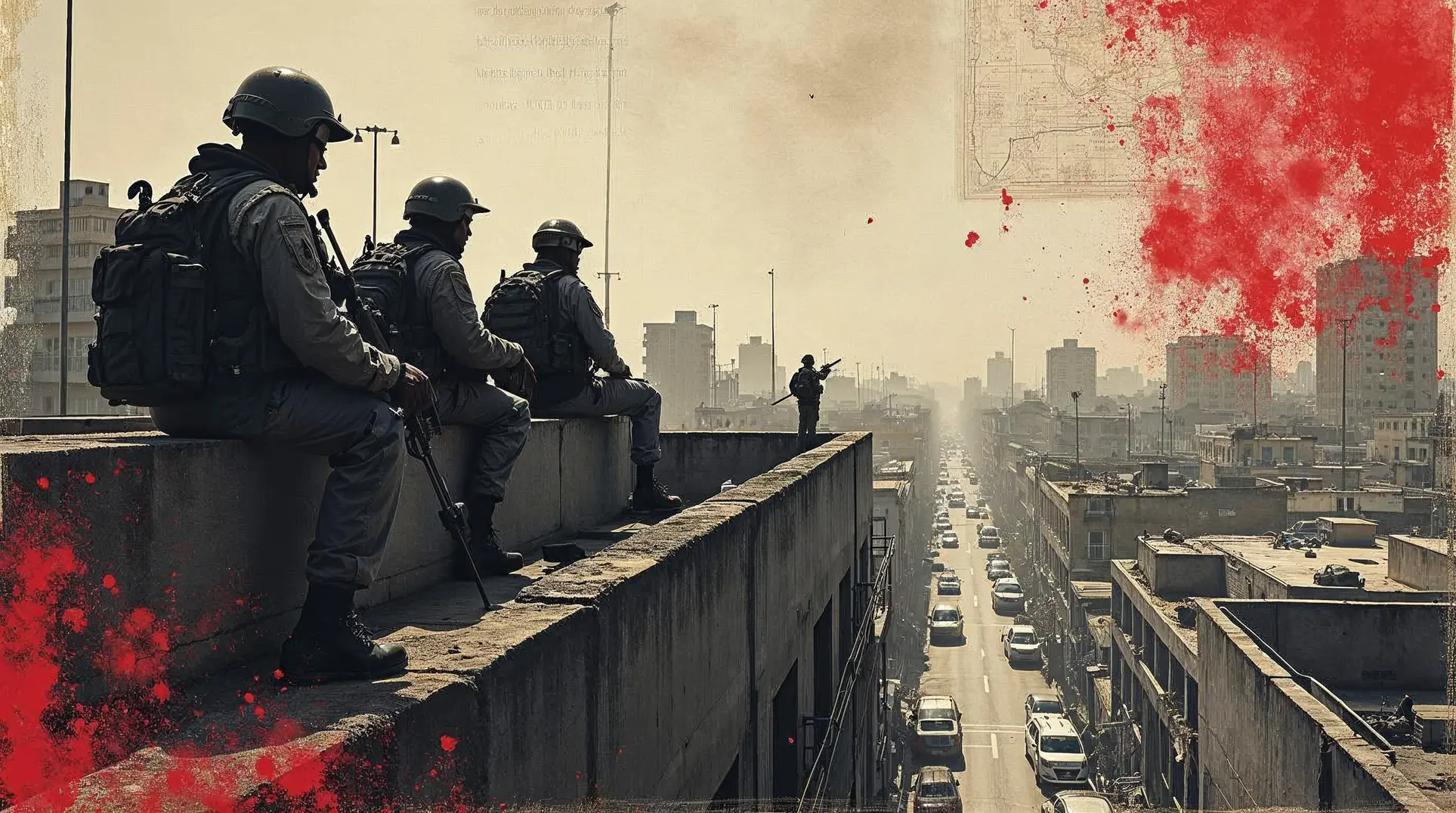
Israeli security forces encircled the northern West Bank city of Tubas on Wednesday, establishing positions across residential neighborhoods, commandeering private homes and rooftops, and ordering Palestinian residents from their dwellings in what local officials describe as a multi-day operation. The incursion—backed by helicopter fire and involving multiple brigades alongside Shin Bet and Border Police units—represents the latest geographic expansion of Israel's months-long northern West Bank campaign, now extending beyond Jenin and Tulkarm refugee camps into a governorate bordering the Jordan Valley.
The operation's scope and tactics signal a strategic shift: from rapid-strike raids to sustained positional control that more closely resembles occupation-era encirclement than counter-terrorism sweeps. With forces erecting earth berms, blocking roads, and restricting movement—including reported impediments to ambulance access—while schools suspend in-person instruction and at least 22 Palestinians are detained, Tubas has become the newest test case for Israel's evolving West Bank security doctrine and the humanitarian costs of its implementation.
From sweep to siege
Tubas governor Ahmed Al-Asaad told Reuters that Israeli forces, backed by a helicopter that opened fire over empty fields, were "encircling the city and establishing positions across several neighborhoods." He added: "The incursion looks to be a long one… [forces] drove people from their houses, commandeered rooftops… conducting arrests." According to Anadolu Agency and Daily Sabah reporting, the helicopter deployment marked the first use of Apache fire in the area in years, a significant escalation in tactical posture.
The Israeli military framed the operation as counter-terrorism work aimed at preventing militant entrenchment, with official sources stating they "won't allow terror to become established in the area," according to the Times of Israel. An IDF spokesperson deferred operational details, saying more information would be released later. Yet the governor disputed claims about targeting "wanted individuals," calling the operation political in nature. Hamas and Islamic Jihad condemned what they termed systematic aggression and land seizure.
The divergence between these narratives maps onto a deeper question: whether Israel is conducting discrete security operations or implementing territorial control that carries the hallmarks of collective punishment. The commandeering of private residences as military posts, multi-day road closures with earth mounds, and restrictions on civilian movement place Tubas within a pattern observed earlier in 2025 across Jenin and Tulkarm—where Israeli forces maintained their longest continuous presence in West Bank cities in decades.
Members are reading: How Tubas reveals Israel's shift from raids to permanent encirclement infrastructure—and the legal tripwires that strategy encounters.
Strategic calculus and political costs
Israel's expanded northern West Bank campaign reflects a calculation that militant infrastructure—particularly in areas like Tubas where the Tubas Brigade has emerged in recent friction—requires preemptive disruption before networks mature into entrenched resistance capabilities. The integration of air assets, intelligence services, and ground forces suggests operational sophistication aimed at degrading coordination capacity among armed factions.
Yet the strategy carries political and legitimacy costs. Each home commandeered, each multi-day blockade, each restriction on ambulance movement erodes Palestinian Authority standing and hardens perceptions that security cooperation yields only deeper Israeli penetration. Settler violence, which has risen since October 2023 and drawn criticism even within Israel's government, compounds the sense of systematic dispossession. In this environment, tactical gains against specific militants risk strategic losses in governance legitimacy and civilian acquiescence.
The detention landscape provides context: as of late 2024, Israel's Prison Service held roughly 9,600 Palestinians on security grounds, according to B'Tselem statistics. The 22 detained in Tubas feed into a mass-incarceration infrastructure that shapes West Bank political consciousness as much as any military operation. Against this backdrop, the question is not whether Israel can sustain operational tempo—clearly it can—but whether sustained encirclement produces the security it seeks or the resistance it aims to prevent.
What comes next
Governor Al-Asaad anticipates the Tubas operation will last several days. Whether Israeli forces eventually withdraw or harden positions into semi-permanent outposts will indicate whether this represents a discrete counter-terrorism sweep or the next step in territorial re-segmentation. The IDF has not disclosed specific operational objectives, success metrics, or timelines, leaving the scope and endgame of the incursion unclear.
Parallel arrests across the West Bank—Tulkarm, Nablus, Hebron—suggest coordinated pressure rather than isolated action, pointing to a campaign logic that transcends individual cities. The evolution from Jenin to Tulkarm to Tubas traces a geographic arc across the northern West Bank, each iteration refining the model of sustained encirclement. Whether that model proves replicable or sustainable depends on variables Israel does not fully control: Palestinian armed-group adaptation, international legal pressure, and the tolerance of civilian populations for indefinite restriction. For now, Tubas joins Jenin and Tulkarm in a new category: West Bank cities where Israeli forces no longer visit but remain.
Subscribe to our free newsletter to unlock direct links to all sources used in this article.
We believe you deserve to verify everything we write. That's why we meticulously document every source.


