


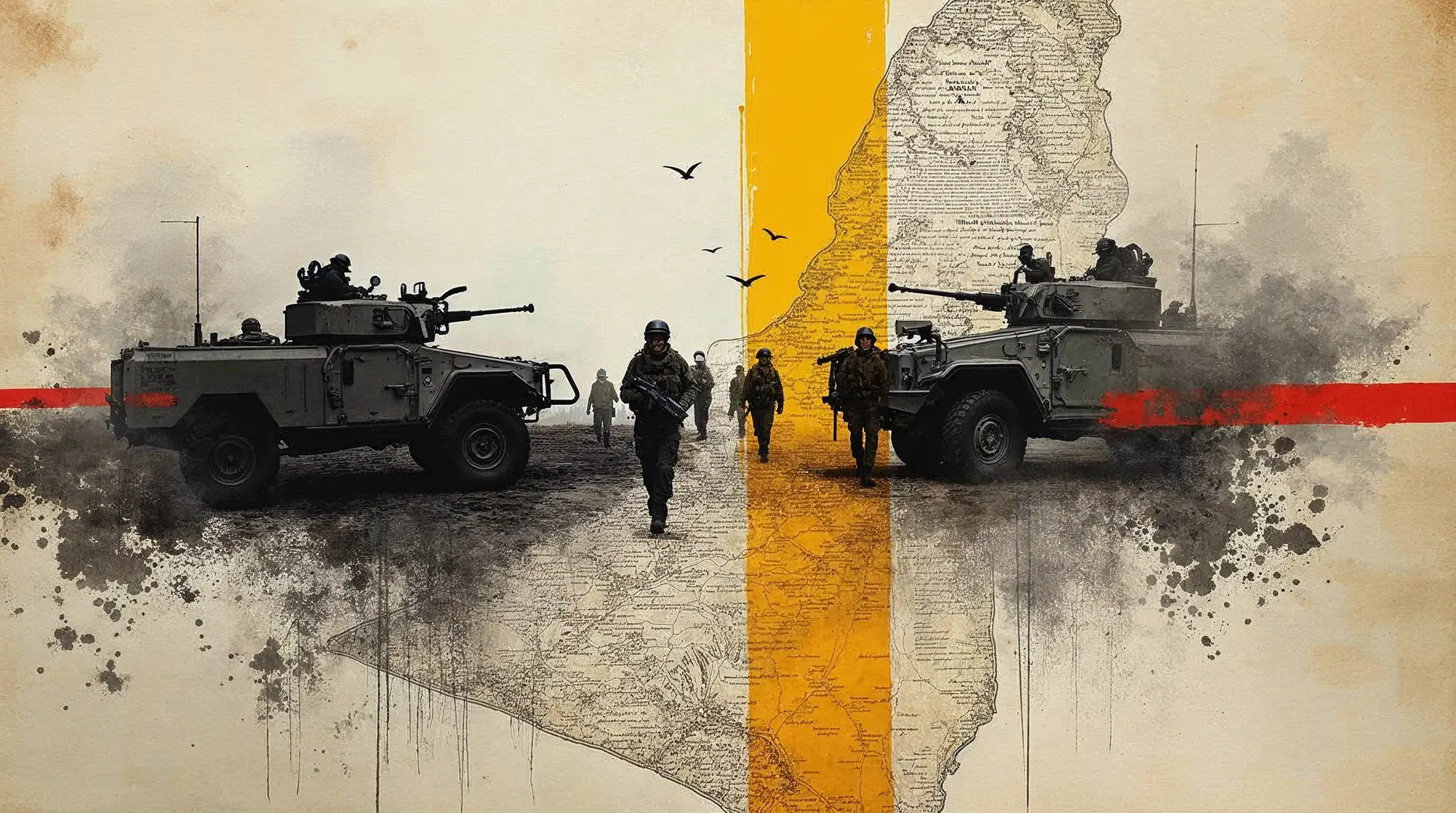
Israel's December 13 strike on a vehicle in Gaza City, killing Raed Saad—the highest-profile assassination since the ceasefire took effect in October—has exposed the fragile scaffolding holding the Gaza truce together. Saad, described by Israel as head of weapons production for Hamas's Qassam Brigades and a top operational commander, was killed west of the so-called Yellow Line, the de facto partition separating Israeli-controlled territory from Hamas-administered zones. The operation, jointly claimed by the IDF and Shin Bet, represents Israel's most assertive test yet of what military freedom of action the ceasefire permits.
In a televised address the following day, Hamas chief negotiator Khalil al-Hayya warned that the killing threatens the "viability of the truce" and called on mediators—particularly U.S. President Donald Trump—to compel Israel to respect the agreement's terms. The exchange crystallizes the core contradiction at the heart of the U.S.-brokered deal: Israel insists on continued authority to conduct counterterrorism strikes against what it defines as imminent threats, while Hamas interprets the truce as requiring Israeli restraint beyond the Yellow Line. With phase two—envisioning an International Stabilization Force, further Israeli withdrawals, and eventual Hamas disarmament—scheduled to begin within weeks, this incident reveals how little consensus exists on the rules governing the transition.
The strike and its strategic calculus
Israel justified the targeting by citing Saad's role in lethal IED attacks on Israeli forces and his operational command during the October 7, 2023 raids. Israeli statements indicate the military considers the Yellow Line a defensive boundary that does not constrain kinetic operations against what Tel Aviv categorizes as active threats. The Israeli military has characterized the Yellow Line as a "new border," a description UN human rights chief Volker Türk explicitly rejected, citing UN Security Council Resolution 2803 from November 17, which emphasized respecting Gaza's territory in its entirety.
The distinction matters operationally. If Israel treats the Yellow Line as a sovereign boundary permitting cross-border strikes, every senior Hamas figure becomes fair game under counterterrorism doctrine. If, as the UN maintains, it remains an internal Israeli military control line within occupied territory, then strikes like Saad's assassination constitute breaches of a fragile ceasefire rather than legitimate border defense. This ambiguity was manageable during phase one's quiet-for-quiet calculus; it becomes structural poison as the parties approach phase two negotiations requiring deeper security commitments.
Hamas has accused Israel of multiple violations since October, including slow aid flows, closure of the Rafah crossing, and ongoing airstrikes. Israel counters that Hamas has failed to return the remains of Ran Gvili, the last hostage, and points to attacks on troops near the Yellow Line. As of December 13, Gaza health authorities report 383 fatalities and 1,002 injuries since the ceasefire, with 627 bodies recovered; UN figures cite 360 killed, 922 injured, and 617 bodies retrieved. The divergence in counts reflects reporting gaps, but both datasets confirm that the "ceasefire" period has been anything but quiet for Gaza's civilian population.
Members are reading: The hidden enforcement paradox that makes every Israeli strike a potential deathblow to phase two's viability.
Scenarios for the next four weeks
The immediate question is whether Hamas responds kinetically or diplomatically. A measured rocket barrage or IED attack near the Yellow Line would test Israeli thresholds for retaliation and risk collapsing the truce entirely. Diplomatic escalation—leveraging international opinion and U.S. mediation—allows Hamas to demonstrate restraint while pressuring Trump to enforce Israeli compliance. The large funeral processions for Saad and rapid appointment of replacement commanders signal Hamas is opting, for now, for internal solidarity displays over military retaliation.
Israel's calculus hinges on the Gvili remains condition. Israeli officials have made clear that progression beyond phase one requires return of the last hostage's body. If Hamas continues to withhold those remains, Israel has justification—by its own stated terms—to suspend further commitments and resume broader military operations. The Saad strike may be a preview of that posture: surgical, deniable, and framed as defensive rather than escalatory.
Absent clarification of what the ceasefire tolerates, each strike becomes a precedent. If Israel can target senior commanders west of the Yellow Line without triggering phase collapse, the distinction between "ceasefire" and "indefinite low-intensity campaign" evaporates. If Hamas can leverage international guarantors to constrain Israeli actions, it gains de facto veto power over Israeli security operations. Neither side appears willing to concede the point, and the ISF mechanism offers no clear adjudication.
Subscribe to our free newsletter to unlock direct links to all sources used in this article.
We believe you deserve to verify everything we write. That's why we meticulously document every source.


