


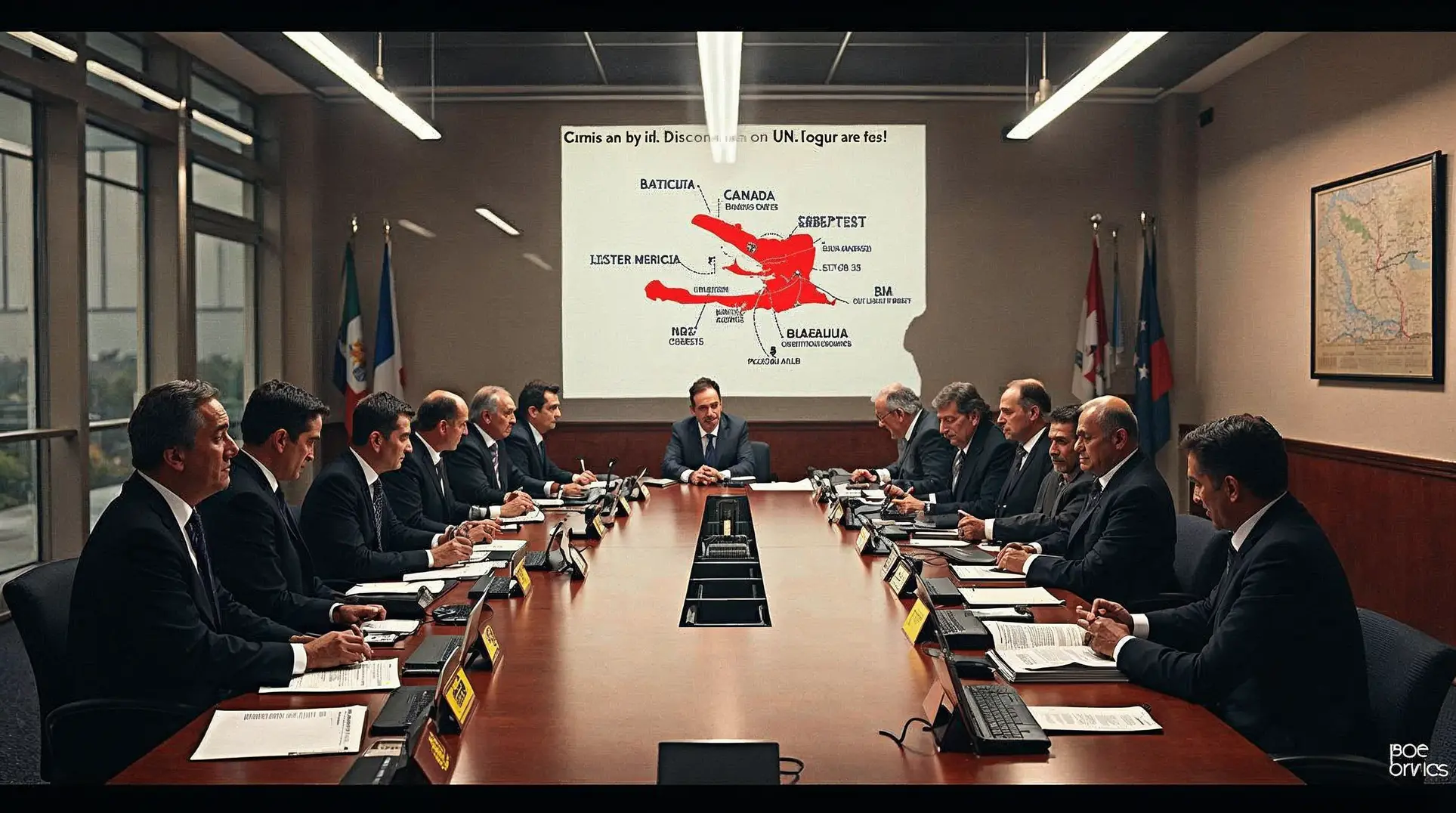
The international coalition backing Haiti's Gang Suppression Force took its first visible step forward on December 8, 2025, when 230 Kenyan police officers landed in Port-au-Prince, bringing the foreign deployment to roughly 1,000 personnel. One day later, a force-generation meeting in New York coordinated by Canada and the United States produced a flurry of new personnel pledges—Bangladesh offered 1,500 troops, Sri Lanka a combat unit, Guatemala committed to doubling its 300-strong contingent, and Argentina pledged military engineers and hospital capability. On paper, the mission is now positioned to reach its authorized ceiling of 5,550 personnel, a fivefold increase over current strength.
Yet the December 9 meeting exposed the central vulnerability that has plagued international engagement in Haiti: the gap between pledges and payroll. Participants were asked to finalize commitments and secure financing by February 2026, ahead of fuller deployment. That deadline is less a marker of confidence than a recognition that without predictable funding lines, signed force contribution agreements, and logistics infrastructure—airlift, armored mobility, medical evacuation—the Gang Suppression Force risks repeating the trajectory of its predecessor, the Multinational Security Support mission, which never exceeded 1,000 personnel against a 2,500 ceiling and struggled to consolidate gains in the face of chronic under-resourcing.
From mandate to deployment: the execution bottleneck
UN Security Council Resolution 2793, adopted on September 30, 2025, authorized the GSF for an initial twelve months and established a UN Support Office in Haiti (UNSOH) to provide logistics and coordination for the force, the Haitian National Police, the Haitian Armed Forces, and the UN Integrated Office in Haiti (BINUH). The resolution permits intelligence-led counter-gang operations to neutralize, isolate, and deter armed groups threatening civilians and state institutions—a sharper mandate than the MSS received. The vote was 12-0-3, with China, Pakistan, and Russia abstaining over concerns about funding clarity, rules of engagement, and lessons learned from past interventions.
The December pledges broaden the coalition beyond Kenya and the initial Central America and Caribbean contributors, signaling political will among a wider set of troop-contributing countries. Bangladesh's 1,500-troop offer is the single largest, and Argentina's engineering and medical capabilities address critical force multipliers. Guatemala's decision to double its presence suggests regional buy-in, while Sri Lanka's combat unit—size unspecified in available materials—adds tactical depth. Together, these commitments could bring the GSF close to its 5,500 uniformed ceiling.
Yet pledges are not deployments. The GSF is financed primarily by voluntary contributions, a model that has historically produced unpredictable cash flow and delayed equipment procurement. The resolution tasks UNSOH with assuming full logistical support within six months of adoption—a March 2026 target—but building that footprint requires funding that remains vague. Haiti's gang crisis has already pushed the state to the edge of collapse, with gangs controlling up to 90 percent of Port-au-Prince and 1.3 to 1.4 million people internally displaced. The security vacuum is not static; delays in force generation allow armed groups to consolidate territorial control, entrench revenue streams, and complicate future operations.
Members are reading: Why the voluntary funding model risks repeating past mission failures and what metrics will reveal if the GSF can scale before the security vacuum widens further.
Measuring progress: five indicators to watch
The February 2026 deadline offers a clear benchmark. Progress can be judged by five indicators: first, cash deposited in the trust fund and assessed support flowing to UNSOH; second, signed force contribution agreements with specific deployment windows; third, logistics infrastructure in place—airlift, sealift, armored mobility, medical evacuation capacity; fourth, joint rules of engagement and accountability mechanisms that satisfy human rights due diligence; fifth, early operations that secure and hold critical nodes—airport, ports, key road arteries—and facilitate humanitarian access.
If these indicators remain amber or red by mid-2026, the GSF will face the same execution bottleneck that constrained the MSS: a mission authorized on paper but under-resourced in practice, unable to consolidate territorial gains or protect civilians at scale. Haiti's gangs have demonstrated tactical adaptability and strategic patience; they will exploit any gap between international rhetoric and operational reality. The December pledges have widened the coalition and clarified the mission's scale. Now the clock is running on financing, deployment, and proof of concept on the ground.
Subscribe to our free newsletter to unlock direct links to all sources used in this article.
We believe you deserve to verify everything we write. That's why we meticulously document every source.


