


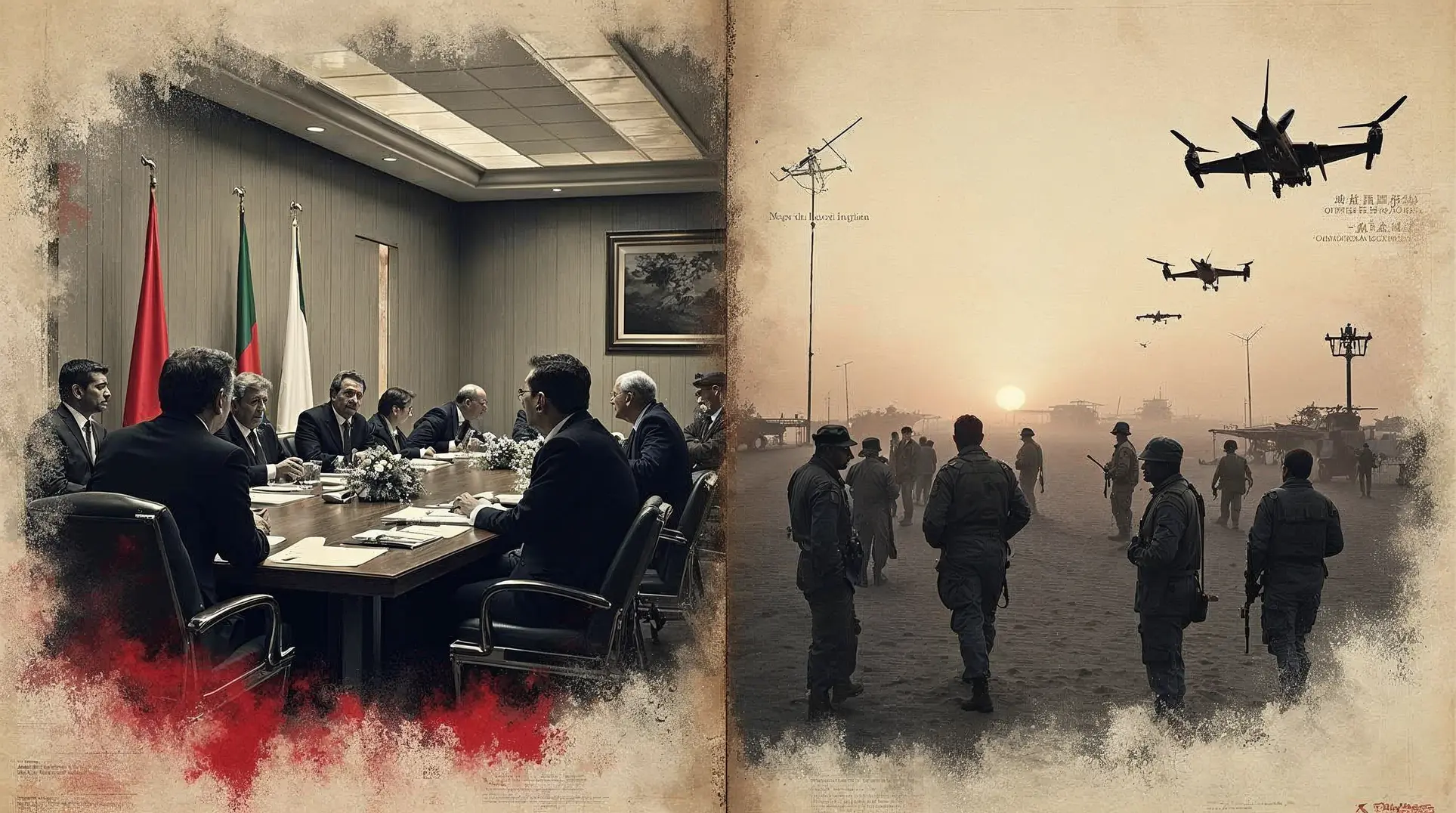
Ethiopia is operating a clandestine military training facility for thousands of fighters aligned with Sudan's Rapid Support Forces, according to a Reuters investigation citing eight sources, satellite imagery analysis, and leaked diplomatic cables. The camp, located in Ethiopia's Benishangul-Gumuz region near the Grand Ethiopian Renaissance Dam, is reportedly financed by the United Arab Emirates, marking the first documented evidence of Ethiopia's direct military involvement in Sudan's civil war.
The revelation transforms the conflict's strategic landscape. What began in April 2023 as a power struggle between Sudan's military factions has evolved into a regional proxy war, with competing coalitions now investing directly in military infrastructure to shape the outcome. The Ethiopia-UAE axis backing the RSF stands against the Sudanese Armed Forces and their own external supporters, effectively turning Sudanese territory into contested ground for broader Horn of Africa and Red Sea rivalries.
The infrastructure of intervention
Satellite imagery confirms construction at the Benishangul-Gumuz site accelerated dramatically in late 2025, with facilities designed to accommodate thousands of trainees. The camp's proximity to the GERD—Ethiopia's strategic crown jewel and source of ongoing tensions with downstream Egypt—adds another layer of geopolitical sensitivity to the operation.
Analysis of imagery from nearby Asosa airport reveals a drone ground control station, suggesting the facility's role extends beyond basic infantry training. An internal Ethiopian security memo and a diplomatic cable obtained by Reuters corroborate witness accounts of systematic recruitment and training operations. The scale and sophistication of the infrastructure indicate long-term strategic planning rather than ad hoc support.
The UAE foreign ministry has categorically denied involvement, dismissing the allegations despite the documentary and photographic evidence. This denial follows a familiar pattern: Abu Dhabi has consistently maintained public positions advocating peace in Sudan while evidence mounts of covert military engagement. The gap between diplomatic rhetoric and operational reality reflects calculated strategic ambiguity designed to minimize international backlash while maximizing influence on the ground.
Members are reading: Detailed analysis of why Ethiopia and UAE are investing in RSF infrastructure and what they expect in return.
Battlefield dynamics and regional instability
The training camp's operational timeline coincides with shifting momentum in Sudan's war. The Sudanese Armed Forces have recently achieved tactical successes, recapturing the strategic town of Al-Sillik and breaking the siege of Dilling. These SAF advances, however, have not fundamentally altered the conflict's trajectory. The RSF's decision to invest in systematic training infrastructure suggests preparation for prolonged conflict rather than negotiations.
The internationalization of the war extends beyond the Ethiopia-UAE axis. Multiple regional actors have stakes in the outcome, creating a complex web of competing interests that makes diplomatic resolution increasingly difficult. Each external power views Sudan through the lens of its own strategic priorities—Red Sea access, counter-terrorism partnerships, resource extraction, or ideological alignment—rather than Sudanese stability or civilian protection.
A proxy war entrenched
The Ethiopia-UAE training operation represents a threshold moment. Foreign powers are no longer simply providing weapons or diplomatic support; they are building dedicated military infrastructure to sustain one side's war-fighting capacity. This level of investment signals confidence that the conflict will continue and determination to shape its outcome.
For Sudanese civilians caught between competing forces, the professionalization of RSF fighters through foreign training programs portends further suffering. The conflict has already displaced millions and created one of the world's worst humanitarian crises. The entry of regional powers as direct participants through facilities like the Benishangul-Gumuz camp extends the timeline for potential resolution while escalating the violence's sophistication and lethality. Sudan's civil war has become a key arena for regional power competition, with peace subordinated to the strategic priorities of external actors pursuing influence across the Horn of Africa and Red Sea littoral.
Subscribe to our free newsletter to unlock direct links to all sources used in this article.
We believe you deserve to verify everything we write. That's why we meticulously document every source.


