


Key takeaways
- A foreign man was beaten to death by about 50 people beside a march in Durban on 22 October 2026.
- Police say the motive is unestablished and warn against rumour, though the killing follows riots in Durban and Soweto earlier in October.
- Unemployment near 33% and failing services meet a foreign population under 4%, and mixed state signals add to the risk.
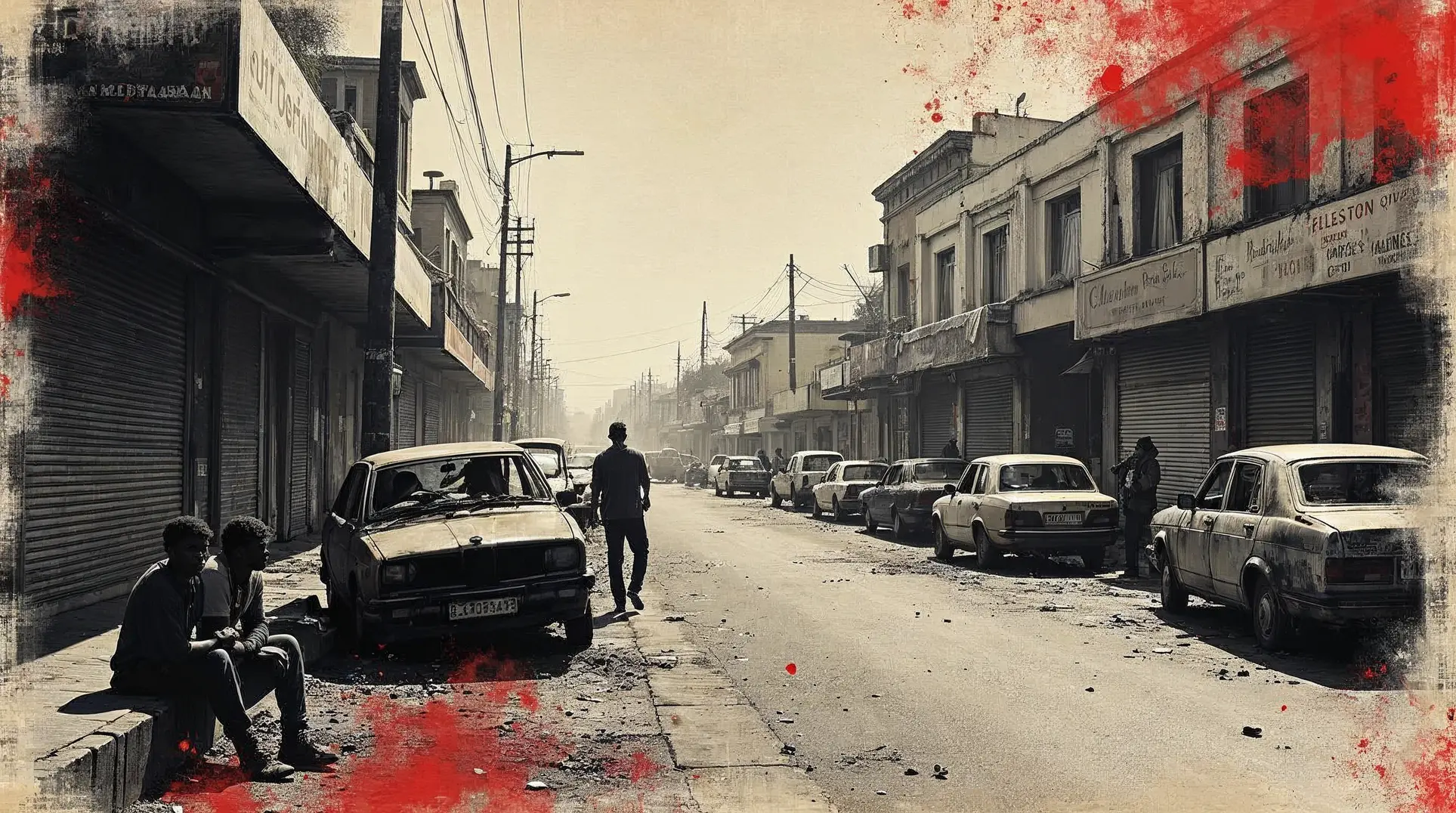
Police in Durban have opened a murder investigation after an unidentified foreign man was beaten to death in the city centre on Thursday morning, 22 October 2026. Authorities estimated he was in his late 30s or early 40s. His name and country of origin have not been released. The attack happened near the corner of Dr Pixley kaSeme Street and Maud Mfusi Street as a crowd of demonstrators moved along the road. Two men broke away from the march and approached him on the pavement. About 50 people then swarmed him. He was declared dead at the scene, according to a police statement.
The South African Police Service (SAPS) said, through KwaZulu-Natal provincial spokesperson Colonel Robert Netshiunda, that the motive has not been established. It cautioned the public against circulating rumours of a premeditated vigilante execution or a xenophobic conspiracy until suspects are questioned and CCTV (closed-circuit television) footage is corroborated. That caution holds, and no motive is assigned here. The narrower question is why a Durban street, in this month, was a place where such an attack on a foreign national could happen, and which structural pressures sit behind it.
Two weeks of unrest before the killing
Detectives are following several leads and using all investigative aids to identify possible suspects, SAPS says, and eNCA reported that police are using CCTV footage to help in that effort. The killing came at the end of a volatile fortnight. On Wednesday 21 October, e-hailing drivers affiliated with, or mobilising alongside, the movement against undocumented migrants marched through the same central Durban streets. SAPS has not established a motive for the killing. Any formal link between it and the previous day's mobilisation is therefore equally unestablished.
On 8 and 9 October, rioting, looting and arson broke out in the Durban central business district after an anti-migrant demonstration focused on undocumented labour and asylum processing. At least 14 vehicles were torched. Foreign-owned shops, a local lodge and a commercial warehouse were looted or damaged. Soldiers of the South African National Defence Force (SANDF) were deployed alongside SAPS to end two days of disorder. On 8 October, police arrested three foreign nationals in Durban in connection with an alleged assault on a local protester, police told AFP, and the allegation that a foreign national had assaulted a South African demonstrator sparked the violence. In early October, violent protests, looting and car-burning also erupted in Soweto, a Johannesburg township, after a high-court ruling on refugee reception centres and asylum claims.
The reported sequence on Dr Pixley kaSeme Street is two people leaving a column and dozens joining within moments. It shows how quickly a gathering can turn into collective violence once a target is identified. Whether anyone planned it is the open investigative question. Earlier Crisis.Zone reporting on vigilantism and social unrest in urban South Africa describes how economic frustration has been channelled into street mobilisation.
Observers are reading: how the gap between state rhetoric and street enforcement shapes the risk of further mob violence in South African cities.
Become an Observer, it's free. Get full access to all Crisis.Zone analysis, briefings and breaking coverage.
Continental fallout and a long shadow
The consequences reach beyond Durban. Nigeria has accused South African authorities of negligence and held them accountable for the deaths of its citizens. Nigerian Consul-General Ninikanwa Okey-Uche condemned the killings of Nigerians in South Africa between 18 and 21 September, the BBC reported. The Nigerian consulate in Johannesburg had earlier condemned the killing of Bishop Taiwo Michael Fakunle, and the Nigerian government issued a warning after the deaths of Fakunle and Mr James Uchechukwu. Ghana formally protested after the fatal shooting of Ghanaian national Bashiru Isak, a father of three, during anti-foreigner demonstrations in Cape Town. Pretoria said there was no evidence of systematic attacks on African nationals, acknowledging only isolated incidents, and claimed the scale of the violence had been overstated, and a bitter dispute followed. In June, thousands of Malawians sheltered in makeshift camps and parks in Durban and asked for emergency repatriation flights. The state set up temporary holding centres. Mozambique also saw its nationals displaced. The wider diplomatic picture is covered in our report on Pan-African diplomacy and xenophobia tensions.
The pattern is not new. The May 2008 attacks left more than 60 people dead and tens of thousands displaced. Further outbreaks followed in 2015 and 2019, and now in 2026. Each cycle has strained Pretoria's standing on the continent, and the present one arrives while South Africa seeks a leading role in the African Continental Free Trade Area (AfCFTA) and influence within the African Union (AU).

Observers are reading: the four indicators that will show whether Pretoria's response to the Durban killing hardens, fragments or begins to restore trust.
Become an Observer, it's free. Get full access to all Crisis.Zone analysis, briefings and breaking coverage.
Assessment
The established facts are limited. A foreign man was killed in central Durban on 22 October 2026 by a crowd of about 50 that formed beside a march. SAPS has opened a murder case, according to The Witness, and a police spokesperson, Netshiunda, said the motive for the killing was unknown. Nothing here should be read as a finding of xenophobic intent in this case.
The surrounding evidence is clearer. Unrest in Durban and Soweto in early October, a documented record of attacks on foreign nationals, and diplomatic protests from Nigeria and Ghana show an unresolved problem. Unemployment near 33%, failing services and a foreign-born population under 4% describe a gap between the cause of the anger and its object. Mixed signals from the state widen that gap. Whether the pattern holds, and what the police establish about the Dr Pixley kaSeme Street attack, will be clearer in the coming months.
Become an Observer (it's free) to unlock direct links to all sources used in this article.
We believe you deserve to verify everything we write. That's why we meticulously document every source.


