


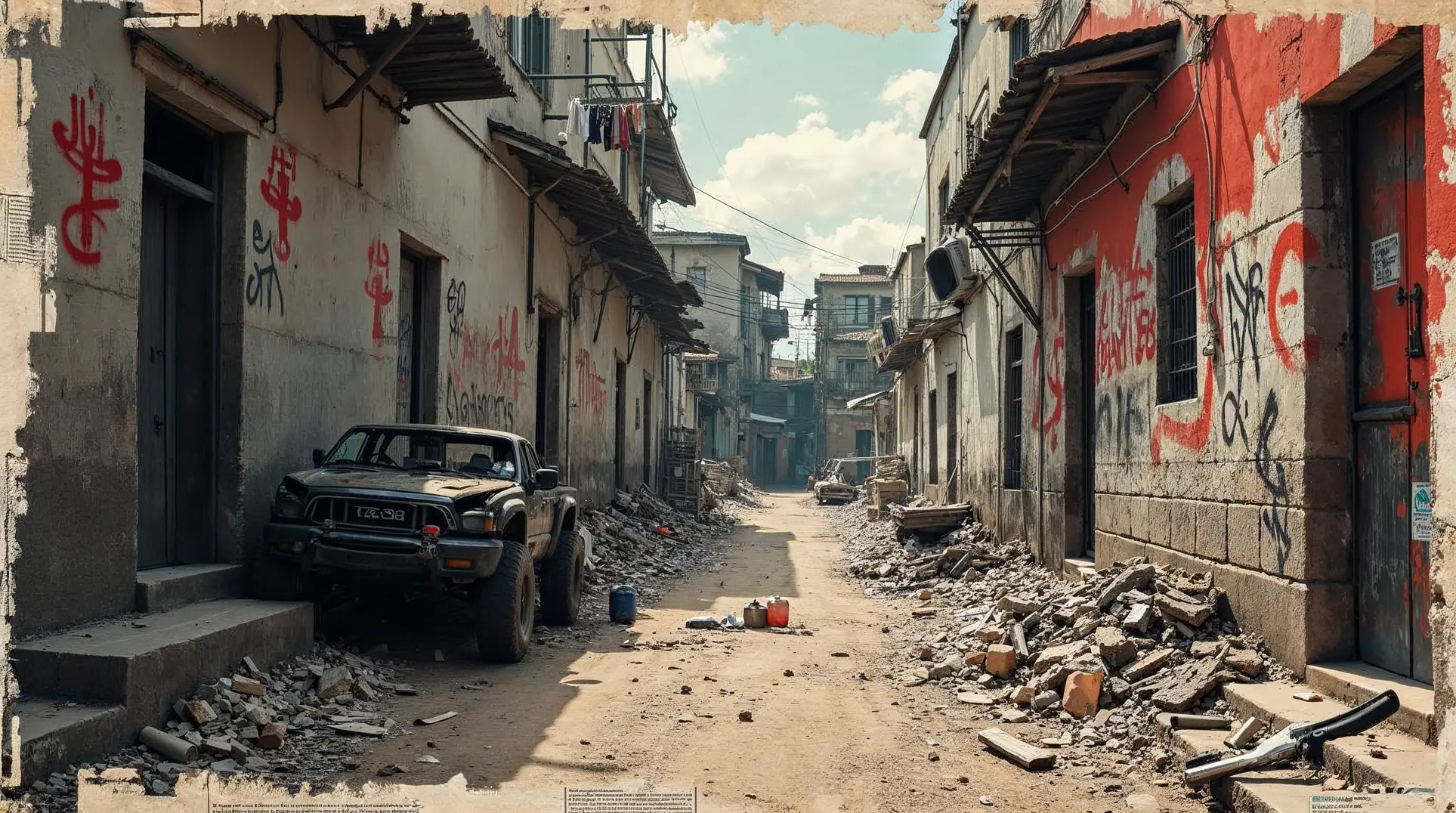
At least 49 people have been killed in Port-au-Prince since Monday, including 10 children and multiple gang figures, as fighting erupted within neighborhoods controlled by the Viv Ansanm coalition, according to the Committee for Peace and Development. Local reporting documents beheadings, targeted executions, and the violent overthrow of at least one mid-level commander, suggesting not an external assault but an internal fracture inside the alliance that has controlled roughly 85–90 percent of Haiti's capital since early 2024. Bodies have been burned and mutilated; the Krache Dife gang reportedly executed 19 women en route to or seeking medical care for wounded men. Ongoing clashes have blocked humanitarian access to Bel-Air and adjacent neighborhoods, leaving casualty counts provisional and needs assessments impossible.
The violence matters because it threatens to reverse the one marginal improvement gang consolidation brought: a reduction in inter-gang warfare. Viv Ansanm's formation in September 2023 bridged rival federations and enabled coordinated military operations that forced Prime Minister Ariel Henry's resignation announcement in March 2024. Post-consolidation, gang-on-gang clashes reportedly dropped, freeing the coalition to expand territorial control, extract revenue, and tighten choke points on humanitarian corridors. Now, leadership injuries and executions risk triggering the revenge cycles and turf grabs that personalized criminal hierarchies generate when command structures fracture.
The trigger: beheadings and a commander's dethroning
Local human-rights monitors report that a boss identified as Dèdè was beheaded in recent days. Kempes Sanon, a former police officer linked to Viv Ansanm, was wounded in the fighting; while under treatment, two men identified locally as Jamesly and Ti Gason reportedly dethroned him. The sequence and chain of command remain unverified due to access denial, but the pattern is familiar: when mid-level commanders are killed, wounded, or displaced, allied factions scramble to fill vacuums, rivals sense opportunity, and retaliatory operations cascade. The reported execution of 19 women by Krache Dife—a gang with a documented history of operations in Bel-Air—suggests either an attempt to deny medical support to a rival faction or collective punishment targeting perceived sympathizers.
Child combatants are among the dead, underscoring the depth of recruitment into gang rank-and-file. Human Rights Watch and UN human-rights monitors have documented pervasive child recruitment across Port-au-Prince, with minors serving as fighters, lookouts, and couriers. Their presence in casualty tolls reflects both the scale of mobilization and the indiscriminate nature of internal gang violence, which does not spare its own youngest members.
Members are reading: How internal gang fractures destroy the minimal predictability civilians and humanitarians depend on to survive in Port-au-Prince.
What to watch: escalation benchmarks and access denial
The immediate question is whether this fracture hardens into a sustained schism or gets patched up through negotiation or the imposition of a new strongman. Historical patterns suggest both are possible: some leadership disputes resolve quickly when a dominant faction reasserts control; others trigger weeks of combat and lasting territorial splits. Key indicators include whether allied groups like Krache Dife expand operations beyond Bel-Air, whether revenge killings targeting associates of deposed commanders continue, and whether other Viv Ansanm zones see similar leadership challenges.
Humanitarian access remains the most acute concern. Aid organizations have repeatedly suspended operations in Port-au-Prince due to insecurity; prison deaths earlier this year underscored state collapse beyond security-force capacity. Fragmentation within the gang coalition makes corridor negotiation nearly impossible, as there is no single interlocutor with authority to guarantee safe passage. More than 1.4 million people have been displaced by violence and instability this year, and displacement figures will continue to rise if residents flee contested zones; malnutrition and disease follow access denial.
The death toll of 49 is almost certainly incomplete. Independent verification is blocked by ongoing fighting, and the Committee for Peace and Development's count reflects only cases documented by local monitors operating under severe constraints. Communities caught between fractured alliances and an absent state face impossible choices: stay and risk crossfire, or flee into displacement camps that offer minimal protection and no livelihood.
This is not an isolated incident but a pattern that recurs when personalized criminal governance structures fracture. Haiti's institutional collapse has created the conditions for gang control; internal gang violence now determines whether civilians can access food, water, and medical care. Until command structures stabilize—through negotiation, violent consolidation, or external intervention—the humanitarian crisis will deepen, and casualty counts will climb.
Subscribe to our free newsletter to unlock direct links to all sources used in this article.
We believe you deserve to verify everything we write. That's why we meticulously document every source.


