


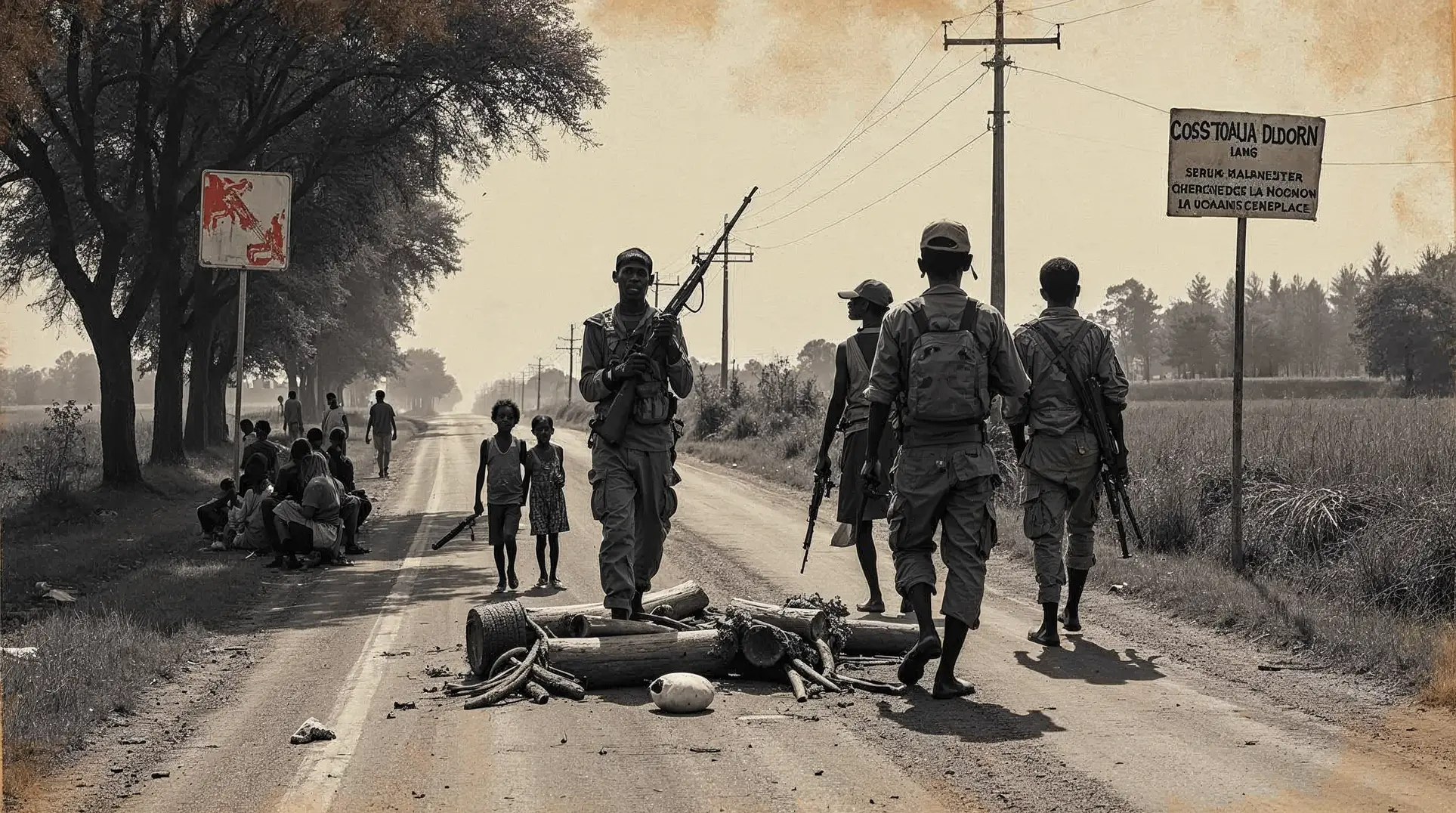
In the early hours of Sunday, November 24, 2025, attackers armed with rifles and machetes stormed the village of Nkana in western Democratic Republic of Congo, killing fourteen people and setting homes ablaze. Captain Antony Mualushayi, military spokesperson for the region, confirmed that thirteen civilians—including three children under five—died alongside one soldier during a firefight between the assailants and a small army detachment. The military identified the perpetrators as members of Mobondo, a militia that presents itself as defending Yaka communities in a land dispute that has consumed Kwamouth territory, roughly 75 kilometers northeast of Kinshasa, for three years.
The Nkana massacre is not an aberration but the latest pulse in a conflict that has killed more than 5,000 people and displaced 280,000 since June 2022, according to the International Peace Information Service. What began as a dispute over customary land tenure and taxation along the Batéké Plateau and Congo River has metastasized into a multi-province militia insurgency at the gates of the capital. As the Congolese state fights existential battles against M23 and Allied Democratic Forces in the east, the west burns—and protection gaps widen where the army cannot be everywhere at once.
From land grievance to militia warfare
The roots of the violence lie in competing claims over land and revenue, not ancient ethnic hatreds. Teke communities, historical inhabitants of the plateau, began increasing customary fees and taxes on farmers—many of them Yaka settlers who arrived more recently—in early 2022. Resistance to these levies triggered enforcement actions by Teke customary authorities, which in turn sparked reprisals. By mid-2022, the cycle had escalated from localized clashes into organized violence. Mobondo emerged as the most visible Yaka-aligned militia, initially wielding machetes and hunting rifles but later acquiring military-grade assault weapons, some captured from army stocks.
By late 2022, Mobondo raids had spread beyond Kwamouth into Kwango, Kwilu, Mai-Ndombe, and even Maluku, a rural commune on Kinshasa's periphery. United Nations reporting documents Mobondo-linked killings across five provinces encircling the capital. In December 2023, the militia seized control of several localities; by mid-2024, direct clashes with the Armed Forces of the DRC were routine. A July 13, 2024 firefight in Kinsele killed nine soldiers and dozens of militia fighters. In April 2024, President Félix Tshisekedi brokered a peace accord between Teke and Yaka factions. It collapsed within weeks, and hostilities resumed at higher intensity.
Members are reading: Why proximity to Kinshasa makes western militia entrenchment a strategic failure the state cannot afford to normalize.
What comes next
The immediate question is whether the military can contain Mobondo in Kwamouth and reverse its territorial gains without triggering further civilian casualties or displacement. The longer-term challenge is political: can Kinshasa construct a land governance framework that addresses the customary fee grievances at the conflict's origin, or will economic desperation and militia recruitment continue to feed each other? Teke-aligned groups have also mobilized and conducted counter-violence, meaning any durable settlement must navigate reciprocal grievances and disarmament across multiple factions.
International attention remains minimal. Western donors focus on eastern DRC; regional bodies have shown limited appetite for mediation in what is framed—incorrectly—as a purely internal, communal dispute. Yet the Nkana massacre is a reminder that conflicts do not stay local when states cannot govern land, protect civilians, or offer alternatives to militia economies. Seventy-five kilometers from the capital, the gap between state authority and state presence has become a killing field.
Subscribe to our free newsletter to unlock direct links to all sources used in this article.
We believe you deserve to verify everything we write. That's why we meticulously document every source.


