


- Chad absorbed 47,000 refugees in one month as Sudan conflict drives unprecedented displacement, with only 4.7% of required $806 million funded
- Humanitarian crisis affects 7 million Chadians—40% of population—with climate shocks, food insecurity, and disease outbreaks converging simultaneously
- Constitutional amendments extending presidential terms without limits entrench authoritarian governance while regional security threats from Boko Haram intensify
As over 47,000 Sudanese refugees arrive in a single month, the humanitarian catastrophe in Chad reveals the limits of international response mechanisms and raises urgent questions about regional stability.
The humanitarian situation in eastern Chad has reached a critical threshold. In May 2025, over 47,000 refugees crossed from Sudan into Chad's eastern provinces in just 30 days—arrival rates unseen since the conflict's outbreak in April 2023. Health centers along the border are collapsing under pressure, with nearly 6,000 people arriving at the Tiné border crossing in Wadi Fira Province in just two days. Chad now hosts over 1 million refugees, including more than 800,000 who have fled Sudan since the war began.
This massive influx compounds an already dire situation. Chad faces a multidimensional humanitarian emergency affecting 7 million people—nearly 40 percent of its population—driven by climate shocks, food insecurity, health emergencies, and persistent conflict. The country's eastern region, where 44 percent of those requiring assistance are concentrated, has become the epicenter of a crisis that threatens to destabilize the entire Lake Chad Basin region.
As international funding remains critically insufficient—the refugee response plan calling for $806 million is only 4.7 percent funded as of May 2025—a fundamental question emerges: Can the international humanitarian system respond effectively to simultaneous, protracted crises, or are we witnessing the structural failure of emergency response mechanisms?
The scale of displacement into Chad defies easy comprehension. Since April 2023, the country has absorbed more than 975,000 arrivals from Sudan—both refugees and Chadian returnees—adding to an existing refugee population of 407,000 from the Central African Republic, Nigeria, and Cameroon. By late April 2025, eastern Chad alone recorded over 726,000 displaced persons.
These aren't abstract statistics. Each arrival represents a person fleeing atrocities in Darfur and beyond, most of them women and children arriving "in total deprivation and in urgent need of food, water, and other basic necessities," according to European Union humanitarian assessments. The International Rescue Committee reports that 90 percent of the over 10,000 curative consultations provided by their mobile clinics in Birak and Guereda were for new refugees.
The infrastructure simply cannot cope. Health centers in Birak and Mile Extension in Wadi-Fira province face frequent shortages of essential medicines and offer no specialized services for mental health or reproductive health. As of April 2025, over 100,000 children in eastern Chad were suffering from severe acute malnutrition. Many refugees must walk long distances for care—"an insurmountable barrier for pregnant women, the elderly, and people with disabilities," the IRC notes.
Chad has opened seven new refugee camps since the Sudan conflict began, but the influx exceeds capacity, with at least three more camps required. The existing 14 camps in eastern Chad, supplemented by 4 new facilities and 2 more in planning stages, still fall short of what's needed. At more than 32 border entry points, refugees continue arriving daily, with no end to the conflict in sight.
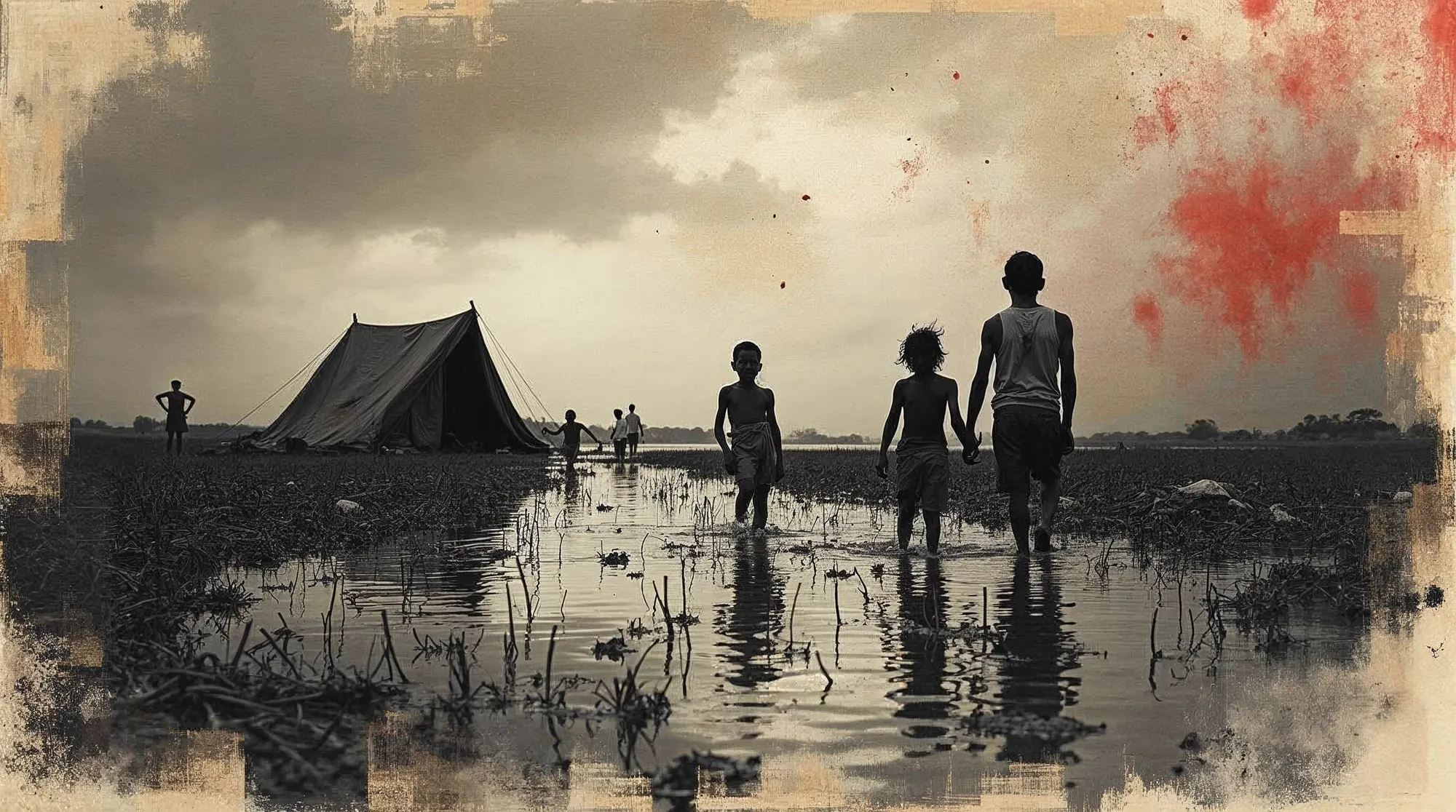
What happens when climate catastrophe, epidemics, and armed conflict converge? Members discover the shocking malnutrition data affecting 1.8 million Chadian children and how multiple disease outbreaks are racing through refugee camps—exclusive intelligence on a humanitarian system pushed beyond breaking point.
The funding catastrophe: Promises versus reality
The gap between humanitarian needs and available resources has reached crisis proportions. The 2025 Humanitarian Needs and Response Plan for Chad requires $1.478 billion—a 31 percent increase from the $1.124 billion required in 2024. As of early 2025, the plan was only 9 percent funded, according to UN Humanitarian Coordinator François Batalingaya.
The breakdown reveals where the system is failing most acutely. Food security requirements have nearly doubled from $145.9 million to $285.8 million. Water, hygiene, and sanitation needs have risen by 40 percent from $34.1 million to $47.7 million. The multisectoral response for refugees, the largest portion of the budget, increased by 27 percent from $631.6 million to $800 million. Support for non-refugee populations—including internally displaced persons, returnees, and host and local communities—has risen by 34 percent.
The refugee response plan specifically calls for $806 million to meet the needs of refugees. As of May 2025, it was only 4.7 percent funded. "While the IRC's mobile clinics are saving lives today, only increased mobilization of donors and humanitarian actors can prevent a health disaster," warned Alain Rusuku, Country Director for the IRC in Chad.
UNFPA's situation illustrates the severity of the funding crisis. The organization requires approximately $27 million for critical interventions in Chad in 2025, yet as of April, only around $916,705—less than 4 percent—had been secured. The severe funding shortfall threatens continuation of essential sexual and reproductive health and gender-based violence services. The cessation of US funding has significantly hampered UNFPA's capacity to sustain lifesaving reproductive health and GBV services.
The European Union has been among the more responsive donors. In 2024, the EU stepped up support with over €85 million in humanitarian aid and allocated an additional €74.5 million in early 2025, with €30 million subject to budgetary approval. This represents a doubling of the EU's initial 2023 allocation. The EU also mobilized the European Humanitarian Response Capacity, organizing multiple EU Humanitarian Air Bridge flights to deliver hundreds of tons of essential supplies and rehabilitating the main airstrip in the border town of Adré to facilitate aid deliveries.
Yet even this increased support falls far short of what's needed. The 2024 humanitarian response plan for Chad, which required $1.125 billion, was only 49 percent funded by October 2024.
The security dimension: Boko Haram's resurgence
While international attention focuses on the Sudan refugee crisis, security threats in western Chad have intensified. Boko Haram has resurged in the Lake Chad region in 2025, with attacks in Nigeria and Cameroon signaling renewed capability and coordination.
The terrorist group's revival represents a dangerous shift. After the death of Boko Haram leader Abubakar Shekau in 2021, the group fell into obscurity while its breakaway faction, Islamic State West Africa Province (ISWAP), steadily rose. Two factors explain Boko Haram's resurgence. First, new leader Bakura Modu (also known as Bakura Doro) adopted a low-profile strategy, shunning media propaganda and taking public attention away from Boko Haram while it grew unnoticed. Although reports said Bakura was killed in Niger in August 2025, the group denied it.
Second, Boko Haram received less attention from Lake Chad militaries. Instead, attention focused on Islamic State for its targeted attacks on military outposts beginning in early 2025, with multiple attacks reported throughout the first half of the year. Lake Chad region countries' counterterrorism efforts focused on countering ISWAP, dangerously neglecting Boko Haram.
Behind closed doors in N'Djamena, democracy dies by constitutional amendment. Members access explosive details on how President Déby's parliamentary maneuver to extend term limits mirrors his father's three-decade autocratic playbook—plus the brutal crackdown on protesters that killed hundreds and the opposition leader now facing 20 years in prison.
The international response: Adaptation and innovation
Despite funding shortfalls, humanitarian actors have demonstrated capacity to adapt. By the first half of 2024, Chad's humanitarian response reached 2.2 million people—nearly half of the targeted population—demonstrating improved response capacity over 2023. Nutrition was a key focus, with 849,537 people receiving vital nutritional programs, largely provided by local NGOs who reached over 80 percent of people in hard-to-reach areas.
The European Union has deployed innovative mechanisms. Between May and October 2023, the EU operated five flights carrying over 450 tons of essential supplies for various humanitarian partners. The EU deployed a helicopter in partnership with the UN Humanitarian Air Service to enable humanitarian workers to access hard-to-reach areas during the rainy seasons. The rehabilitation of the airstrip in Adré "has considerably reduced the hassle of getting to Adré, solving many problems in terms of flexibility, and even the supply of humanitarian materials that are hard to find locally," commented Benoit M., an ACTED project manager in Adré.
The EU also established a logistics hub in Adré in partnership with HI/Atlas Logistique to enable organizations to store and ship humanitarian supplies. "The warehouse is of great interest to us. It enables us to store items free of charge, so that we can then redeploy them in the field and distribute them to our beneficiaries," the ACTED manager noted.
The IRC has deployed mobile clinics across Birak and Guereda to deliver free, life-saving health services to refugees and host communities. Support includes malnutrition services, support to pregnant women, services for women experiencing gender-based violence, and mental health consultations. The IRC has reached more than 10,000 people with disease prevention and nutrition education, providing over 10,000 curative consultations, treatment for almost 219 cases of acute malnutrition and over 60 cases of chronic illness, almost 300 mental health consultations, 392 prenatal consultations, and 3,668 nutrition counseling and awareness sessions.
A new Emergency Development Response approach was adopted in November 2024 for the eastern provinces, in close collaboration with the Chadian government. This approach aims to introduce sustainable development initiatives alongside humanitarian efforts to support structural and social changes necessary for a transition to long-term development. Key elements include flexible funding, programs targeting underlying vulnerabilities, and an expanded focus on community development.
In the East of Chad, the European Commission's humanitarian aid department, development cooperation directorate, and foreign policy instruments have adopted a joint programming approach aiming at delivering drinking water sustainably, shifting from food assistance to self-reliance, and preserving intercommunity social cohesion.
The regional security imperative: Chad's strategic importance
Chad's stability carries implications far beyond its borders. Following the July 2023 coup in Niger and amid ongoing war in Sudan, Chad is the only country in the wider Sahel region to have avoided losing territory to violent extremist groups, facing regional or international sanctions, and falling under the influence of the Kremlin and Wagner paramilitary group.
Chad's military has historically played a decisive role in regional conflicts. Chadian troops have intervened in northern Mali, the Central African Republic, and against Boko Haram in the Lake Chad Basin. The country participates in three key anti-terrorist forces: the Multinational Joint Task Force, the United Nations Multidimensional Integrated Stabilization Mission in Mali, and G5 Sahel. Chad is the largest troop contributor to MINUSMA, with more than 1,400 soldiers present.
Yet Chad's willingness to shoulder this burden has shown signs of strain. After a horrific confrontation in late March 2020 in which a Boko Haram raid resulted in the death of 92 Chadian troops, President Idriss Déby told national television, "Our troops have died for Lake Chad and the Sahel. From today, no Chadian soldiers will take part in a military mission outside Chad." Though the statement was later corrected to mean that Chad would no longer conduct unilateral operations beyond its borders in Lake Chad, it suggested Chad would like to diminish its overall role in anti-terrorism operations in the Sahel.
The Déby administration has had continuous frustration concerning imbalanced partnerships. Back in 2015, Chad accused the UN of failing to provide support in MINUSMA after a roadside bomb killed five Chadian UN troops. Recently, the elder Déby complained, "Chad is alone in shouldering all the burden of the war against Boko Haram."
The United States has been among the more vocal international partners in pressing for democratic reform and calling for respect for human rights and accountability in Chad. The United States is broadly seen as a credible actor in the eyes of Chadian civil society and across the political spectrum. Since 2021, the U.S. Institute of Peace has worked with civil society leaders, research institutions, and women-led organizations to promote constructive debate and elevate citizen engagement in Chad's political transition process.
Looking ahead: The convergence of crises
The humanitarian situation in Chad is projected to deteriorate further in 2025. The UN Humanitarian Coordinator in Chad, François Batalingaya, stated that "the country is in crisis with the east reaching a breaking point. Floods impacted nearly 2 million people last year; 3 million people are struggling to feed themselves."
Several factors will determine Chad's trajectory. The continuation of conflict in Sudan will drive further refugee flows. With no end to the Sudan conflict in sight, the influx continues unabated at more than 32 border entry points in the east. The Office of the United Nations High Commissioner for Refugees is gravely concerned by the rapidly increasing number of Sudanese refugees crossing into eastern Chad due to escalating violence in Sudan's North Darfur region, with nearly 20,000 people—mostly women and children—arriving in the past two weeks alone as of reports in early 2025.
Climate patterns will significantly impact food security. The 2024 floods destroyed vast agricultural capacity, and the lean season between June and August 2025 is projected to see over 4.3 million people suffering crisis and emergency levels of food insecurity.
The security situation in the Lake Chad Basin remains volatile. Boko Haram's increased activity may worsen displacement and protection issues in 2025. The governments and militaries of Lake Chad region countries must pay attention to Boko Haram as much as Islamic State in their counterterrorism efforts.
Political stability will be tested. Despite conciliatory gestures such as the 2022 formation of an interim parliament and 2023 presidential pardons of hundreds of civil activists, protesters, and rebels, tensions around governance remain high. The constitutional changes extending presidential term limits have deepened political rifts. Long-term peace in Chad will be achieved through the establishment of credible and effective institutions, open and competitive electoral processes, increased space for political dialogue and civic engagement, and addressing underlying sources of tension at the local level.
The international community faces a choice. As one analysis notes, "failing to meet the vital needs of refugees and vulnerable host populations could fuel inter-community tensions." The question is whether donors will provide the resources necessary to prevent a health disaster and broader destabilization, or whether Chad will become another example of the international humanitarian system's inability to respond to protracted, complex emergencies.
The answer will determine not only Chad's future but the stability of the entire Sahel region. In a volatile area prone to armed conflicts, rising disinformation, intercommunal violence, and the influence of malign actors including extremist organizations and foreign mercenary forces, Chad's collapse would create a security vacuum with consequences extending far beyond the Lake Chad Basin. The world cannot afford to look away.


